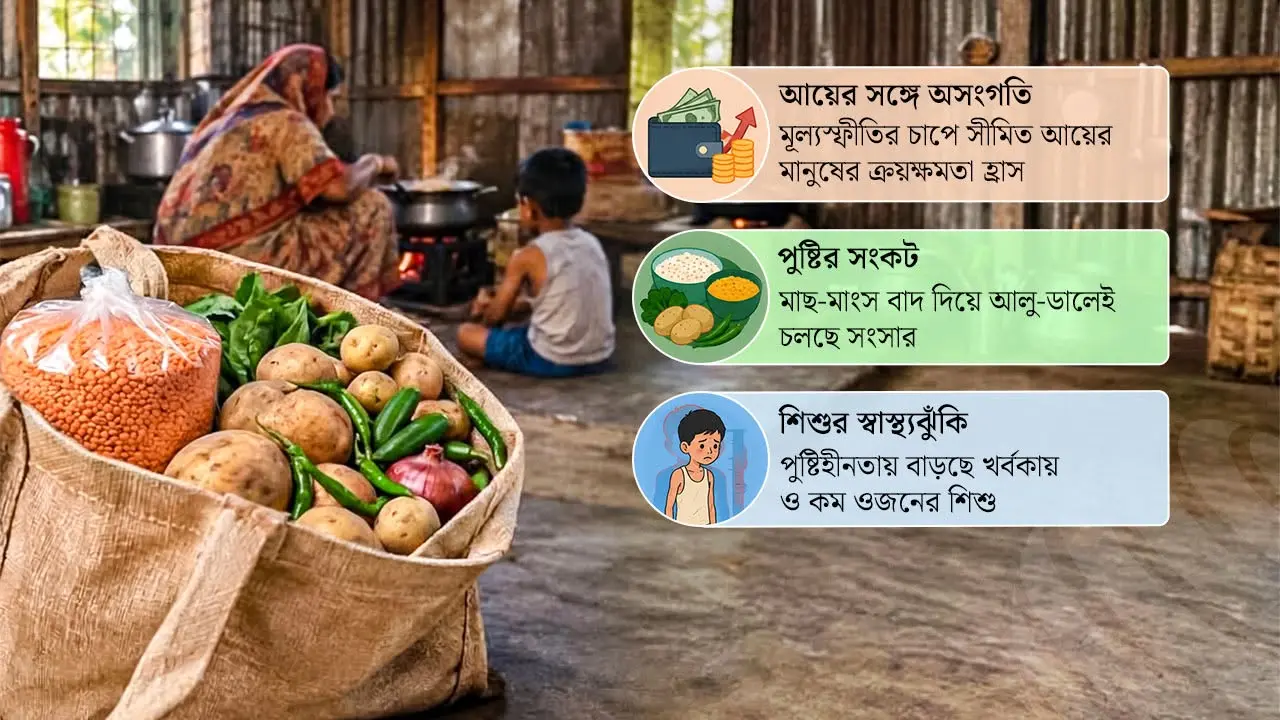
Khaleda Begum, a domestic worker, and Alfaz, a security guard, live in Rampura in the capital with their three children. Together they earn 19,500 taka a month. Two of the children are in school, which costs 3,500 to 4,000 taka a month. Their rent was 7,000 taka until July; since September it has been 8,000 taka. Alfaz has asthma, and his medicine costs another 2,000 to 2,500 taka a month. Once all of that is paid, little is left for food and the other needs of a family of five.
Prices of everyday goods keep rising, but their income has not kept pace. Nutritious food such as fish and meat has dropped off the family’s plate. Most of the time they get by on potatoes, papaya and lentils.
“Prices in the market have gone up, but our income has not,” Khaleda Begum said. “On top of that, the rent went up by a thousand taka two months ago. We can no longer afford to eat anything decent with the children. We have not been able to buy meat since the last Eid-ul-Azha. Fish is so expensive that if we buy it, we cannot buy rice. So we have to buy cheaper vegetables.”
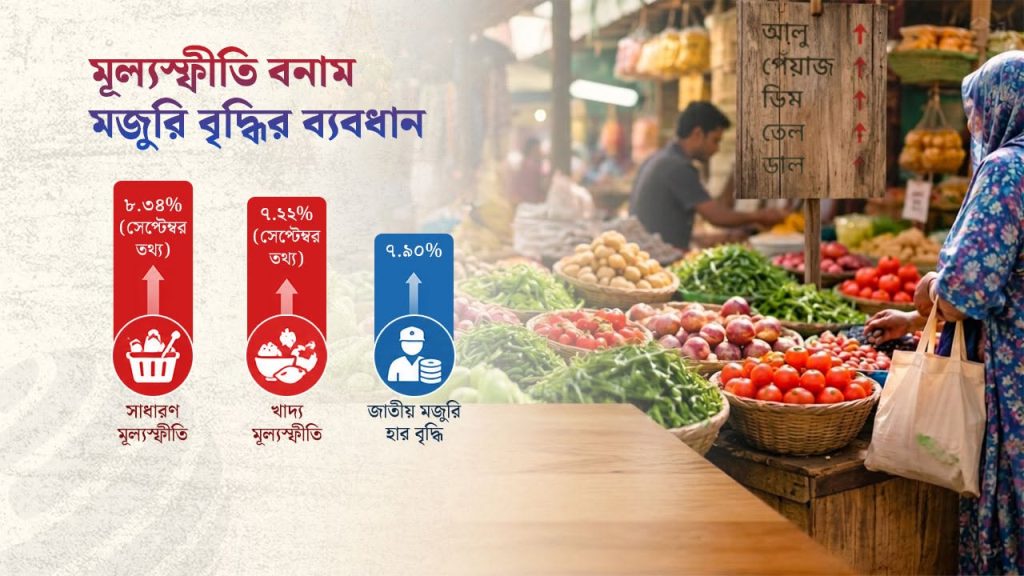
General inflation has risen to 8.34 percent and food inflation to 7.22 percent, while growth in the national wage rate is stuck at 7.90 percent. In this uneven race between income and spending, the hardest blow has landed on the plates of low-income people. From the 2026 Global Hunger Index to the BDHS survey, the data show that food inflation is not only emptying pockets but pushing the country’s children and women towards serious undernutrition.
“Most of the time our meals are potatoes and papaya with a little lentil soup,” she said. “The young children do not want to eat it, but when they are hungry they eat. The last week of the month is very hard. Then it is rice with mashed potato or papaya at every meal.”
Asked whether she receives any government help, Khaleda said she used to have a TCB card, but it has been stopped for the past six months. If things go on like this, she fears she may have to take two of the children out of school.
Like Khaleda Begum’s family, many people on limited incomes are cutting the quality and variety of their food to meet rising costs. That has reduced their ability to eat nutritious food and raised serious concern about undernutrition among children.
According to the Bangladesh Bureau of Statistics (BBS), general inflation was 8.26 percent in August and rose to 8.34 percent in September. Over the same period, food inflation rose from 7.02 percent to 7.22 percent. The national wage rate index rose 7.90 percent, less than general inflation. With income failing to keep up with prices, the purchasing power of people on limited incomes is falling sharply.
Higher fuel prices have added to the pressure. On 21 September the government raised the prices of diesel, petrol, octane and kerosene by 20 taka a litre. Traders say higher transport costs and paddy prices have fed directly into the rice market.
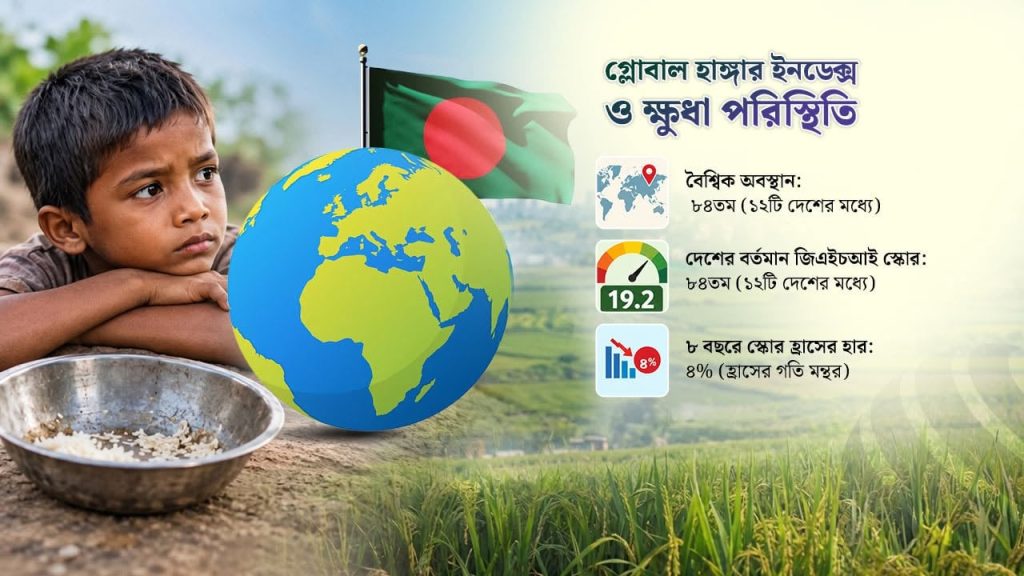
Meanwhile, the 2026 Global Hunger Index (GHI) report, published in Berlin last week, says Bangladesh’s progress in reducing hunger has slowed. Bangladesh ranks 84th of 122 countries, and its level of hunger is still “moderate”. Its score was 20 in 2018 and is 19.2 in the latest assessment, a fall of 0.8 points, or 4 percent, in eight years. Between 2000 and 2018 the score fell by more than 42 percent.
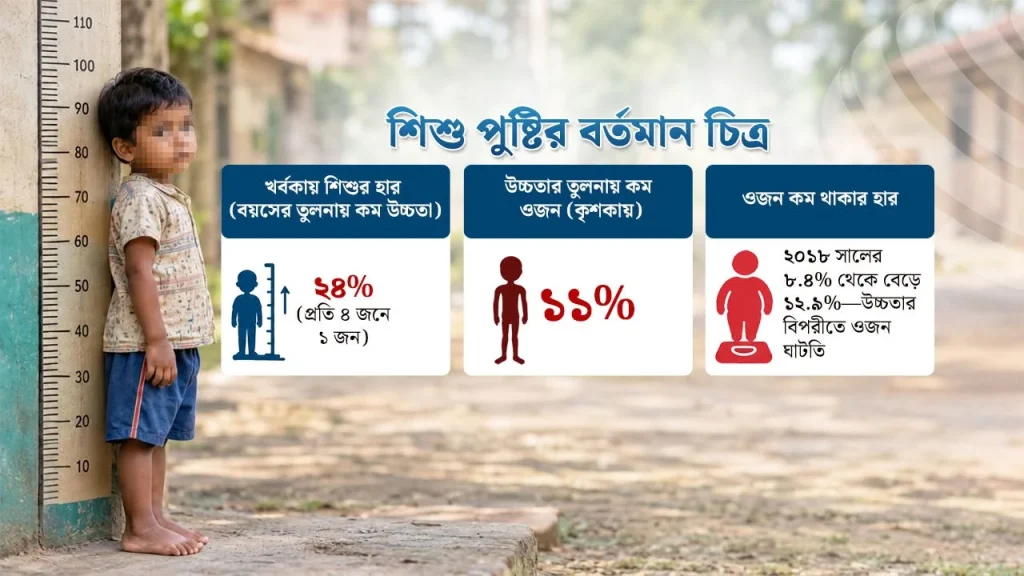
Some indicators of child nutrition are worrying. The report says wasting (low weight for height) among children under five rose from 8.4 percent in 2018 to 12.9 percent, the highest since 2000. Stunting has fallen slightly over the long term, to 24 percent, which means that nearly one child in four is short for their age.
“When the government gives welfare support, it has to borrow or raise taxes. And putting extra money suddenly in people’s hands can create new inflationary pressure. Besides, this situation does not depend only on domestic matters; it is tied to a global crisis as well.”
Dr Syed Abdul Hamid, Professor, Institute of Health Economics, University of Dhaka
The report also says undernourishment in the population as a whole fell from 12.1 percent in 2018 to 8.2 percent now. Over the same period, the under-five mortality rate fell from 3.3 percent to 3 percent.
The Bangladesh Food Safety Authority’s “Family guidelines on safe food”, published in 2022, painted a worrying picture of nutrition in the country. According to the guidelines, about a third of children do not get a minimum acceptable diet and about 56 percent of women do not eat enough. About 50 percent of women of reproductive age suffer from a lack of essential nutrients, and about 50 percent of pregnant women are anaemic, which greatly raises the risk of low birth weight.
The guidelines recommend that an adult’s daily diet include rice or wheat, starchy roots and tubers, fish or meat, lentils, milk or dairy, seasonal fruit, vegetables and eggs. They set out 270 to 420 grams of rice or wheat a day, 75 to 100 grams of starchy roots, tubers and bananas, one to four medium pieces of fish or meat, one to two cups of lentils, at least one cup of milk or dairy, at least two seasonal fruits, 100 grams of vegetables or 200 grams of leafy greens, and at least one egg.
The Bangladesh Demographic and Health Survey (BDHS) 2022, conducted by the National Institute of Population Research and Training (NIPORT), the Medical Education and Family Welfare Division and the Ministry of Health and Family Welfare, found that 24 percent of children under five are stunted (short for their age), 22 percent are underweight and 11 percent are wasted (low weight for height).
Dr Syed Abdul Hamid, a professor at the University of Dhaka’s Institute of Health Economics, spoke about easing the hardship of people on limited incomes as food prices rise, and about long-term economic development. “When the government gives welfare support, it has to borrow or raise taxes,” he told Dhaka Post. “And putting extra money suddenly in people’s hands can create new inflationary pressure. Besides, this situation does not depend only on domestic matters; it is tied to a global crisis as well.”
“Food inflation is steadily reducing the ability of low-income people to buy nutritious food. If this is not brought under control quickly, the number of undernourished people in the country could rise further. People at every level need to be made aware of the importance of nutrition. Those who cannot afford nutritious food must be given social protection and support.”
Saika Siraj, Bangladesh representative, Nutrition International
“Because of the government’s various limits, it is not possible to help everyone in the country directly,” Professor Hamid said. “So to ease the hardship of the middle class and the poor, people should not rely only on the government but should also change how they spend. We need to cut needless spending on fast food, crisps and chocolate and get used to cheaper, nutritious local food.”
He said the government should be made smaller and waste cut everywhere, especially in administration, education and health. Such change cannot happen overnight, he said; it needs long-term planning. He also urged caution about artificial or fortified foods sold as alternatives, saying the pure food grown by the country’s farmers and its traditional food culture must be protected. There is no quick or easy solution to this crisis, he said.
In the meantime, he advised eating soybeans, guava, bananas, vegetables, lentils and small fish in place of fish and meat, and, where possible, at least one egg a day.
“People at every level need to be made aware of the importance of nutrition,” said Saika Siraj. “Those who cannot afford nutritious food must be given social protection and support. Nutritious food could also be added to TCB’s subsidised trucks, and school meals could be started at the institutional level.”
বাংলায় মূল প্রতিবেদন পড়ুন · Read the original Bengali report