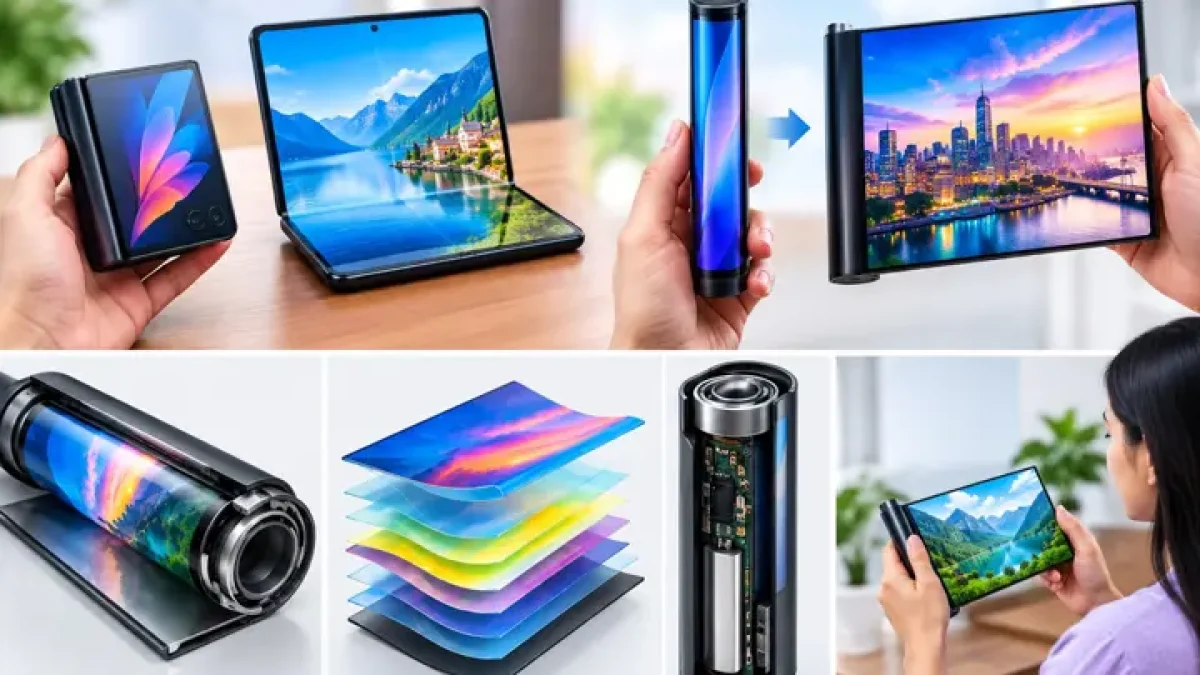
Small mobile phones were once a symbol of modernity. In time, large-screen smartphones became popular. But to get the benefit of a big display the phone itself had to be big. To get round that limit, manufacturers brought in foldable phones: small when folded, a large screen when opened. The innovation created new possibilities in smartphone design. But the advance of technology does not end there. Rollable displays are now being discussed, in which the screen can be rolled away or extended as needed, not folded. The question is whether this technology will bring the next big change in smartphones after foldables.
Rolling, not folding
The display of a foldable phone folds along a fixed line. When the phone is opened, the two parts together make a large screen. In rollable technology the method is different. A display of this kind can be kept rolled up inside a special structure. When needed, the screen can come out with the help of a mechanism and its display area can grow. After use it can be returned to its earlier state.
This could make it possible to use a large display while keeping the main body of the phone comparatively small. In other words, there is a prospect of having both ease of carrying and the experience of working on a large screen in one device.
A flexible screen is the foundation
The most important thing in making a rollable display is the flexibility of the screen. The layers and components of a conventional screen are not suited to being bent or rolled again and again. So materials are needed that can withstand the stress of expanding and contracting over a long time.
OLED technology can play an important part here. Because of its comparatively thin structure and the ease of making it flexible, an OLED display is suited to innovation of this kind. But making the screen flexible will not solve the problem by itself. The protection of the display, the electrical connections, the battery and the position of other parts must also be arranged so that the whole system works reliably.
Screen size that changes with need
One of the attractions of a rollable phone could be the use of different display sizes on the same device. In the pocket the phone would stay small. That size may be enough for making calls, sending messages or ordinary tasks. But for watching video, reading an e-book or working on a large document, the screen could be extended.
This would make it possible to increase the visible screen area without making the whole body of the phone bigger. In future such technology could also change the way smartphones are used, according to the user’s needs.
Possibilities beyond the smartphone
The use of rollable displays is not expected to be limited to mobile phones. The technology could also be used for an extra-large screen on a laptop, a display on a car dashboard that appears as needed, or a television that can be stored in little space. There are possibilities for its use in portable electronic devices too.
For example, a portable computer of the future might be kept small while its screen grows at the time of work. In the same way, the idea of rolling away a television display to save space at home could become reality. How widely these possibilities are realised will depend, however, on the development of the technology and on production cost.
Durability is the big test
One of the biggest challenges facing rollable displays is durability. Rolling and extending a screen again and again can create stress and friction in its various layers. After long use there is also a risk that the display will work less well or that faults will appear in the mechanical parts.
For this reason it is essential to build technology that will work normally even after countless uses. Protection against scratches, damage and other outside effects on the screen must also be ensured.
The internal design of the phone is another complicated matter. How the arrangement of the battery, camera, processor and circuits will be kept working as the display grows and shrinks is an important question. If a motor or mechanism is added to move the screen, the phone’s weight, thickness and power use may rise. Keeping the moving parts protected from dust and moisture will not be easy either.
Will the price come down?
Production costs are usually high in the early stage of a new technology. With a flexible display, special protection and a complex mechanical structure, the price of a rollable phone is also likely to be high. So at first it may be popular only among a limited number of buyers.
If the production process improves and the technology spreads commercially, however, there will be scope for costs to fall. Phones of this kind could then reach ordinary users too. That will depend on manufacturers’ innovation, market demand and the ability to bring production costs down.
Which way for the smartphone?
The rollable display is not only a new way of changing screen size; it could also change accepted ideas about the design of the smart devices of the future. Until now the screen size of a device has been thought of as fixed. Rollable technology goes beyond that idea and shows the possibility of using a small and a large screen on the same device.
But it cannot yet be said with certainty that this technology will be the next big chapter in smartphones after foldables. Besides an attractive design, a device has to be durable, reliable, easy to use and within the buyer’s means. Only if it can meet these conditions will the rollable phone be able to take a significant place in the market.
Foldable phones showed that a smartphone screen can be folded when needed. The rollable display takes that idea further, to a screen that can be rolled away and extended as needed. If this innovation overcomes its technical limits and succeeds commercially, both the look and the use of the smartphones of the future could change.
বাংলায় মূল প্রতিবেদন পড়ুন · Read the original Bengali report