The dengue season was once understood to mean only the monsoon. But that idea has changed over the past few years. Because of changes in the life cycle of the Aedes mosquito, unplanned urbanisation, climate change and a lack of public awareness, dengue infections are now seen even in winter and summer.
The disease has now spread beyond the capital into rural areas. Amid a severe measles outbreak this year, the Aedes-borne dengue virus is once again on the rise. Dengue patients have already been identified in 58 districts, with the districts of the Barishal division seeing the highest numbers.
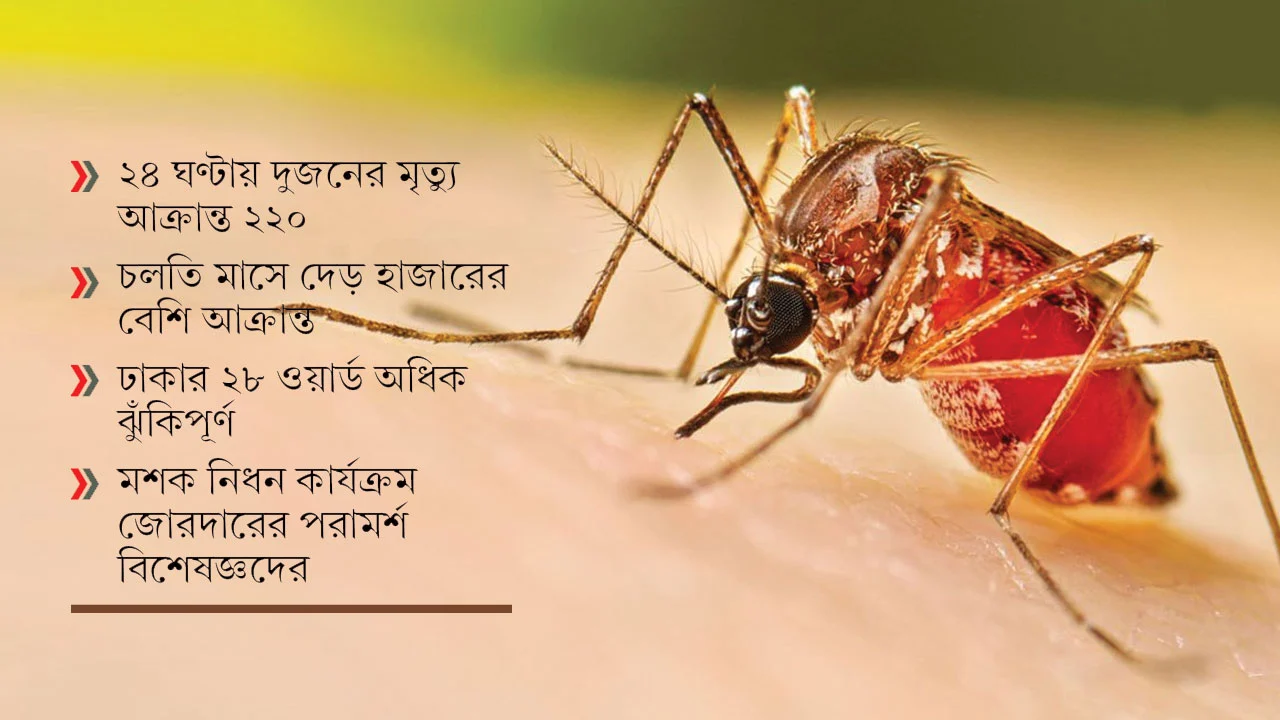
According to the Directorate General of Health Services, 1,703 people were infected with dengue in the first 21 days of June. Of these, two died in the past 24 hours and 220 were infected, the highest single-day infection and death record this year. In May, 714 people were infected, and 640 in April. In other words, the infection rate is rising steadily.
The highest number of patients was found in the Barishal division. Although the death toll so far is comparatively low, public-health experts and entomologists have expressed concern about the situation even before the season has begun. The government’s health minister has also voiced alarm, saying tackling dengue this time will not be easy. Dengue is no longer an ordinary illness, experts say, but has become a major challenge for the whole nation.
According to experts, June to September is the favourable period for Aedes mosquito breeding. After May, mosquito eggs in stagnant water quickly turn into larvae, and intermittent rain increases breeding further. Although Dhaka was once seen as the main centre of dengue, it has now spread across the country. Experts attribute the worsening situation to year-round negligence in mosquito control, a lack of adequate surveillance and a shortfall in coordinated efforts.
Dengue was first detected in the country in 2000. At that time the disease was known as ‘Dhaka fever.’ Health experts later tested and identified it as dengue fever, and records of dengue patients have been kept since that year. That year, 93 people died of dengue and 5,551 were infected. Although the disease remained limited for more than a decade, it took a severe form in 2019, when 101,354 people were infected and 179 died.
The most severe situation, however, developed in 2023. That year 1,705 people died of dengue and 321,179 were infected, with the infection spreading to all 64 districts. In 2024, 101,214 people were infected and 575 died. In 2025, the number infected was 102,861 and 413 died. Up to June 21 this year, nine people have died of dengue and a total of 4,900 have been infected, about 62.7 percent of them male and 37.3 percent female. The Barishal division has the highest number of cases, at 1,297, followed by the Chittagong division with 972. All six districts of the Barishal division have a comparatively higher dengue prevalence: 344 cases in Barishal district, 297 in Pirojpur, 244 in Patuakhali, 230 in Jhalakathi, 118 in Barguna and 64 in Bhola.
বাংলায় মূল প্রতিবেদন পড়ুন · Read the original Bengali report