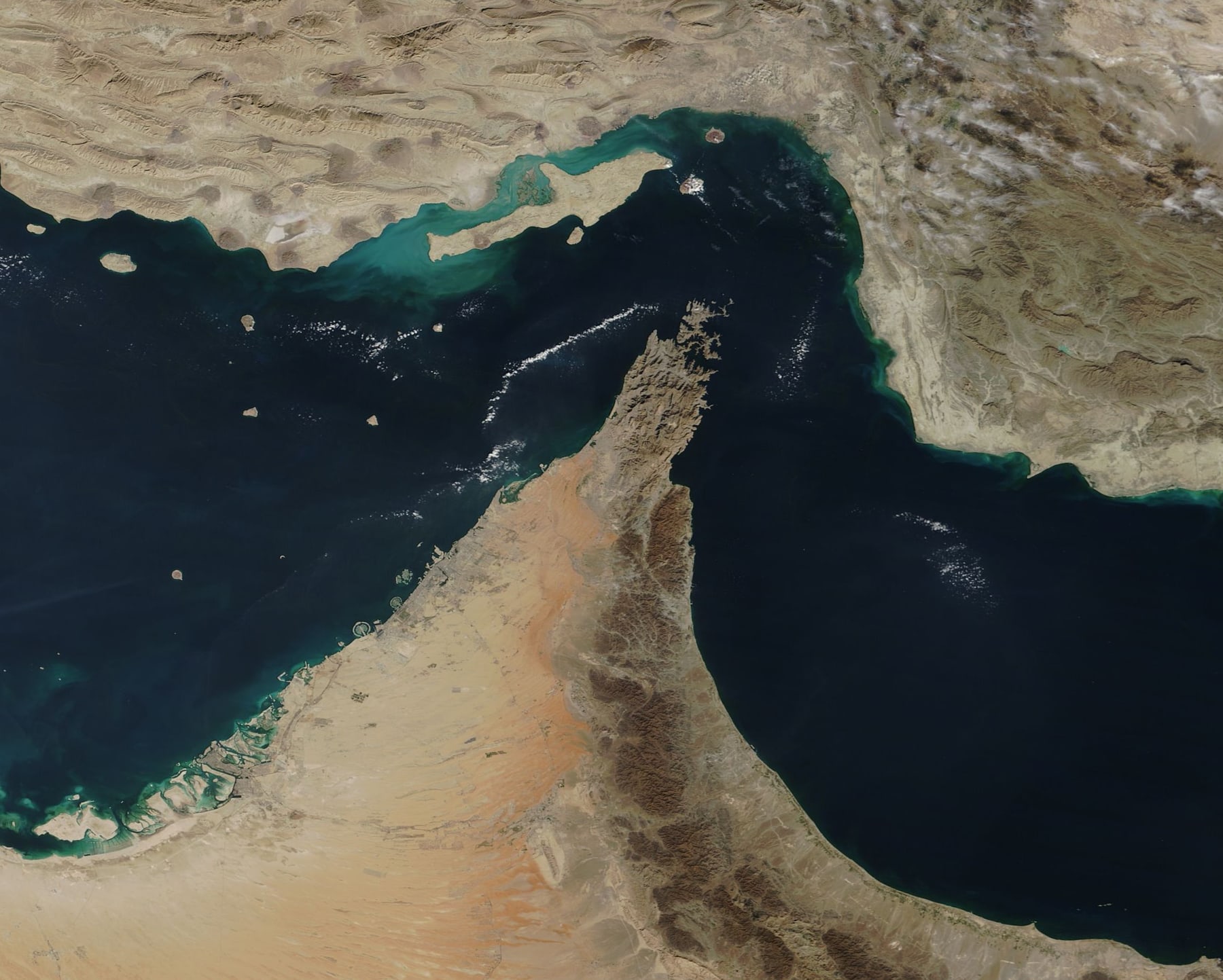
At the heart of every major conflict in the Middle East lies some geopolitical reality — sometimes energy resources, sometimes borders, and sometimes a vital sea route. In the current Iran-United States tensions, that focal point has become the Strait of Hormuz. One of the world’s most important waterways, it is now not merely an arena of military confrontation but a key factor shaping the future of the global economy, energy security and international diplomacy.
The Strait of Hormuz connects the Arabian Gulf to the Gulf of Oman and the Indian Ocean. A significant share of the world’s crude oil and liquefied natural gas (LNG) reaches international markets through this route each day. Any disruption to its normal flow therefore means pressure on global energy supply — which in turn affects industrial production, transport, food prices and the cost of everyday life.
For Iran, the Strait of Hormuz has long been a strategic asset. In the face of international sanctions and diplomatic pressure, the strait is Tehran’s most effective instrument of leverage. By raising its military presence there or obstructing shipping, Iran seeks to increase political and economic pressure on international powers. But this strategy has a major limitation: Iran’s own oil exports pass through the same route, so the more instability grows in Hormuz, the more Iran’s own economy suffers.
Washington’s position, by contrast, is clear. It views guaranteeing free navigation on international sea routes as an essential condition of global trade and security. Under the international law of the sea, the United States opposes any single state’s control of the strait or the imposition of extra conditions on shipping. The differences between Iran and the United States over the strait’s future are therefore not only military but run deep into questions of international law and geopolitics.
The position of the Gulf Arab states in this crisis is also highly complex. While Saudi Arabia and the United Arab Emirates have arranged to export some oil through alternative pipelines, that capacity cannot replace Hormuz. Almost all of Qatar’s LNG exports depend on the strait. Oman is both a geographic partner to the waterway and an advocate of adhering to international law. Each state in the region is thus trying to reconcile its economic interests with a diplomatic balance.
The greatest impact of the crisis is falling on the global economy. When oil prices rise, the effect is not confined to the energy sector. Transport costs go up, industrial production costs increase, and inflation accelerates. With marine insurance costs also multiplying several times over, the cost of international trade has risen further, placing import-dependent countries under added strain.
Asian economies in particular are more exposed in this situation. China sources a large part of its imported crude oil through the Strait of Hormuz and is one of the biggest buyers of Iranian oil. Japan, too, depends on this route for energy imported from the Middle East, and many European countries likewise face uncertainty in energy supply. Instability in Hormuz is therefore not merely a Middle East crisis but a major challenge to global economic stability.
Though it draws comparatively little attention, the impact on the fertiliser market is highly significant. A large share of the world’s seaborne fertiliser trade is conducted through this strait. If supply is disrupted, fertiliser prices rise, agricultural production is hampered and food security is put at risk. The effect is not immediate but can extend to the following season’s harvest — a particular worry for developing and food-import-dependent countries.
An energy- and food-import-dependent economy like Bangladesh’s is not entirely insulated from this crisis either. A rise in international oil prices, higher transport costs and increased fertiliser import costs could have a direct effect on the country’s production costs and inflation. In other words, the longer the conflict in Hormuz is prolonged, the more its economic effects will be felt across the countries of South Asia.
The current reality suggests there is no easy solution to the dispute over the Strait of Hormuz. On one side, Iran wants to retain the strait as the main source of its strategic influence; on the other, the United States and nations dependent on maritime trade are not prepared to step back from the principle of free navigation. A lasting resolution of the crisis is therefore not possible without a political settlement.
The greatest risk to the world economy is not war alone but prolonged uncertainty — markets fear uncertainty even more than war. If the Strait of Hormuz remains unstable for a long time, its impact will not be confined to the energy market; it will cast a long shadow over world trade, agriculture, industrial production and the cost of ordinary people’s lives. Hormuz is thus no longer merely a sea route but has become one of the most important testing grounds of contemporary world politics and economics.
বাংলায় মূল প্রতিবেদন পড়ুন · Read the original Bengali report