Food is an inseparable part of human life, yet it has become a silent killer. The quality of street food or food served in hotels and restaurants across the country rarely draws attention — except when a consumer-rights raid uncovers a problem at some restaurant, sparking a brief uproar that fades within days, after which everything returns to normal. As a result, food quality never really improves, putting thousands of people’s health at risk.
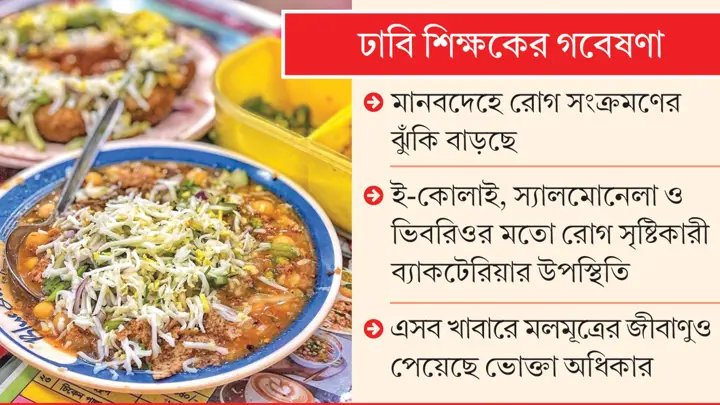
A recent study on street food and ready-to-eat meals found harmful bacteria in various foods sold outside the home. The study, titled “Analysis of Microbial Risk and Its Potential Hazard in Street Food and Restaurant Ready-to-Eat Salads,” was led by Dr. Md. Latiful Bari, principal researcher at Dhaka University’s Centre for Advanced Research in Sciences.
The study found levels of disease-causing bacteria such as E. coli, Salmonella and Vibrio exceeding safe limits in street food, restaurant salads, juices and sherbets. The risk of E. coli infection was highest in chanachur mix or chola-muri at 45.5%, Salmonella risk was highest in aloe vera sherbet at 10.5%, and Vibrio infection risk was highest in chotpoti at 22%.
In a 2018 survey by the food safety authority, only four out of 100 hotels received a green rating, 45 received yellow and 51 received red. Eight years later, the situation has improved little. In fiscal 2025-26, the authority graded only 1,265 hotels, restaurants and bakeries and published a list of just 557 on its website. Food officer Imran Hossain Molla says about half of the graded establishments are in good standing, while C-category establishments are being advised to improve. Yet officially, the number of hotels and restaurants nationwide has surpassed 500,000. Agency secretary Shrabosti Roy said just 371 staff members are struggling to monitor this vast sector, and a letter has been sent to the relevant government department requesting more personnel.
A 2017 survey by the Institute of Public Health found 90% of Dhaka’s street food unsafe. A 2015 icddr,b study found germs in 55% of street food and unhygienic microbes on the hands of 88% of vendors. A 2019 BARC study was even more alarming, finding more than 1,100 total coliforms and E. coli per gram in samples of jhalmuri, fuchka, chotpoti, noodles and other items, against a safe limit of just 30. Former BARC director Monirul Islam said the water used in street food is the most dangerous factor, yet it draws almost no attention.
The BARC study found that around 140 types of food were sold on Dhaka’s streets in 2019, consumed by roughly 6 million people daily — a figure also cited at a 2017 event organized by the Bangladesh Tourism Board at Dhaka University. Students are among the biggest buyers of this food. Abdul Alim, a student eating puri near Dhaka University recently, said that despite concerns about dust and water safety, he had not heard of any government initiative on the issue.
Dhaka North and South city corporations have no registration system for street food vendors, and authorities keep no fixed list of sellers. Md. Mahmudul Hasan Ansari, a food inspector at Dhaka South City Corporation, said an earlier initiative to regulate mobile vendors’ food quality stalled due to a lack of cooperation from police, and no effective system exists today. He said taking action on this front remains quite difficult.
A food safety authority official admitted that little real work has been done on street food quality, with efforts largely limited to inspection visits. A joint FAO-icddr,b initiative that distributed 400 glass-enclosed “street food vans” in Dhaka, Khulna and Barishal in 2015 has become defunct since the project ended, and no one has information on their current status.
Md. Abdul Jabbar Mondol, assistant director of the Directorate of National Consumer Rights Protection, said his office has seen cooked food stored alongside raw meat, and dye added to food kept frozen for long periods at upscale hotels. He said a single plate of fuchka was found to contain more than 70 million bacteria, including fecal microbes.
Five-star hotels also face virtually no oversight from the food safety authority, with mandatory grading stalled at the announcement stage; only four magistrates are assigned to this work nationwide.
Aminul Haque Bhuiyan, a professor at Dhaka University’s Institute of Nutrition and Food Science, said many countries have separate management systems, germ-free water and regular monitoring for street food, and the same is achievable in Bangladesh with proper management and sincerity. He said registering vendors and assigning them designated spaces would make quality control easier.
Consumer-rights officials admit that conditions improve briefly after a raid before gradually reverting to the old picture. Experts say solving the problem requires not just the administration but also the business community, media and conscious consumers to step up. Without more personnel, mandatory grading, and continuous monitoring at every stage from production to serving, they say, the uncertainty surrounding food for tens of millions of people will not be resolved.