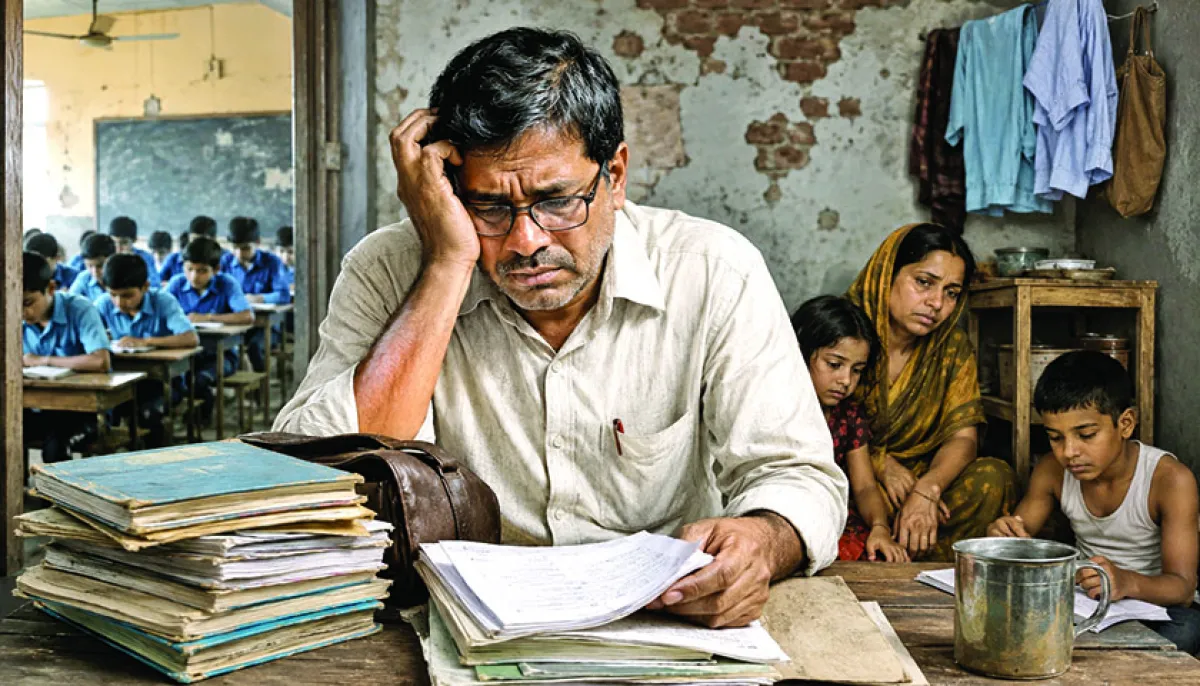
Long after independence, the state, the government and the bureaucracy continue to operate without much thought for teachers. The prevailing attitude seems to be that teachers are not ordinary people and that their needs are somehow provided for by the Creator, as freely available as rainwater. Such a poor mindset is hardly visible in any other country. Every government has worked on improving education by prioritising infrastructure, free books for children, stipends, nutritious food, uniforms and various projects.
Educational institutions now boast large buildings and other visible development. Child education improved, more or less, under every government except the interim one; the interim government, the writer argues, was pushing child education toward ruin, and had it stayed in power longer, would have damaged the reputation of free primary education and handed it over to NGOs rather than enriching it.
In earlier times, child education took place in sitting rooms, in cutcherry houses, under broken tin fences and roofs of split bamboo, and in some places under thatched golpata roofs; the slightest hint of rain in a broken room meant school had to be let off. A fundamental change in this ailing state of child education began under the late former president Ershad’s government, and that trend continues today, with development moving at a geometric pace.
Yet the teacher is the soul of education, and action on their salaries, allowances and standard of living has moved extremely slowly. Around the world, respect for teachers, and obedience to court orders, is socially and constitutionally binding; in particular, failing to honour a court ruling, or delaying it, is a punishable offence. The highest court in our country is the Appellate Division of the Supreme Court, whose rulings everyone is bound to obey.
Since being granted second-class status on March 9, 2014, our primary head teachers have repeatedly appealed for the tenth grade enjoyed by other government employees, and, failing to get it, finally had to obtain a ruling from the Appellate Division of the Supreme Court. Why, then, the knots and the delay after the ruling? While not opposing punishment for any genuine wrongdoing by primary teachers, the writer argues that the advisers of the interim-government period and those currently involved in delaying and obstructing the latest court ruling should be brought to account. Conspiring to obstruct or dragging one’s feet over the implementation of a court ruling is a punishable offence, and those responsible for the delay should be punished and the ruling implemented without delay.
The three-point demand of assistant teachers, including the eleventh grade, is largely settled, but positive steps on it have also been slow, as though the administration and the government were dozing. It would take the government just 48 hours to resolve this settled matter and bring a smile to the teaching community. Imagining an improvement in the quality of education while keeping teachers in distress and discomfort, behind a show of big projects, is merely a dream.
Fill the vacant posts of head teachers and assistant teachers, recruit cleaning staff, stop the pressure of all non-teaching duties, give teachers a pay scale on par with other government employees, bring them under accountability, and enrich the education system of government primary schools. Whatever else is done while teachers are neglected is bound, like the moral of the Babui-bird poem, to be entirely in vain. It must be remembered that the enrichment of education must, first of all, be accompanied by the enrichment of the teacher. That is the plain truth.
বাংলায় মূল প্রতিবেদন পড়ুন · Read the original Bengali report