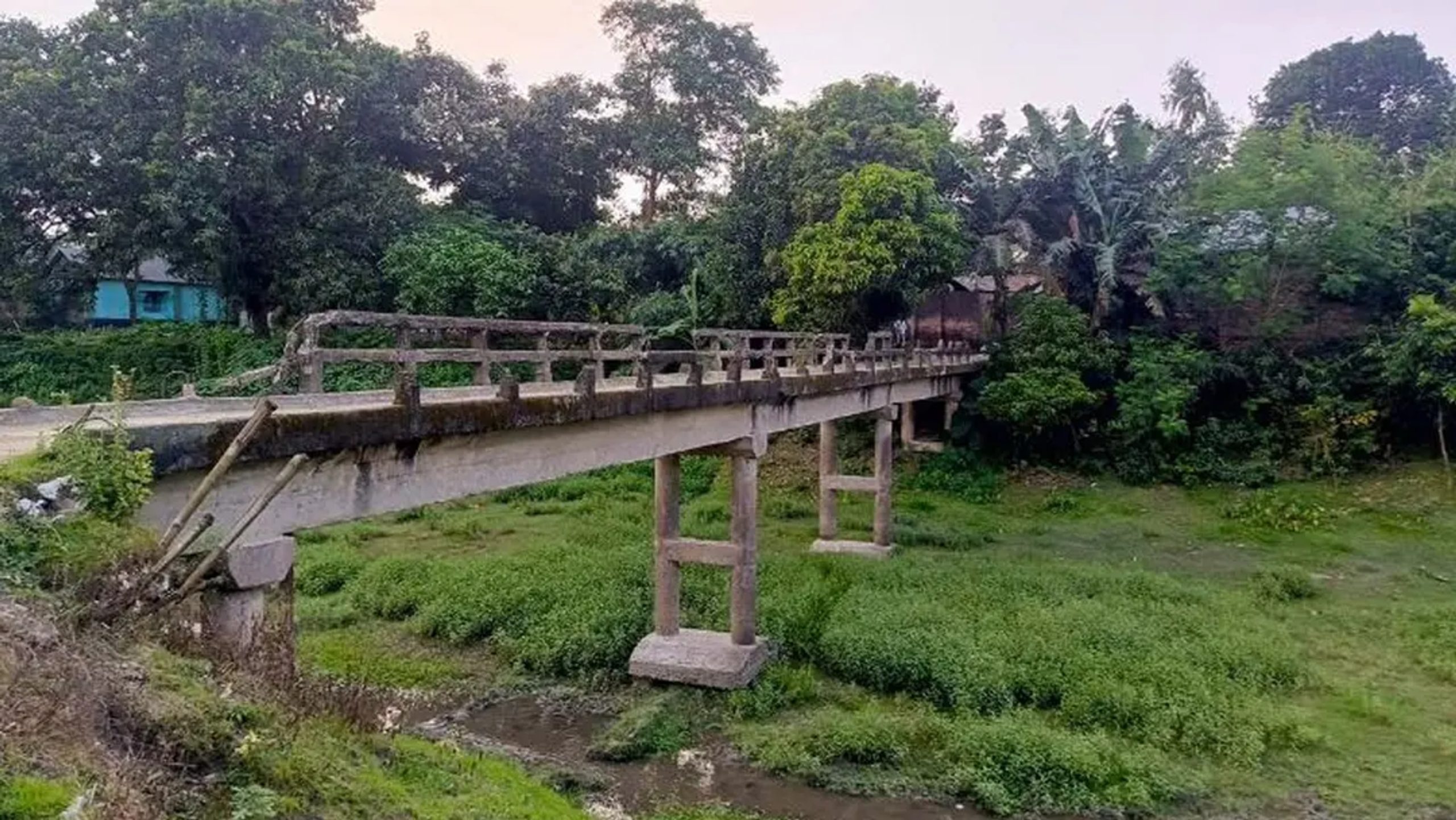
Jahurul Islam, a farmer in his 60s, was describing the daily hardship the village faces crossing a dangerously dilapidated bridge. He is a resident of Shailbari village in Alampur union, Taragonj upazila, Rangpur.
The Sarmangala River flows through Shailbari and the neighboring villages of Bhimpur and Dangapara. A dilapidated bridge, 35 years old, stands over the river and is the only means for local residents to cross it. With no better transport infrastructure available, this hazardous bridge is now the sole route for people from about 10 surrounding villages.
A visit to the site found that the railings of the bridge, built 35 years ago, have broken away, and in some places have disappeared entirely. The safety railings on either side of the 3.5-foot-wide bridge are essentially nonexistent. Plaster has crumbled off the pillars, exposing the rebar underneath, and the bridge deck is scarred with small potholes. Having gone without repair for a long time, the hazardous bridge now stands on shaky legs, and no vehicle other than motorcycles or bicycles can cross it.
Local residents say about 25,000 people, including school, college and madrasa students from several nearby villages, along with farmers, laborers and other professionals, regularly cross this bridge. But because it is so narrow, ambulances or microbuses cannot reach the village if someone falls ill. Auto-rickshaw, van and motorcycle drivers cross the hazardous bridge at their own risk, raising fears of a major accident at any time.
Eshramul Haque, a local madrasa teacher from Shailbari, said, “You can’t use this bridge. Rickshaw-vans, microbuses, autos — none of them can cross. Why did they even build it? It’s far too narrow.”
Lokman Hossain of Dangapara village said, “It shakes when you step on the bridge — only God knows when it’ll collapse. The railings have broken off, and the support posts are all cracked.”
Local journalist Dipak Roy said the bridge’s poor condition has hit farmers and young madrasa students the hardest. Farmers from about 10 surrounding villages are struggling to transport rice, vegetables and other produce to markets. Heavy vehicles are out of the question, and even vans and auto-rickshaws are reluctant to cross the bridge because of the risk, forcing farmers to take longer alternate routes, which increases both travel time and transport costs.
Despite the large number of people who cross it every day, the bridge has not undergone any effective repair for a long time. It is 90 feet long and 3.5 feet wide. Plans are reportedly underway on whether to repair the bridge or build a new one.
Taragonj Upazila Local Government Engineering Department (LGED) engineer Nafiur Rahman said a proposal for reconstruction has been sent to the district level, taking into account the bridge’s dilapidated condition. He said work on a new permanent bridge would begin quickly once the necessary budget and project approval are secured, though he could not confirm when that might happen.