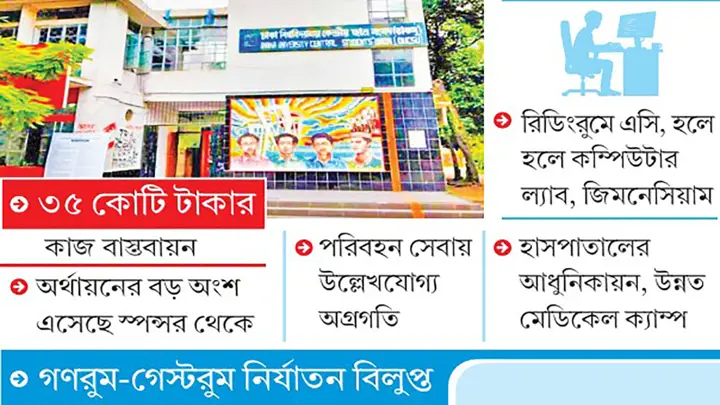
The current committee of Dhaka University Central Students’ Union (DUCSU), elected after the July uprising, has completed one year in office. Over that year, the committee has taken several visible initiatives, including expanding transport services, modernising the medical centre, ending the “gonoroom-guestroom” culture, adding AC and computer facilities to reading rooms, hall-based gymnasiums, and skills development and career support.
The committee, led by VP Sadik Kayem and GS S M Forhad, won election on September 9 last year and took office on September 14. Having pledged to implement a 36-point election manifesto, not all promises have been fulfilled in the year since, but DUCSU’s work in several areas has drawn a positive response from students.
VP Sadik Kayem said that despite a limited budget, they tried to do their utmost for students by securing sponsorships and various forms of support. He claimed the committee had taken numerous initiatives beyond its manifesto as well.
Significant progress in transport
Transport services rank among DUCSU’s most visible achievements. The union says around 45 million taka worth of work has gone into this sector. Alongside launching several new routes, bus service has been extended as far as Cumilla. Evening and Saturday bus trips have been introduced, and work has progressed on a “Lal Bus” app to track bus locations. Those involved see these steps as important progress in easing students’ daily commuting pressure.
End of gonoroom-guestroom culture
One of the most talked-about post-July DUCSU initiatives has been ending the culture of abuse in dormitory “gonorooms” and “guestrooms.” VP Sadik Kayem claims that every gonoroom and guestroom on campus has been permanently abolished since the committee took office.
Some of the former gonorooms have been converted into reading rooms, which are being fitted with AC and computer facilities. At the same time, initiatives have been taken to set up gymnasiums in various halls and build student-friendly, hall-based infrastructure.
Major investment in infrastructure
Around 30 million taka has been spent developing the central playing field. Renovation of the central Jame mosque is under way with a similar amount of funding. Renovation of the historic Musa Khan Mosque is costing around 28 million taka.
Work worth around 60 million taka is also ongoing to install air conditioning in various dormitories. Funds are also being spent on developing reading rooms and other student facilities.
DUCSU has also taken some initiatives specifically for women students. Around 6.5 million taka has gone toward developing a gymnasium at the physical education centre for them. Initiatives include a breastfeeding corner at Kola Bhaban, AC installation in the women’s common room, and free distribution of more than 10,000 sanitary napkins across women’s halls. Around a thousand women students have also received hijabs, and maternity leave arrangements have been put in place.
Medical centre being modernised
The health sector has also seen several visible changes over the year. DUCSU says around 30 million taka worth of infrastructure development work has been carried out at the Shaheed Buddhijibi Dr Mohammad Mortaza Medical Centre.
With financial and technical support from Turkey’s Cooperation and Coordination Agency (TIKA), the medical centre has added equipment including an ambulance, air conditioners, an X-ray machine, an ECG machine, an analyser and a microscope.
DUCSU also says around 4 million taka was spent on a first-aid bootcamp, and that more than 5,000 students received free treatment through various medical camps. Hall-based bedbug extermination and dengue prevention programmes have also been launched.
Skills development and employment initiatives
DUCSU says around 6.5 million taka has been spent on various free courses to boost students’ skills and employability. Work worth around 5 million taka is also ongoing to set up computer labs in dormitories, with labs already completed in four halls and work continuing in eight more.
A job fair involving more than 31 Chinese companies created employment opportunities for around 430 students. Free access to seven international journals has also been arranged to expand research and higher education opportunities.
DUCSU has also been active in cultural activities. Twenty-seven books have been published under the cultural secretary’s editorship. According to DUCSU, around 10 million taka has been spent on various seminars, summits and cultural events. The union also says it has provided security and legal assistance to 270 students.
Most of the funding from sponsors
DUCSU leaders say that despite lack of cooperation from the university administration, limited funding and various obstacles, work and initiatives worth around 350 to 400 million taka have been implemented with support from individuals, alumni, domestic and foreign organisations, and corporate sponsors. Of that, DUCSU received 3.5 million taka from the university administration in two instalments. The rest was implemented with support from various individuals, alumni, and domestic and foreign organisations and corporate sponsors.
DUCSU VP Sadik Kayem said that despite a limited budget, they worked to their utmost by gathering sponsors and various forms of support. Calculating the financial value of various projects, he said DUCSU’s work over the year amounts to close to 350 to 400 million taka.
He said they had carried out numerous tasks beyond the manifesto as well, with everyone at DUCSU working day and night to build the “campus of their dreams.” He claimed this DUCSU had delivered more welfare work for students than any DUCSU in history, and expressed hope that students would move through the campus with their heads held high. He said that if students remain united, fascism would never be able to return to the campus.
DUCSU GS S M Forhad said DUCSU received 3.5 million taka from the university administration in two instalments, and claimed the organisation implemented work and initiatives worth around 300 to 400 million taka with support from domestic and foreign organisations, individuals and alumni.
Challenges remain in some areas
Alongside these visible initiatives, however, some fundamental problems remain a year on. Before the election, the “United Students Alliance” had pledged a firm “yes” on six basic issues, including guaranteed housing from first year, a safe campus, security for women students, healthy food, and simplified administrative services. A year later, students and opposition student organisations allege that visible change has not come to several of these pledges.
Housing remains one of the areas where DUCSU has lagged. The seat shortage in women’s halls in particular remains severe, with many students still waiting for accommodation. Although a permanent solution has been discussed, there has been no full progress on building new residential infrastructure or resolving the existing shortage. Meanwhile, the 28.41 billion taka mega-project is moving at a snail’s pace, and DUCSU has not shown any initiative to pressure implementation or hold the university administration accountable.
Security has also seen no expected change. Incidents of theft and snatching, the presence of drug users and vagrants, and harassment of women students on campus have been rising recently.
Food quality has also raised questions. While DUCSU leaders occasionally inspect dormitory canteens, incidents of stones, worms, blades, lizards, cockroaches and fishhooks found in food have created discontent among students.
There has also been no notable change in the digitisation of administrative services. Despite promises to introduce a “paperless registrar building” and “one-stop service” to reduce harassment and delays centred on the registrar’s building, this has not been implemented. The failure to launch an e-library for the business faculty and lack of initiative on renovating the central library also remain on the list of unfulfilled promises.
Students’ comments
Tahmina Akter, a resident student at Begum Rokeya Hall, said she is not personally a member of any party, but has been impressed by the current DUCSU leadership’s work, particularly its healthcare initiatives. Getting such services outside campus would cost significant money, which is not affordable for many students, she said, adding that DUCSU’s efforts despite various obstacles deserve praise.
She added that this DUCSU’s initiatives should push future leadership to try to do even better than the current one.
Ayesha Siddika, a student at Kabi Sufia Kamal Hall, said the functioning of DUCSU and hall unions has created an environment of accountability at various administrative levels of the university. From hall administration down to officials and staff, she said, people now have to answer students’ various questions and complaints. DUCSU has served as an effective platform for bringing students’ demands and problems before the relevant authorities, she said.
Meanwhile, DU Chhatra Dal leader and DUCSU GS candidate Sheikh Tanvir Bari Hamim questioned the source of funds for DUCSU’s development work. He said students deserve a transparent account of how 35 million taka in allocation turned into spending of 350 million taka. He claimed the housing and food crises had seen little change during DUCSU’s tenure, with many first-year students still unable to move into halls. Although canteen ownership has changed hands, he alleged, food quality has not improved, and most of the installed water filters remain out of order.
On the overall picture, VP Sadik Kayem said DUCSU had its limitations, but did not stop trying. He said an initiative has been taken, with Chinese cooperation, to build a new hall with capacity for around 1,500 women students as a permanent solution to the housing crisis.
He said the university administration had failed to cooperate on many fronts. “We built a gymnasium for women students at a cost of hundreds of thousands of taka, but the university administration isn’t putting it into operation. When we bring air conditioners for the mosque and reading room, the administration doesn’t install them. When we proposed strengthening the security system, they took no initiative.”
DUCSU AGS Mohiuddin Khan told Amar Desh that DUCSU had taken various plans and initiatives to resolve the security, food and housing crises, but that lack of cooperation from the administration on controlling outsiders and managing homeless people prevented these plans from being implemented. An initiative with TCB for low-cost, quality food was also scrapped after the political transition. “There are many such areas where we couldn’t move forward,” he said.