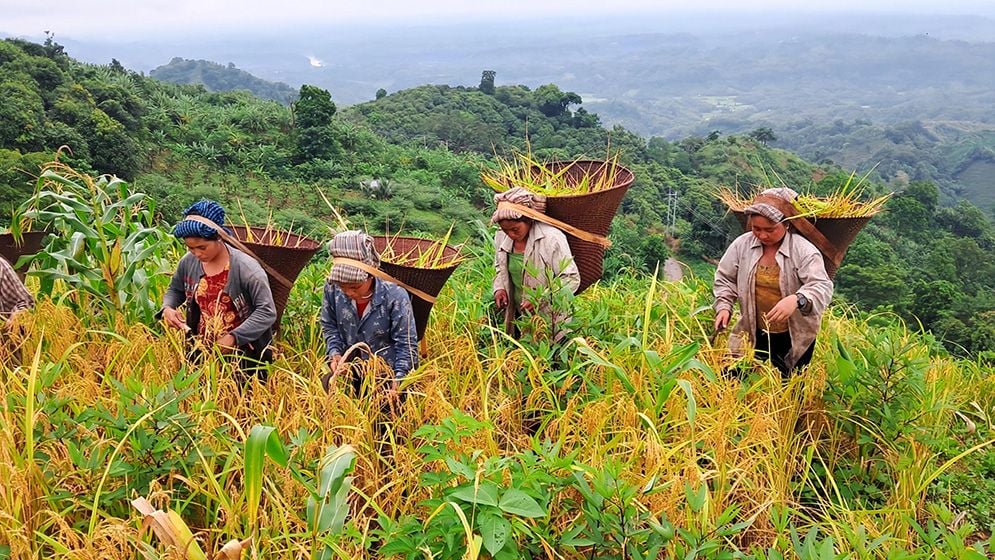
The scent of ripe jum (swidden-cultivated) paddy is spreading across the hills of Bandarban. Along both sides of the rural roads and on the slopes of distant green hills, the golden hue of ripe jum paddy stands out — from afar, it looks as though the hills themselves have turned gold.
In some areas, jum farmers, known as jumias, have already begun harvesting the ripe paddy grown on the hillsides. In other areas, hill people are busy bringing in companion crops grown alongside the jum paddy.
According to the agriculture department and jumias, the area under jum cultivation is increasing every year across Bandarban district’s seven upazilas. Last fiscal year, 2024-25, jum cultivation covered 8,267 hectares, producing more than the 12,499-metric-ton target. This fiscal year, 2025-26, the jum cultivation target has been set at 11,895 hectares of hillside, with a production target of about 20,000 metric tons.
The good jum harvest has brought relief and smiles to jumia families. As far as the eye can see, the golden hue of ripe jum paddy dots the gaps between the green hills. Timely rainfall this year meant not too much of a gap in sowing the jum paddy, resulting in a comparatively good yield in many areas.
However, since rainfall is not uniform across all hilly areas, jum paddy does not ripen at the same time everywhere. Those who managed to sow right after the first rains in early Boishakh have jum paddy ready for harvest earlier.
As the jum paddy ripens, farmers in some areas have started harvesting, while others are still waiting for their paddy to ripen. Many jum farmers are staying with their families in jum huts to guard the ripe paddy and crops. Some are collecting companion crops such as pumpkin, corn, marfa and chinal before harvesting the paddy, while others wait for the right time to harvest.
A field visit to the Jaminipara area of Tarachha union in Ruangchhari upazila found jum farmers busy harvesting the ripe paddy. No one, young or old, is sitting idle at home; entire families have gone up to the jum fields on the hillside to bring in the harvest.
Jaminipara resident Ring Lot Mro is harvesting the ripe jum paddy with his family and eight women laborers hired for the work.
Jum farmer Yangri Mro said he cultivated about three acres of hilly land this year, sowing three “aris” of seed paddy — one ari being roughly 10 kilograms. He said this year’s jum yield has been fairly good, thanks to timely rain. “In the past, jum paddy did well when the sun and rain came at the right time. Now the timing of sun and rain has become unpredictable — even nature seems to have turned upside down. Still, I’m hopeful for a good yield this year.” He expects to get around 150 to 200 aris of paddy from his three acres of jum, and up to 250 aris in a better outcome.
Local jum farmer Ring Lot Mro retired from the police force in June this year. Rather than sit idle after retirement, he returned to jum cultivation, the traditional livelihood of his forefathers. “Jum doesn’t just produce paddy. We grow eggplant, marfa, sesame, barley, corn, chinal, chili, roselle and 30 to 35 other companion crops. We only need to buy salt and nappi (a type of dried fish) from the market. Jum is like a market for us — it provides most of the vegetables we need.”
Woman laborer Sangdong Mro said, “What would we eat if we didn’t do jum? We have to do it. We cultivate jum every year. It’s our tradition.”
She said that, alongside paddy, jum fields produce 30 to 35 varieties of companion crops, including pumpkin, marfa, eggplant, corn, sesame, chili and okra. These companion crops meet the farmers’ own needs and also earn them some income when sold in the market.
Jumias say jum cultivation is essentially a long agricultural process carried out in step with nature and the seasons. Each year, in November-December, the land for the following year’s jum cultivation is selected. Clearing the jungle in the designated hilly area begins in January-February. After the cleared jungle dries in the sun, it is burned within a designated “firing line” in March-April. Throughout April, the jum land is cleared and prepared for sowing paddy and companion crops.
Jum farmers then wait for the first rains. If the expected rain comes at the start of Boishakh, seeds of paddy and various companion crops are sown in the jum fields. Those who can sow quickly after the first rain see their jum paddy ripen earlier, while those who sow somewhat later see their paddy ready for harvest later as well.
Jum paddy harvesting generally begins in remote hilly areas in late August or early September. Harvesting, threshing and drying continue through September and October. After drying, the paddy is transferred from the jum hut to the main house.
From December through February, hill communities celebrate the Nabanna harvest festival for jum paddy in homes throughout the hill tracts, marked by rice from the new harvest and various traditional foods.
The harvest festival is thus now underway across the hill slopes. Jum huts are filling with golden ears of paddy. Hill people are busy with the joy of bringing home the fruit of a long year’s labor. For jum farmers who persevere against nature, this paddy is not just food — it is their life, livelihood and a tradition passed down through generations.
Confirming the situation, Toufiq Ahmed Noor, additional deputy director of the Bandarban Department of Agricultural Extension, said jum cultivation covered about 11,895 hectares in the district this year, with various companion crops grown alongside the paddy.
He said a good jum yield is expected this year, though rainfall is not uniform everywhere in the hilly region, so yields vary by area. Ripe jum paddy harvesting has already begun in remote areas of Ruangchhari, Ruma, Thanchi and Alikadam upazilas, with harvesting to begin in other upazilas in turn. To boost jum production, farmers are being encouraged to grow improved and hybrid paddy varieties alongside local ones.