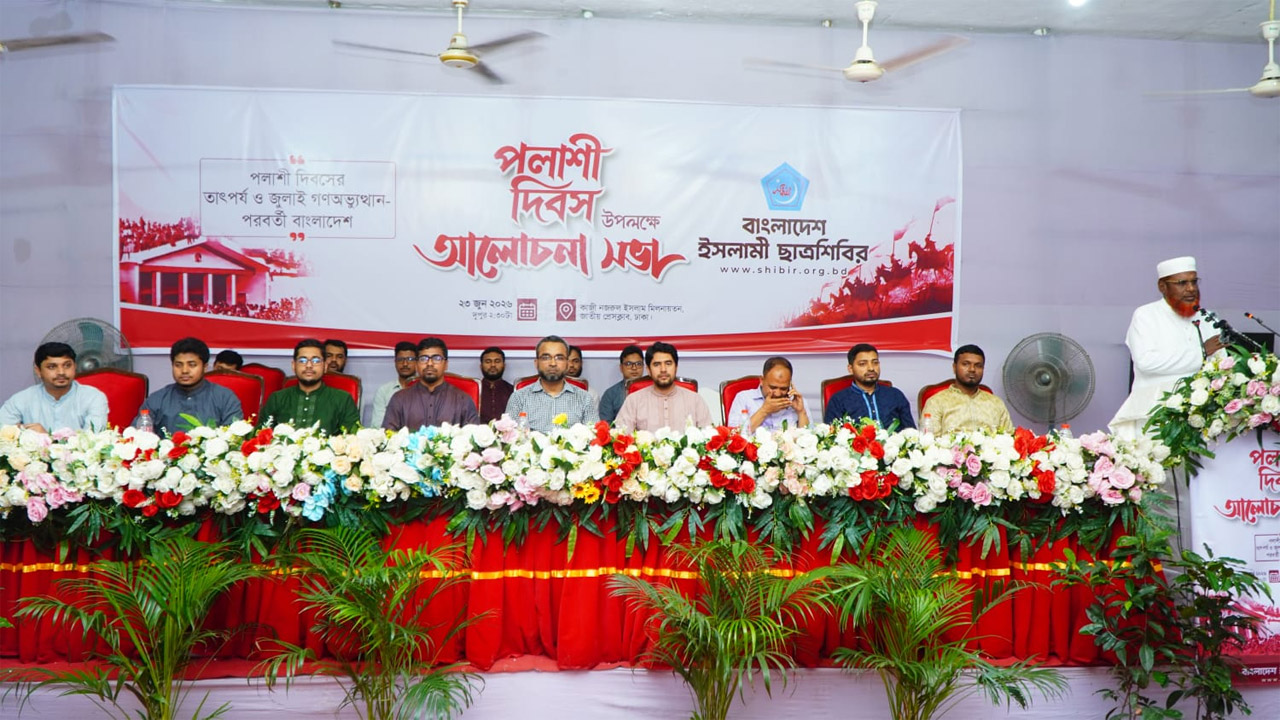
A discussion meeting was held on the historic Palashi Day on the initiative of Bangladesh Islami Chhatra Shibir, with a call to resist hegemony and internal conspiracy.
The discussion, held at the Kazi Nazrul Islam auditorium of the National Press Club on Tuesday (June 23), had as its main theme ‘The significance of Palashi Day and post-July-uprising Bangladesh.’
In his address as chief guest, the secretary general of Bangladesh Jamaat-e-Islami, Mia Golam Parwar, said: ‘The historic tragedy of Palashi, almost 270 years ago, is still highly relevant to the politics of our country today. Palashi is not confined to the banks of the Bhagirathi river; the same kind of conspiracy is active today on the banks of the Padma, the Meghna, the Jamuna and the Buriganga in present-day Bangladesh. The form of neo-imperialism or hegemony has now changed — they no longer occupy territory directly, but control the country’s economy, politics, trade and culture from behind the curtain, at their own command.’
He added: ‘Even in today’s independent Bangladesh, there is no shortage of characters like Mir Jafar and Ghaseti Begum, who serve foreign masters and are busy surrendering the country’s independence and sovereignty at the feet of Delhi’s hegemony.’ Citing the words of the freedom fighter Major M A Jalil that ‘unguarded independence is subjugation,’ he said that although the country’s map and flag were separate, the overall system of control was today bound in the chains of subjugation. The most worrying matter, he said, was the ideological poverty of a section of the country’s political circles: out of greed for power and to please the neo-hegemonists, even the representatives of front-rank parties were showing the audacity to stand in parliament and give away or deny the territorial boundary and historical basis of 1947.
‘Had the boundary of a separate national identity not been created in 1947, it would not have been possible to win the red-and-green flag of Bangladesh through the armed struggle of 1971,’ he said. ‘In post-July-uprising Bangladesh, awakening in every citizen the spirit of true independence and of one’s own values is now the greatest need to resist this internal conspiracy and slavery mentality.’
Speaking as special guest, the Jagannath University history professor Belal Hossen said that about 150 years after 1757, Muslims had obtained a political organisation through which to present their demands politically. The state and its governance were political, not social, matters, he said, and after being lost from politics Muslims had returned to it through the founding of the Muslim League, by whose hand the state of Pakistan was born in 1947.
He said that in the roughly 1,500 years since the passing of the Prophet (peace be upon him), Muslims had passed through their most vulnerable and painful time in the last 100 years. If Muslims had one notable success in that difficult period, after the fall of the Ottoman caliphate, it was the state of Pakistan in 1947, which Muslim leadership had won in a Hindu-majority India through political wisdom and negotiation, he said. ‘The territory of that Pakistan state is today two states, one Bangladesh and one Pakistan. I believe that if the people of these two countries embrace their lost heritage and the golden age that Muslims once had, Muslims will once again achieve eminence in the world,’ he said.
In his address as chair, the Chhatra Shibir president, Nurul Islam, said history repeated itself, with figures like Ghaseti Begum and Rai Durlabh appearing again and again — people who had eaten and grown up in this country and done business with its people’s money, only to impose hostile pacts on those same people and keep them subjugated for hundreds of years.
‘On exactly this day (June 23) in 1948-49, a political party was born — the Awami League. Its birth was no accident; it was born to keep Bangladesh subjugated,’ he said, alleging that when the people of the country took a stand against the party, it had again taken shelter with the very hegemonists whose dominance it had tried to establish in Bangladesh.
Tracing what he described as the thousand-year history of the region — from the rule of the Mauryas, Guptas, Palas and Senas to the roughly 600 years of independent Muslim sultanate — Nurul Islam said that when Muslims ruled, Hindus, Muslims, Buddhists and Christians had lived together in communal harmony, and that because this harmony was protected there were no Hindu-Muslim riots even after centuries of Muslim rule. He said the East India Company had set up its first factory at Kasimbazar in 1634 to expand its trade, hiring only Hindu employees and building up what he called a Hindu alliance, and gradually establishing a politics of division by turning Hindus against Muslim rule. In 1757, he said, those who permanently subjugated the region for the personal gain of a few — Mir Jafar, Ghaseti Begum and Rai Durlabh, all close to the Nawab as his general, his finance minister, his aunt or a close businessman — had betrayed Nawab Siraj-ud-Daulah and sided with the English merely to gain power.
The Shibir president said the people of Bengal had been subjugated again and again and had given their lives, and had then sought independence, rebelling whenever their backs were to the wall and forcing rulers to flee. ‘History tells us a mass uprising took place, and our July revolution that followed was brought about by hundreds of thousands of lives,’ he said. He alleged that the ruling group, who had long lived lavishly abroad, came back to seize power after every revolt; that they did not want the structure of the state reformed or a murder-prevention ordinance implemented; and that they were destroying Bangladesh’s economic sectors. He claimed that 600 people had been killed in 100 days of rule without any justice, and that the Awami League was openly opening offices and holding processions and meetings.
Nurul Islam said Islami Chhatra Shibir had, since its founding, tried to present the streams of Bangladesh’s history before the nation and its youth. ‘We love our country. We want to create honest, skilled and patriotic citizens to build a prosperous Bangladesh. We will not create people who are born in this country and then launder billions of dollars out of it,’ he said, calling on all to learn from history and to help build a self-reliant and prosperous new Bangladesh. He also called for the immediate delivery of justice for all killings on the soil of Bangladesh.
Also present as honoured guests were the former central president of Bangladesh Islami Chhatra Shibir, Salahuddin Ayyubi, MP; the Jagannath University history professor Dr Mohammad Bilal Hossain; and the noted writer and researcher Dr Sayeed Wakil. Also present were Islami Chhatra Shibir’s office secretary, Azizur Rahman Azad; its literature secretary, Saidul Islam; its publication secretary, Amirul Islam; its finance secretary, Anisur Rahman; and its cultural secretary, Adib Musa, among others.
বাংলায় মূল প্রতিবেদন পড়ুন · Read the original Bengali report