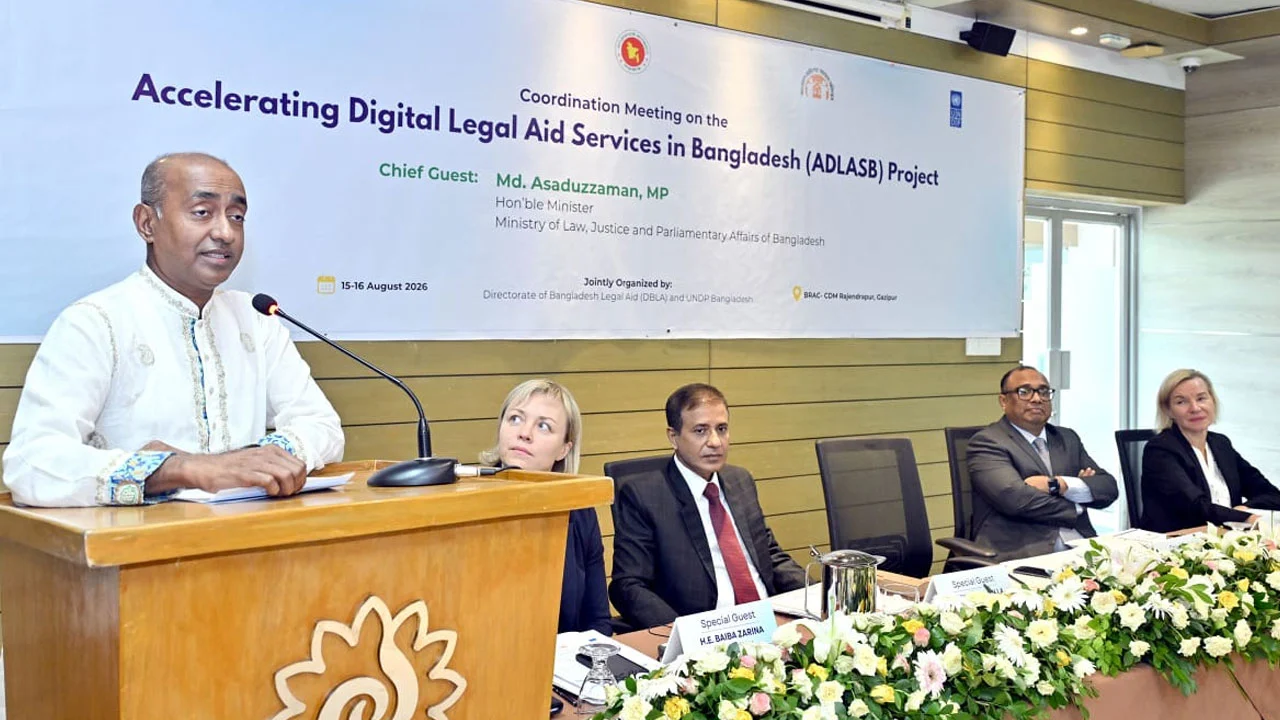
Law, Justice, and Parliamentary Affairs Minister Md Asaduzzaman has described ensuring access to justice as a fundamental component of human rights protection, saying every person possesses certain inalienable and universal rights that the state is responsible for upholding.
He made the remarks Saturday morning while inaugurating a two-day coordination meeting on the “Accelerating Digital Legal Aid Services in Bangladesh” project at the BRAC-CDM facility in Rajendrapur, Gazipur. Judges, legal aid officers, and other stakeholders attended.
A central topic of discussion was how to deliver digital legal aid effectively to marginalized and disadvantaged communities. The initiative covers nine districts — Rajbari, Habiganj, Barguna, Netrokona, Joypurhat, Thakurgaon, Jhenaidah, Khagrachhari, and Bogura — encompassing 57 upazila legal aid committees and 413 union legal aid committees. The focus is on strengthening these committees as effective grassroots platforms for delivering legal aid to the poor, women, persons with disabilities, and other disadvantaged groups, including through mediation and alternative dispute resolution before cases reach court.
The law minister said access to justice is not limited to dispute resolution or mediation — its fundamental goal is to protect, preserve, and guarantee every citizen’s human rights. Even those accused of the gravest crimes have the right to defend themselves, he said, and the state must ensure that right.
He urged judges not to confine themselves to the black letter of the law, saying they must interpret legislation in light of each case’s reality, its social context, and the aims of justice. “Judicial officers must above all serve the people,” he said.
He directed the Director General of the Bangladesh Legal Aid Directorate to take necessary steps to recognize eight outstanding legal aid officers — one from each division — to encourage and reward exemplary service. He also called for evaluating and recognizing 20 outstanding judicial officers nationwide for their exceptional performance.
Highlighting the importance of digitization, the minister said digital technology can expand public awareness of legal aid services while simplifying application processing, case monitoring, and dispute resolution. He cautioned, however, that the potential risks of artificial intelligence must also be considered.
The meeting also discussed institutionalizing online dispute resolution under the 2026 amendment to the Legal Aid Act 2000, and integrating digital legal aid with mediation systems. Research findings on the design, development, and implementation of a digital legal aid system were also presented.
The minister said approximately 4.5 million cases are currently pending across the country, with a target to reduce the backlog significantly within the next year. Legal aid, mediation, digital technology, and coordinated judicial initiatives will play a crucial role, he said.
The meeting was chaired by Md Manjurul Hossain, Director General of the Bangladesh Legal Aid Directorate. Speakers included Romana Schweiger, UNDP Bangladesh’s Senior Rule of Law, Justice, and Security Adviser; Baiba Zarina, the European Union’s Charge d’Affaires in Bangladesh; and Liakat Ali Molla, Secretary of the Law and Justice Division.
The second day of the meeting, on August 16, will cover training for district and sessions judges, legal aid committee operations, data management, and reporting. Discussions will review judicial services and legal aid for women, persons with disabilities, and people in poverty, and identify areas for digital service improvement.
বাংলায় মূল প্রতিবেদন পড়ুন · Read the original Bengali report