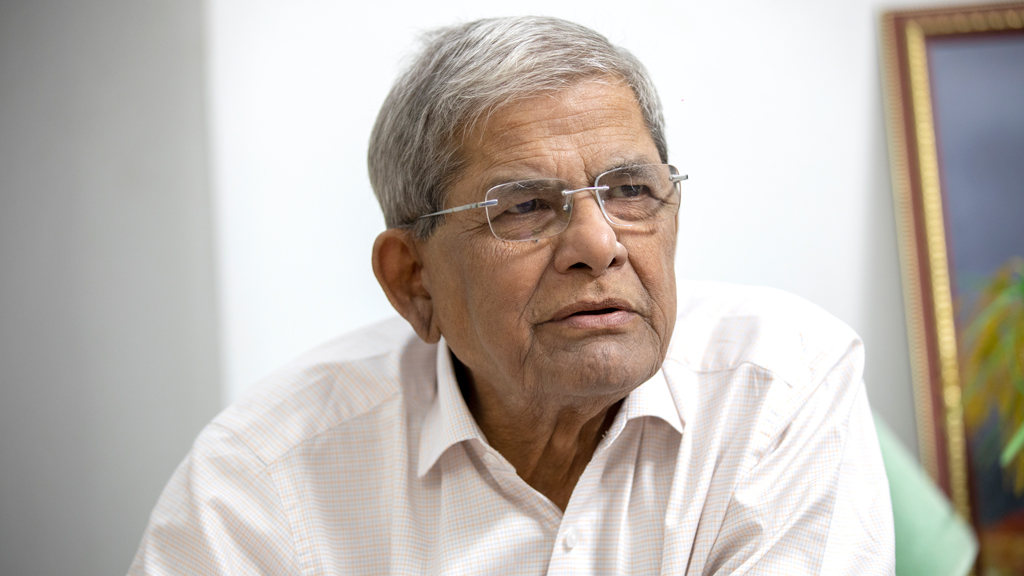
Mirza Fakhrul Islam Alamgir has risen step by step from grassroots politics. He was a student leader in his student days and an economics teacher in his working life, before entering politics and serving as a municipal chairman, a member of parliament, a state minister and a minister.
BNP secretary general and Local Government, Rural Development and Cooperatives Minister Mirza Fakhrul Islam is now set to become the country’s 23rd president. Prime Minister Tareque Rahman today formally announced him as BNP’s presidential candidate. At 78, Mirza Fakhrul has a long and varied political life, having pressed on through many adversities alongside his political responsibilities.
Mirza Fakhrul has served as BNP secretary general since 30 March 2016. Before that he was the party’s acting secretary general for five years from 20 March 2011, and at BNP’s fifth national council on 8 December 2009 he was named the party’s senior joint secretary general.
His political journey began in his student days. While studying economics at Dhaka University he became involved in left-wing politics and led the East Pakistan Students’ Union at various levels, serving as president of its Dhaka University branch and elected general secretary of its SM Hall branch. During the 1969 mass uprising he was president of the Students’ Union’s Dhaka University branch.
After earning bachelor’s and master’s degrees in economics from Dhaka University, Mirza Fakhrul took up teaching. He taught economics at Dhaka College before entering government service. In 1979, during the rule of President Ziaur Rahman, he served as private secretary to the then deputy prime minister, S A Bari. In 1986 he left his government job and returned to active politics.
In 1988 he contested the Thakurgaon municipal election as an independent and was elected chairman. In the early 1990s, during the nationwide anti-Ershad movement, he joined the BNP, and in 1992 he was made president of the Thakurgaon district BNP. Rising through the party’s organisational tiers, he first became a member of its executive committee and later its senior joint secretary general.
Before reaching the top leadership, he was the first vice-president of BNP’s farmers’ wing, the Jatiyatabadi Krishak Dal, and later served for a long period as its president. In the 2001 eighth parliamentary election he was elected a member of parliament as the BNP candidate from his home seat of Thakurgaon-1, and from 2001 to 2006 he served as state minister for agriculture and for civil aviation and tourism.
He also contested the 2008 ninth parliamentary election. In the 2018 eleventh parliamentary election he won from both Thakurgaon-1 and Bogura-6, but, alleging nationwide vote-rigging, he did not take the oath as a member of parliament.
Mirza Fakhrul came into BNP’s top leadership at the hardest and most critical time in the party’s history. After the political upheaval of One-Eleven and during the long Awami League rule, the BNP faced severe repression and political adversity. The then BNP chairperson, Begum Khaleda Zia, was in jail for nearly two years from 2018 and later became inactive in politics because of ill health, while the party’s then senior vice-chairman, Tareque Rahman, went to London during the 2008 army-backed caretaker government and ran the party from there.
In such circumstances, it was Mirza Fakhrul who, from inside the country, became the main helmsman of BNP’s political activities and movement. He led from the front in the street movement against the ousted Sheikh Hasina government and was jailed three times solely for carrying out political programmes. At BNP’s sixth national council in 2016 he was formally elected secretary general, a post he has held continuously since.
Mirza Fakhrul Islam Alamgir was born on 26 January 1948 in the Kalibari area of Thakurgaon town. His father, Mirza Ruhul Amin, was a lawyer, a two-time member of the Pakistan provincial assembly and later a member of parliament of Bangladesh who also served as a minister under the Ershad government; his mother was Mirza Fatema Amin. After his primary and secondary education in Thakurgaon, he passed his higher secondary examination from Dhaka College and then studied economics at Dhaka University. He entered national politics through Maulana Abdul Hamid Khan Bhashani’s National Awami Party (NAP) before, via teaching and government service, joining the BNP.
As BNP secretary general, he has played an important part in the party’s policymaking and overall activities, and senior leaders have praised his role in keeping the BNP organised and sustaining its political position in difficult times. After the BNP formed the government under Prime Minister Tareque Rahman, Mirza Fakhrul has played an important role in the new political context; in the 13th parliament his seat is right beside that of Prime Minister Tareque Rahman. According to BNP senior leaders, elevating him to the state’s highest constitutional post is a recognition of his long sacrifice during the party’s gravest crises.
In his personal life, Mirza Fakhrul is a family-centred figure. His family comprises his wife, Rahat Ara Begum, and two daughters, Mirza Shamaruh and Mirza Safaruh. His wife, a former senior officer at a private financial institution, is now retired; his elder daughter is an expatriate in Australia and a postdoctoral fellow in Sydney, while his younger daughter teaches at an English-medium school in Dhaka.
Spanning more than five decades — from student leader and teacher to grassroots politician, member of parliament, state minister, minister and BNP secretary general — Mirza Fakhrul’s political journey is closely bound up with the history of Bangladesh’s politics. His nomination for the presidency is set to open an important new chapter in that long political life.
বাংলায় মূল প্রতিবেদন পড়ুন · Read the original Bengali report