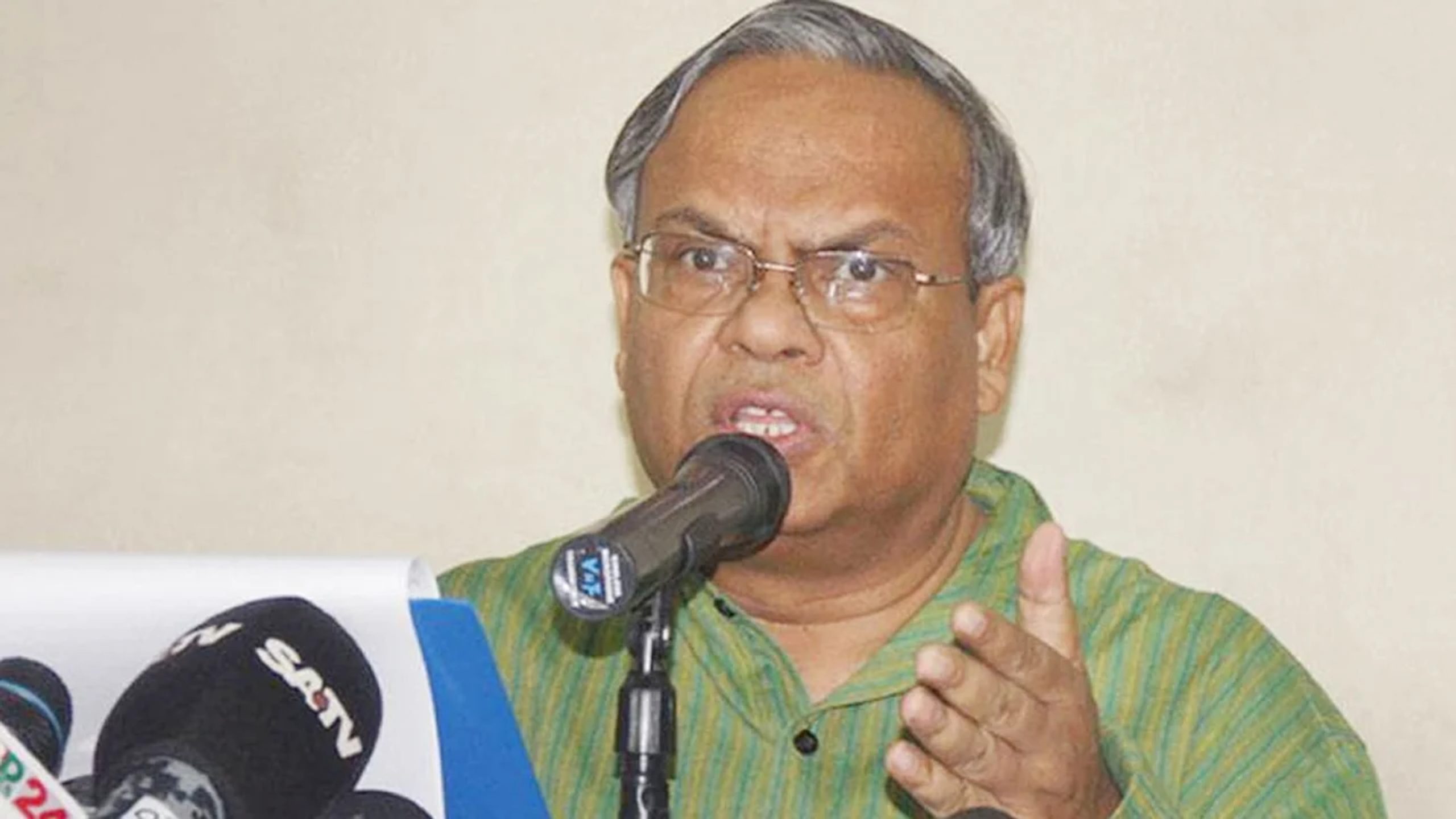
Describing the July National Charter as essential, the prime minister’s political adviser and BNP senior joint secretary general, Ruhul Kabir Rizvi, said the government, the ruling party and opposition parties could discuss it. “If there is anything more to say or add, where is the difficulty in doing so?” he said. “Whatever needs to be made law should be enacted in parliament through discussion, and whatever requires a constitutional amendment should be completed, so that we can establish our July Charter.”
He made the remarks as chief guest at a discussion titled “July Memory” and “Youth Startups and a Bangladesh of Possibility,” held on Monday at the auditorium of the International University of Business Agriculture and Technology (IUBAT) in Uttara.
Rizvi said establishing the July Charter would require everyone to sit at one table, agree through discussion and complete the enactment. These tasks needed to be done quickly, he said, because anti-democratic forces could re-emerge through various loopholes, growing strong again with large sums of money and backing from outside the country.
The BNP leader said the July-August change had at least brought some light of democracy, and that there was now at least a system for a fair election. The situation in which anyone who strongly criticised the government had to face enforced disappearance or extrajudicial killing no longer existed, he said, adding that the freedom to speak and criticise — an essential element of a democratic society that had not existed before — had been secured by July.
Calling the significance of July very deep, Rizvi said its meaning had to be understood further and the remaining work for the development of state democracy completed. “But I say again — there must be a minimum understanding among the political parties on at least a few key issues,” he said. “Without that understanding, democracy will again be endangered, and on that path the protection of the country’s independence and sovereignty could also be disrupted.” Recalling martyr Mir Mugdho’s words from July, “Anyone need water, water?”, he said Mugdho’s and others’ sacrifice could not be forgotten.
Rizvi alleged that the previous government had broken and shattered all democratic institutions, including the Election Commission. He claimed that whatever the then leader said had to be broadcast in the media, that all media were fully controlled, and that the judiciary had no independence, with courts merely reading out verdicts written by the government. The Election Commission, he said, had turned itself into a laughing stock by holding one farcical election after another. He alleged the previous ruling party had wanted to stay in power forever by destroying institutions, and claimed that Begum Khaleda Zia had been kept in a dilapidated jail so that illness and age would weaken her.
Also present were BNP Dhaka metropolitan north member secretary Mostafa Zaman, reserved-seat MP Ferdousi Ahmed (Misti), AB leader Abu Saeed Chanchal, central Swechchhasebak Dal vice-president Dr Zahidul Kabir, and central Chhatra Dal vice-president Dr Touhidur Rahman Auwal, among others.
বাংলায় মূল প্রতিবেদন পড়ুন · Read the original Bengali report