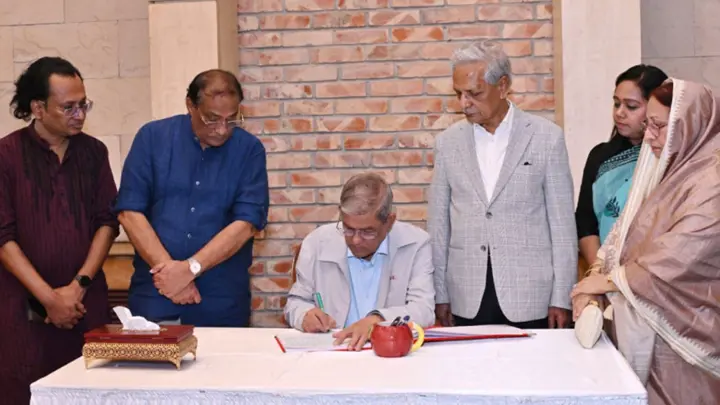
President Mirza Fakhrul Islam Alamgir grew emotional while visiting the July Uprising Memorial Museum and watching a short documentary film, saying, “We have been freed from the fascists and regained democracy, but we have paid a very heavy price. The state can never repay its debt to these martyred and wounded July fighters. May such a tragic and brutal massacre never happen in this country again.” His wife, Rahat Ara Begum, was present with him during the visit.
When President Mirza Fakhrul Islam Alamgir arrived at the museum at 11 a.m. Wednesday, he was welcomed by Cultural Affairs Minister Nitai Roy Chowdhury, State Minister for Cultural Affairs Ali Newaz Mahmud Khaiyam, the prime minister’s policy and strategy adviser Dr. Zahed-Ur-Rahman, the secretary of the Ministry of Cultural Affairs, the director general of the July Uprising Memorial Museum, and senior officials from the President’s Office and relevant ministries.
Entering the July Museum with a visitor ticket, the president walked through the Long Walk to Democracy walkway, viewing historical images depicting the Liberation War and various stages of Bangladesh’s democratic journey. He toured the memorial built in honor of those martyred during the 16 years of fascist rule, as well as a replica of the “Aynaghar” secret detention facility. Paying deep tribute to the memory of those martyred and injured in the July uprising, the president planted a tree on the museum premises.
He also toured the museum’s sections on the BDR massacre, the Shapla massacre, torture equipment, and enforced disappearances. He grew visibly moved while viewing letters, mementos and keepsakes belonging to the martyrs. He walked through exhibits covering key events of the July uprising and the struggle of students and the public. Finally, the president became emotional after watching a documentary film at the museum’s Monsoon Theatre. He signed the museum’s visitor book at the end of his visit.
He said it was the responsibility of everyone to build a democratic, just, discrimination-free and humane state system that upholds the spirit of the July uprising. He said preserving such memories and the role of the museum were extremely important for accurately presenting the history of the July uprising to future generations.
The president prayed for the eternal peace of the souls of those martyred in the July uprising, and also wished for the swift recovery and well-being of all those injured and affected.
Paying deep tribute to the martyrs and the injured of the July uprising, Mirza Fakhrul described their sacrifice as a significant chapter in Bangladesh’s struggle for democracy and justice. He said the nation would remember with deep reverence the sacrifice of the students and the public who took part in and gave their lives during the July uprising. He paid respect to the sacrifice of the martyrs and the courage of the injured, and expressed condolences to their families.
Also present were July Museum governing board members Sanjida Islam Tuli, Abrar Ilias and Mir Mahbubur Rahman Snigdho. During the visit, July Museum research team members Zubair Ibne Kamal and Farhan Masud briefed the president on the museum’s various installations and documents.