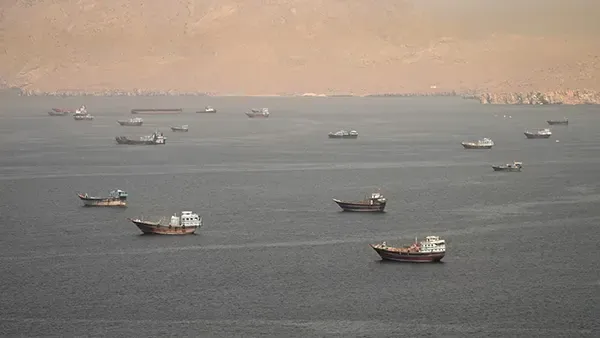
Fresh tensions have arisen over commercial shipping in the Strait of Hormuz. For the first time since the ceasefire took effect, an Iranian drone has struck a commercial ship. In response, the United States struck Iranian military targets around the strait, plunging one of the world’s most important energy-trade routes back into uncertainty.
On Thursday (25 June), Iran’s Islamic Revolutionary Guard Corps (IRGC) broadcast a warning to ships passing through the Strait of Hormuz, saying any ship that tried to cross the strait without its permission or outside designated routes would bear all the consequences.
Within a few hours, an Iranian drone struck the Singapore-flagged container ship Ever Lovely, a US official told CNN. It was the first attack on a commercial ship since the ceasefire was signed.
US President Donald Trump on Friday called the incident a “foolish violation” of the ceasefire. In response to Tehran’s attack, US forces struck Iranian military installations around the Strait of Hormuz on Friday. But a US official said the strike did not mean a full-scale war was resuming, with no sign of a major military operation restarting, at least for now.
Iran’s state media Press TV later said the IRGC had carried out counter-strikes on US military positions in the region in response to the US strike, though the United States has not so far confirmed any such attack.
Meanwhile, Bahrain said early on Saturday that an Iranian drone attack had taken place on its territory, though the actual target of the attack remained unclear.
Under the ceasefire, Iran had pledged to make its “best efforts” to ensure the safe passage of commercial ships through the Strait of Hormuz. About one-fifth of the world’s total oil and liquefied natural gas (LNG) supply passes through the strait. Ensuring safe navigation was one of Iran’s biggest commitments to the United States, but in Iran’s view, reopening the strait does not mean it will give up control of it.
A vague clause in the agreement says Iran and Oman will jointly determine the future administrative arrangement of the Strait of Hormuz, giving Tehran a formal role in managing the strait. Although talks with the United States continue, the recent drone attacks suggest Iran wants to keep in its own hands the decision over which ships pass through the Strait of Hormuz, and when and by which route.
The IRGC has already declared routes not approved by Tehran “unacceptable,” “extremely dangerous” and “prohibited,” calling on all ships to coordinate only with its navy for safe passage. The newly formed Persian Gulf Strait Authority (PGSA) has issued new rules under which ships must apply for approval by email; on approval, they receive a “safe-passage guarantee” that also includes insurance cover.
When CNN tried to contact the authority, however, the PGSA’s email was not working. At present, three separate routes are operating in the Strait of Hormuz’s waterway, which is just 21 miles wide. One southern route runs close to Oman’s waters; the middle route was used before the war; the northern route is entirely under Iran’s control. Shipping companies are thus in a major dilemma, finding it hard to decide which route is safe.
Dimitris Maniatis, chief executive of the maritime-risk analysis firm Mariscs, said the whole situation was extremely confusing for safe navigation and the current environment very dangerous.
Shipping companies now face a hard choice: if they avoid the Iran-controlled route and use another, they risk attack; if they follow IRGC instructions and use Iran’s route, they risk US sanctions should the ceasefire later collapse. Maniatis said the world’s shipping companies wanted to avoid dealings with Iran for fear of future US sanctions, noting that the current US administration had warned in the past that even paying Iran any toll fee could be grounds for future sanctions.
Iran had initially spoken of collecting tolls from ships using the strait. It later said it would not take direct tolls for now, planning instead to impose fees for maritime services and a new environmental tax — a plan that has particularly worried the United States’ Arab oil-exporting allies.
After the attack on the Ever Lovely, the International Maritime Organization (IMO) temporarily suspended a coordinated humanitarian operation to safely move more than 500 commercial ships carrying over 11,000 sailors stranded in the Gulf. The organisation said the operation would remain halted until the situation became clear. According to maritime experts, at least four ships have since turned back midway. Ships using the Oman route are passing very close to one another, raising the risk of collisions and accidents.
During the war, owners had to pay an extra premium of more than $1 million to insure a very large crude carrier (VLCC) against the risk of attack. Although attacks are now comparatively fewer, insurance premiums remain very high. Matthew Wright, chief freight analyst at the market-analysis firm Kpler, said that to get insurance, each ship had to declare in advance which route it would use.
In his words, it was not a full return to normal but a sign that “we are still within the 60-day ceasefire,” with no guarantee yet that the Strait of Hormuz has fully and safely reopened. He warned that if the dispute over routes was not resolved by mid-August, all three routes could be used chaotically, making navigation even more unsafe.
Despite the risks, some ships have gradually begun using the Strait of Hormuz again. But shipping companies are still waiting, wanting to return to fully normal operations only after safe passage is ensured over a long period without any attack. Wright said there was long-standing distrust between the two sides, so the agreement was “certainly a good first step.” But he added that there was still a large gap between what the United States said and what Iran said, and that “we are still going through an extremely chaotic period.”
বাংলায় মূল প্রতিবেদন পড়ুন · Read the original Bengali report