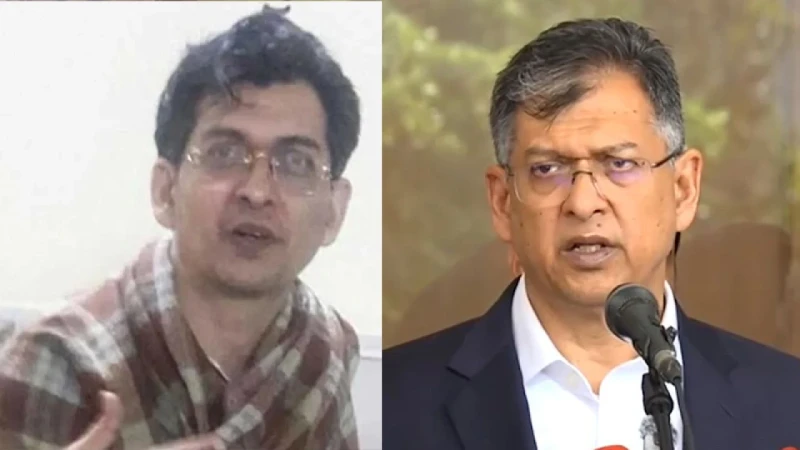
Among those who were victims of enforced disappearance under the past Awami League government is current Home Minister Salahuddin Ahmed. While serving as the party’s spokesperson during the anti-government movement, Salahuddin, then BNP’s joint secretary general, was abducted from a flat in Dhaka on March 10, 2015. After being missing for two months, he was found on May 11 in Shillong, in India’s Meghalaya state.
Today, August 30, is International Day of the Victims of Enforced Disappearances. Observed every year since 2011, the day exists to remember victims of enforced disappearance worldwide, express solidarity with their families, and hold states accountable.
Observance of the day began after the International Convention took effect at the UN General Assembly in 2010. This year’s theme is “Victim First, Action Now.”
Against the backdrop of this year’s Enforced Disappearance Prevention Day, the country’s most talked-about disappearance case has come back into focus. Many are curious to know exactly how, under what circumstances, and from where Salahuddin Ahmed was disappeared.
The owner of the flat in Dhaka’s Uttara from which the current home minister was disappeared has given BSS a chilling account of the incident.
A tense situation developed around January 5, 2015, the first anniversary of the 10th national parliamentary election, as the Awami League and BNP held rival programs. On January 3, the government and BNP clashed over holding a rally at the capital’s Suhrawardy Udyan. As an alternative, the Awami League prepared to hold sit-ins at 16 locations in the capital, while BNP prepared for a rally in Naya Paltan.
But to prevent BNP leaders and activists from entering Dhaka to join the program, law enforcement tightened security at the capital’s entry points. Intelligence agencies kept BNP’s top leaders under close surveillance. On January 4, BNP chairperson Begum Khaleda Zia took position at the party’s Gulshan office. Amid the tense situation, the government arrested nearly all of BNP’s senior leaders one by one.
Meanwhile, senior joint secretary general Ruhul Kabir Rizvi Ahmed had been issuing statements from the central office in Naya Paltan, keeping the movement going. But within a few days, police arrested him too. Amid the confrontational situation, Begum Khaleda Zia announced a continuous blockade program. In that context, joint secretary general Salahuddin Ahmed was given responsibility as the party’s spokesperson.
While carrying out that responsibility, Salahuddin Ahmed was picked up and forcibly disappeared by state law enforcement. After being missing for 62 days, he was found in a mentally shattered state in Shillong, the capital of India’s northeastern state of Meghalaya.
An eyewitness and witness to the grim events of where and how he was before his disappearance is Syed Habib Hasnat, a close associate of Salahuddin Ahmed. A distinguished son of the Mia Bari family in Vellapara, Patiya upazila, Chattogram, Syed Habib Hasnat was serving in a senior position at a private bank at the time.
In Syed Habib Hasnat’s account: “I already had close contact and a good relationship with brother Salahuddin. From the moment he took on the responsibility of party spokesperson, government agencies, intelligence services and RAB-police began searching various locations to arrest him, hunting frantically at every suspected location. In that situation, he was staying at various flats in Gulshan, using different methods and changing locations while carrying out his party duties. At one point, things reached a stage where intelligence agencies confirmed he was somewhere in Gulshan, though they hadn’t yet confirmed exactly which house or flat. But the situation was such that the moment they confirmed it, they would catch him.”
He said: “After intelligence activity centered on Gulshan intensified, brother Salahuddin, on the party’s advice, decided to quickly change locations. I was working at a private bank at the time, and my office was a short distance from where he was staying in Gulshan. When the party and those involved suggested a few alternative locations for him to move to, he decided to go to my flat in Uttara. It was probably the last day of February, around lunchtime, when brother Salahuddin called. He said he needed to quickly get out of Gulshan and wanted to move into my flat in Uttara. I immediately said there was no problem, that I would take him myself. I said I’d come after evening, to be ready.”
“As agreed, I set out with my car around 5 p.m. Very few people, only a handful of us close associates, knew which house in Gulshan he was staying at. Only BNP chairperson Begum Khaleda Zia, brother Salahuddin’s wife, and a few close party leaders knew about it. I parked some distance from the house and told my driver there was a sweet shop nearby, to go get some sweets — because the driver couldn’t be allowed to understand anything. I drove the car myself right up to the house and called brother Salahuddin. He came down immediately, along with BNP leader Tabith Awal. I seated the two of them in the back seat and started driving toward Uttara. On the way, I chose routes that had no police checkpoints. We drove with them and reached the house in Uttara a little after evening. The guards there couldn’t be allowed to know either. So I called the guard on duty and said, ‘I’m heading up, go bring me two packets of cigarettes, I’ll wait right here at the gate.’”
“The moment the guard stepped outside, I opened the car door — brother Salahuddin and Tabith got out. I told them to quickly go up to a certain flat on a certain floor. I had already arranged a cook and an assistant there in advance, and I told them, ‘A guest will be staying here, take care of all his needs.’ After sorting out the other arrangements, I left there and went with my wife to stay at a different flat. From that flat, brother Salahuddin kept sending statements and video messages, as instructed by the party, calling for the movement to continue. The movement went on, and the government kept searching for him — that’s how the days passed.”
Habib Hasnat said: “I went to Uttara on March 10. I’m well familiar with what the Uttara area typically looks like in the evening. That day, from the moment I entered the Uttara area, I noticed a kind of abnormality — some street lights were off, there was a stifling atmosphere in some places, and no people were in sight anywhere nearby. The residential shops were also closed. There are a few playgrounds in the area where young people play after evening, but I saw no one there either! A strong sense of unease came over me. As I got closer to the house, I saw a heavy law enforcement presence. Gathering my courage, I went inside the house. The guard looked very downcast, but he didn’t say anything. When I reached the flat’s door, I was shocked — the door was broken! The moment they saw me, the cook and assistant came rushing out from inside, wailing. Crying, the two of them said the guest had been taken away!”
“I didn’t know exactly what to do! I had to decide quickly. It was obvious that if I got caught, I would be disappeared too. But if I wasn’t out there, there would be no one left to say what had actually happened to brother Salahuddin. Thinking this through, I decided I had to leave the country quickly. I already had a visa; my wife was staying in another flat upstairs, and I took her with me, just as we were, straight to the airport. My associates quickly arranged tickets. By the time the plane reached Dubai airport, I got a call from the OC of Uttara police station — he was looking for me!”
In Habib Hasnat’s account: “I went and settled in an area of America with few Bangladeshis. From there, I would speak by phone with brother Salahuddin’s wife, Hasina Ahmed, and with Madam Khaleda Zia. Meanwhile, the government denied taking brother Salahuddin away. Sister-in-law Hasina Ahmed kept trying in various ways, but the government kept claiming that law enforcement had not taken brother Salahuddin, and instead spread the propaganda that he had ‘gone into hiding,’ trying to frame him. At one point, Madam Khaleda Zia had someone call me and asked that I hold a press conference in America or Dubai. She wanted me to say at the press conference that brother Salahuddin had been taken from my flat in Uttara, that he had been staying at my flat, and that he had gone missing from there. I was preparing to do exactly that, but shortly after, an intelligence agency called and told me: ‘Quiet! Stay completely silent. If you say even one word, you will never be able to come back to this country for the rest of your life.’ They even threatened my life! Because of that, I didn’t hold the press conference. That’s how I spent many days on American soil.”
He said: “For a long 17 years, millions of people in this country fought for their rights, gave their lives, gave their blood. While playing a behind-the-scenes role in the anti-fascist movement, I myself lived in fear for my life during that time. By Allah’s grace, through an uprising soaked in the blood of youth, we were freed from that tyrant’s rule. Now all of us should set aside division and discord and work united for the people of this country, to make the country prosperous. Everyone must work hand in hand, shoulder to shoulder, to build a beautiful Bangladesh for future generations. For that, we must rise above narrow self-interest and preserve the unity of anti-fascist forces. If that unity is broken, we will all suffer — we must always keep that in mind.”
Looking back at history
Before Salahuddin Ahmed was picked up, RAB arrested his two drivers, Shafiq and Khokon, and his personal assistant, Osman Gani, on March 7. The next day, March 8, RAB searched for Salahuddin at Gulshan’s First Security Islami Bank and at the flat of a senior bank official (that office and flat belonged to Syed Habib Hasnat). Then, on March 10, Salahuddin Ahmed was picked up from the Uttara flat. In between, his Gulshan residence was searched multiple times, and intelligence agents kept round-the-clock watch at the gate of his home.
A report published in two of Dhaka’s national dailies on March 18 said multiple eyewitnesses in the area confirmed that it was law enforcement that took Salahuddin away. Security personnel and multiple eyewitnesses from the area where he was taken described the incident to the two newspapers.
Citing security personnel from Uttara Sector 3 and several eyewitnesses, multiple Dhaka media outlets reported at the time that before Salahuddin was picked up, a law enforcement pickup truck had been parked near the house. Members who arrived in that pickup had also asked security guards employed by the Sector 3 welfare association about the location of Road 13-B. Security guards at the house said unidentified armed men had forcibly taken Salahuddin away.
However, from the very start, the then-ruling party had treated the matter with a kind of mockery. At an event in the capital on March 14 that year, then-prime minister Sheikh Hasina said: “We are searching for him (Salahuddin) to arrest him. Khaleda Zia herself must answer where he is. Salahuddin was issuing statements from underground. But everyone knows he issued them from right there (the chairperson’s political office in Gulshan). Whether he’s been smuggled off somewhere along with eight sacks of garbage — Khaleda Zia herself must answer that.”
Afterward, government ministers and MPs also began making sweeping statements suggesting, or directly claiming, that Salahuddin was hiding somewhere. Even after Salahuddin Ahmed was found in a physically and mentally shattered state in Meghalaya on May 13, that rhetoric did not stop.
That same day, May 13, at a discussion event in the capital, veteran Awami League leader, the late Suranjit Sengupta, said of Salahuddin Ahmed: “This is not a disappearance, a vanishing or a missing-person case — this is hiding. Hiding and disappearance are not the same thing. It has become clear that this act of hiding was carried out on the party chief’s own orders.”