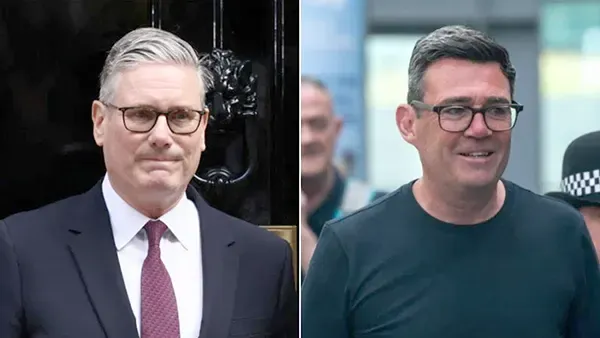
On Monday (June 22) morning, with his colleagues and his wife beside him, British Prime Minister Sir Keir Starmer addressed the nation in an emotional voice from Downing Street. He admitted that he was no longer the right person to lead Britain. Despite having won one of the biggest electoral victories in British political history, Starmer is having to give up power in less than two years.
Over the past 10 years, six prime ministers, including Starmer, have resigned in the country. The rate of change of political leadership in Britain has now reached its highest level in nearly two centuries.
Like his predecessors, Starmer failed to ease public anger over the standard of living. Since the global financial crisis of 2008, British living standards have remained virtually stagnant. Global shocks — particularly the Covid-19 pandemic — increased the burden of national debt and curtailed government spending. The failure to control illegal immigration has also created deep divisions in British society and politics.
The historian Anthony Seldon, known for his research on Britain’s prime ministers, said Britain was now in a deep crisis because Starmer and his predecessors Liz Truss and Boris Johnson had failed to present the public with a clear political direction. On Starmer’s likely successor, Andy Burnham, Seldon said that if Burnham too failed as prime minister, Britain’s future would be very dark.
Britain was once a symbol of stability
Britain was once regarded as a symbol of political and economic stability. The long-serving Margaret Thatcher and Tony Blair played important roles in the transformation of modern Britain. But the global financial crisis of 2008 dealt a major blow to the British economy. The over-reliance on the financial sector for economic growth put the country at risk, and the subsequent policy of cutting public spending weakened Britain’s ability to face future crises. The last British prime minister to win an election outright and serve a full term was Tony Blair, who was in power from 2001 to 2005.
Britain once mocked Italy for its frequent changes of government. Now many look enviously at Italy’s prime minister, Giorgia Meloni, who, after nearly four years in power, is on course to become the longest-serving head of government in the history of the Italian republic.
Although many analysts blame Britain’s current instability on the 2016 referendum to leave the European Union, Jill Rutter, a senior fellow at the Institute for Government (IfG) and a former Treasury official, believes the problems began with the 2008 financial crisis. She said a general feeling had taken hold among people that their lives were not improving, and that even their children’s lives would not be better than before — and every government since had failed to change that.
By voting to leave the European Union in 2016, Britain radically changed its longstanding foreign policy. The Scottish independence movement was also reinvigorated, as most Scottish voters had voted to remain in the EU. Meanwhile, heavy government spending during the Covid-19 pandemic and the steps taken to deal with the impact of Russia’s full-scale invasion of Ukraine pushed Britain’s government debt close to 100 percent of gross domestic product.
Although Japan, Italy, the United States and France have higher debt ratios, Britain’s borrowing costs are relatively high because of high inflation and reliance on foreign investors to fill the budget deficit. This has had a negative impact on the living standards of ordinary people. According to 2025 data from the supermarket chain Asda and the Centre for Economics and Business Research, although average real disposable income in Britain rose, the spending power of the lowest-earning 40 percent of people fell compared with 2021.
‘Why nothing works’
The former British government adviser Sam Freedman, in his book ‘Failed State: Why Nothing Works and How We Fix It,’ argues that Britain’s system of governance is overly centralised and that the state’s key institutions are not capable enough of meeting modern challenges. The longtime member of parliament Roger Gale, for his part, believes the culture of British politics has also deteriorated, with the pressure of 24-hour media and social media forcing politicians to make quick decisions. ‘The government must move more slowly. Too much legislation is being made, much of it bad and poorly drafted. We need a more mature government,’ he said.
Starmer was criticised for failing, in office, to present a clear plan to deal with important issues such as high electricity prices, increasing investment, improving healthcare and raising defence spending. Andy Burnham, meanwhile, is now being discussed as possibly taking over as prime minister within weeks, in which case he would have to quickly form a cabinet and present a clear political and economic outline for the country. The former prime minister Rishi Sunak, who was defeated by Starmer in the 2024 election, commented that it was essential for Burnham to have a clear plan of action; otherwise, he wrote, Burnham too would become just another prime minister lying awake at night wondering why nothing works.
বাংলায় মূল প্রতিবেদন পড়ুন · Read the original Bengali report