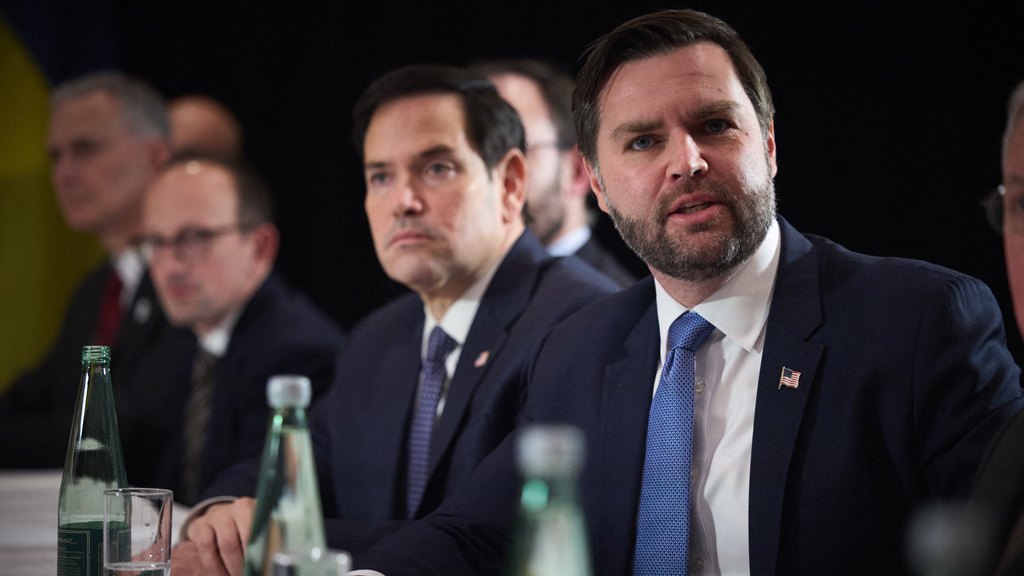
US Vice-President JD Vance has criticised hardline members of the Israeli cabinet in unprecedented terms for opposing the newly signed US deal with Iran. He said plainly that no country can solve all its national-security problems merely through violence or killing.
JD Vance made the comments at a White House briefing and in interviews with US media. At the same time, he answered internal critics in his own Republican Party with a forceful defence of the deal reached with Iran.
At the White House briefing, JD Vance named Israeli National Security Minister Itamar Ben Gvir and Finance Minister Bezalel Smotrich, saying, “They should accept reality.”
Responding to the Israeli ministers’ anger, the US vice-president said, “If I were in the Israeli government’s cabinet, I would not attack the world’s only powerful ally this way.”
Criticising Israel’s military policy, Vance added, “A country of 9 or 10 million people cannot solve all its national-security problems merely by carrying out killings.”
Even amid this sharp exchange, Israeli Prime Minister Benjamin Netanyahu kept a somewhat softer tone. Reaffirming the importance of close relations with Washington, he said the United States had stood “shoulder to shoulder” with Israel in the hard times of war.
Meanwhile, although the deal has been signed, tit-for-tat attacks have continued in Lebanon between Israel and the Iran-backed armed group Hezbollah. On Thursday, three civilians were killed in an Israeli air strike in Lebanon.
Israel claims that its fight against Hezbollah is entirely separate from the war with Iran. Hezbollah, too, has rejected the terms of the deal.
On this, JD Vance issued a stern warning, saying that killing civilians by carrying out attacks in densely populated civilian areas such as Beirut was in no way acceptable. He stressed that Israel must respect this peace process.
The Donald Trump administration’s decision to end the war has created sharp discontent within the United States, especially among Republican Party hardliners. Many are angry over a provision to create a $300 billion fund for Iran’s reconstruction.
Republican Senator Bill Cassidy described the deal as “the biggest foreign-policy mistake of the past several decades.” In his view, “Iran’s nuclear ambitions have not been curbed; rather, they have learned that threatening to close the Strait of Hormuz works.”
In response to the criticism, JD Vance said the deal would give Iran no concessions unless it met the conditions. Under the terms, Iran must destroy its stockpile of enriched uranium and provide specific proof of halting funding to regional proxy groups. He warned that all sanctions would be reimposed if the terms were broken.
বাংলায় মূল প্রতিবেদন পড়ুন · Read the original Bengali report