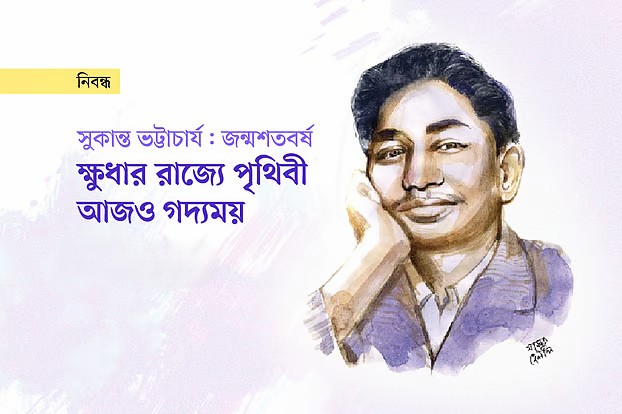
Nearing the end of his life, Rabindranath Tagore wrote in his poem “Oikatan”:
“He who shares the peasant’s life,
Who has earned true kinship through deed and word,
Who lives close to the soil —
For his voice, the poet listens.”
Sukanta Bhattacharya earned that true kinship with the life of the peasant, even though he was born in the city, far removed in social position from the fields and the farmers who worked them. Carrying the peasant’s hopes, aspirations, and struggles in his consciousness, he gave Bengali literature an extraordinary body of poems. Living in a heartless city of brick and stone, he still heard the “call of the harvest” from the village soil, and answered with fierce conviction:
“Put the sickle in this hand of mine —
A golden sea lies ahead; into it I will leap.”
The peasant’s defiant consciousness against exploitation found extraordinary expression in his poem “Durmar.” In September 1946, Sukanta lay ill in bed when he was stirred by news of the Tebhaga movement, which demanded two-thirds of the harvest for the tillers. He wrote, with deep feeling:
“From the Himalayas to the Sundarbans, suddenly
Bengal trembles and trembles in the surge of the Padma.
In that clamor’s choked voice, I find my purpose —
A rushing tide of erosion comes, in water and in soil.”
Sukanta recognized that through the peasant movement, “the rice of awareness has been born,” wiping away the death of the last famine, “and the life of Bengal has come again.”
The fighting spirit of the Tebhaga movement echoes in the blood-red lines of his poetry:
“‘Either rice or life’ — with these words,
The whole country loses its bearings;
Having died once, they have today forgotten
Their fear of death.”
The powerful rise of the peasants is rendered in an unprecedented symbol of hope, one that carries Bengal beyond the limits of place and time:
“Bravo, Bengal, this earth
Watches on in wonder:
Though burned to ashes,
Still it will not bow its head.”
It was not only the peasant — the worker, the laborer, the postal runner, the hungry, the exploited and dispossessed — whose cries and resolve found deeply moving expression in Sukanta’s poetry. He took even the most ordinary objects and, through metaphor, turned them into potent weapons against the oppressor. Historically and class-conscious, Sukanta’s poetry echoes the eventful history of a subjugated India during a particular period, 1939 to 1947. The struggle against colonial rule, labor strikes, the August Movement of 1942, the heat of World War II, the rampant profiteering of black marketeers and hoarders, the fight of the Azad Hind Fauj, the naval mutiny, communal riots, and the direct and indirect influence of imperialist aggression — all of these stirred Sukanta’s creative world into turbulence.
The Jallianwala Bagh massacre and the sensational Chittagong armoury raid also found reflection in his writing. Against the backdrop of the eventful character of the 1940s, Sukanta’s political consciousness and his poetry developed in parallel.
Bengali writers typically begin their literary careers through poetry, and Sukanta was no exception. What set him apart was his subject matter. It is the fate of Bengali poets to write love poetry in adolescence and youth. Yet at that same age, Sukanta chose not love but the many afflictions of the social body as his subject. He did not stop at diagnosing the disease — he also pointed the way to a cure. Confronting hard truths in a nerve-shredding reality, he realized his poetry needed to embody not the dreamy sweetness of love and beauty, but the harsh reality of life’s struggle.
A believer in the Marxist view of society, Sukanta held that capitalism would one day dig its own grave — that the injustice, exploitation, and greed at the root of capitalist society carried within it the seeds of capitalism’s own inevitable destruction. This belief found extraordinary form in his poem “Charagachh” (The Sapling), in which a sapling of a peepal tree is seen growing on the wall of an ancient palace.
The dream of communism that stirred Sukanta resonates clearly throughout his poetry. Consider the titles of his widely discussed poems: “Bibriti” (Statement), “Anubhav: 1940,” “Anubhav: 1946,” “Khabar” (News), “Bodhon” (Awakening), “Rabindranather Proti” (To Rabindranath), “Lenin,” “Mahatmajir Proti” (To the Mahatma), “Thikana” (Address), “Pochishe Boishakher Uddeshye” (For the 25th of Boishakh), “Suchana” (Beginning), “Chharpatra” (Discharge Certificate), “Dinbadaler Pala” (The Turning of Days), “Agneyagiri” (Volcano), “Runner,” “Durbar” (Unstoppable), “Juddher Gaan” (War Song), “He Mahajibon” (O Great Life), “Deshlai Kathi” (Matchstick), “Sirhi” (Staircase), “Kolom” (Pen), “Cigarette,” “Ekti Morogher Kahini” (Tale of a Rooster), “Udyog” (Endeavor), “Athero Bochhor Boyosh” (Eighteen Years of Age), “Prem: 1943” (Love: 1943), and “Priyotamasu” (To My Beloved). Dissecting these poems reveals that protest against hunger, exploitation, and injustice, alongside a dream of equality, served as the central driving force of Sukanta’s literary work.
Lenin, Rabindranath Tagore, and Mahatma Gandhi — these three towering contemporaries deeply influenced Sukanta. He dedicated his life to the work of the Communist Party. After the killing of the celebrated short-story writer Shomen Chanda in Dhaka, he joined the Anti-Fascist Writers’ and Artists’ Association. A revolutionary political ideal remained awake within his poetic identity. Relentless labor combined with chronic illness laid the ground for his untimely death. In a 1945 letter to his sister-in-law, he wrote:
“…Because I am a poet, should I love solitude? Am I that kind of poet? I want to be a poet of the masses — how can I do without the masses? Beyond being a poet, more importantly, I am a communist, and the work of communists is entirely about the masses.”
The anguish of a homeland devastated by colonial rule and exploitation found voice in his words — “Born in this land, I received only the kick of a boot.” Sukanta, the “poet of the people,” felt no urge to compose “gentle poems” adorned with “the charm of rhythm’s tinkling grace.” Forging a deep, organic bond with the people, he called upon “prose’s stern hammer,” and gave poetry its leave. The poem “He Mahajibon” (O Great Life) from his collection “Chharpatra” can be described as the central philosophy of Sukanta’s literary practice:
“There is no need for poetry’s gentleness —
Today I grant you, poetry, your leave.
In the kingdom of hunger, the world is prose;
The full moon seems but a scorched roti.”
The humanist Sukanta’s poetry repeatedly gives shape to the people’s longing for liberation. He dreamed of building a world of equality. He roused the people to rise up against injustice and exploitation. In his poem “Chharpatra,” he pledges to clear away the debris of inhumanity and inequality to build a livable world for the new generation. This bold declaration is the shared goal of both his poetic and his life’s mission:
“I will depart, but as long as breath remains in this body today,
With all my strength I will clear the debris of the world,
I will make this world fit for this child to live in —
This is my firm pledge to the newborn.”
In the Marxist view of society, capitalism will one day dig its own grave. The injustice, exploitation, and greed at the root of capitalist society carry within them the seeds of capitalism’s inevitable destruction. This belief found extraordinary form in the poem “Charagachh,” in which a sapling of a peepal tree is seen growing on the wall of an ancient palace. In Sukanta’s words: “In this child I see an old, towering tree / bringing defiant cracks, root by root / into the body of that proud, ancient, aristocratic palace.”
Against the tyrannical, exploitative landowner, Sukanta wielded a fierce whip of satire in his rhyme “Bhalo Khabar” (Good Food). A powerful landowner gorges himself with such aggressive appetite that he eventually loses his taste for food altogether. Doctors and traditional healers fail to cure his ailment. His terrified estate manager then asks the landowner, Dhanapati Pal, what the finest food might be. And then —
“At the manager’s request, Dhanapati looked all around,
And smiled, again and again, a thin and knowing smile.
Then he said: it is truly hard to say,
But the finest food to eat is the blood of the poor.”
This sapling will one day grow tall, and with the strength of its roots, bring down the palace — the proud, towering palace representing capitalist civilization will fall. Sukanta could give artistic form to political conviction precisely because he was a poet of great power. Through artistic and symbolic expression, he gave voice, across many poems, to the exploited’s fury against the oppressor. In the poem “Runner,” the runner, or postal courier, is a symbol of the exploited and laboring people who carry society’s burden on their shoulders. Sukanta portrays the runner’s life of poverty and despair with deep tenderness:
“…Leaving behind many years of his life,
The hungry runner delivers the burden of the world, unbroken.
His exhausted breath touches the sky, the earth soaked with his sweat,
They have bought every night of their lives at a meager price.”
Sukanta never accepted the night of despair as final. In the poem “Bibriti” (Statement), he calls out: “Tear the blossoming morning free from the deep stem of night.”
Famine returns again and again in Sukanta’s poetry like a recurring nightmare. In the poem “Oitihasik” (Historical), he reminds us that famine recognizes no nation, religion, caste, or community — everyone is caught in its terrible grip. Freedom from famine requires a united front of the people, a unity they demonstrated by standing together in food-relief lines. In “Rabindranather Proti” (To Rabindranath), he describes himself as “the poet of famine.” In one of his most memorable poems, “Bodhon” (Awakening), he exposes the barbaric role of the hoarders and black marketeers who created the famine. He does not merely place them in the dock as criminals — he expresses a resolve for vengeance to eliminate them:
“If I am in any way a primal, fierce humanity,
Then on the cremation ground where you have lost your kin,
I will surely raise your pyre.”
Sukanta was a citizen of the world. Just as he sang the praises of the laboring people in the context of his own homeland, he was no different at the international level. His exhilaration at the fall of imperialist and fascist forces, owing to the powerful role of the Soviet Union, found expression in the poem “Rome: 1943.” An extraordinary synthesis of nationalism and internationalism occurs in the poem “Priyotamasu” (To My Beloved). Written against the backdrop of the end of World War II, Sukanta presents himself in the poem in the guise of a soldier — a soldier who is patriotic but not a fervent nationalist, a soldier who is a lover, yet equally committed to both country and world. At the war’s end, his expression is:
“I have fought many wars for others,
Now the war is for you and me.
If you ask what I gained from fighting so much? The answer is —
In Tunisia I found victory,
In Italy, the friendship of the people,
In France, I found the mantra of liberation;
And in a Burma free of thorns, I found the call to return home.”
Against the tyrannical, exploitative landowner, Sukanta wielded a fierce whip of satire in the rhyme “Bhalo Khabar” (Good Food). A powerful landowner gorges himself with such aggressive appetite that he eventually loses his taste for food altogether. Doctors and traditional healers fail to cure his ailment. His terrified estate manager then asks the landowner, Dhanapati Pal, what the finest food might be. And then —
“At the manager’s request, Dhanapati looked all around,
And smiled, again and again, a thin and knowing smile.
Then he said: it is truly hard to say,
But the finest food to eat is the blood of the poor.”
Sukanta wrote five short stories that survive across various periodicals. The year was 1943 — 1350 in the Bengali calendar — a period consumed by the wildfire of World War II. Undivided Bengal faced the largest famine in living memory, one that remains a stain on history as the “Famine of Fifty” (referring to 1350 Bengali year). Food shortages, the ravages of malaria and cholera, and the tragic collapse of nutrition and medical care led to the horrific deaths of roughly 3 million people within a few years. Sukanta’s stories became a living document of hunger and deprivation. Those stories are “Kshudha” (Hunger), “Dordi Kishor” (The Compassionate Boy), “Durbodhyo” (Incomprehensible), “Kishorer Swapno” (A Boy’s Dream), and “Bhadrolok” (The Gentleman).
Carrying the tragic memory of the Famine of Fifty, Sukanta edited an invaluable poetry anthology titled “Akal” (Famine). That an entire poetry anthology could be devoted solely to famine was an idea only Sukanta Bhattacharya could have conceived. Alongside his own poems, the anthology included works by poets and writers such as Buddhadeb Bosu, Bishnu Dey, Arun Mitra, Amiya Chakravarty, Premendra Mitra, Samar Sen, Subhash Mukhopadhyay, and Dinesh Das — among whom he was the youngest. His remarks as editor, in the preface titled “Kathamukh,” bear witness to his extraordinary historical consciousness. He wrote:
“What could speaking to any Bengali about the year 1350 be, other than a futile effort? Because 1350 is not merely a date in history — it is itself a distinct history. That history is the history of a country turned into a cremation ground; a history of broken homes and abandoned villages; a history of weeping at every door and death on every road; a history of our own helplessness.”
Sukanta wanted to be a “poet of the people,” and he was one. Politics made his poetry popular, but the tendency to confine him within the wrapper of politics has also done injustice to his poetic genius. During his birth, growth, and demise — and even for several decades afterward — socialist politics held a powerful influence worldwide. At that time, the assessment of Sukanta was driven primarily by political perspective, not literary perspective. After the fall of the socialist bloc in the 1990s, engagement with Sukanta’s work began to wane. But evaluating Sukanta’s literature through the rise and fall of socialist politics is not a fair measure. From a genuine literary perspective, it remains possible to recognize that, in the kingdom of hunger, the world remains prose even today. That is why Sukanta’s voice, now entering its hundredth year, has not gone out of date. As long as inequality, exploitation, and hunger exist in this world, Sukanta’s literature will live on as a powerful representative of the deprived and the hungry.
বাংলায় মূল প্রতিবেদন পড়ুন · Read the original Bengali report