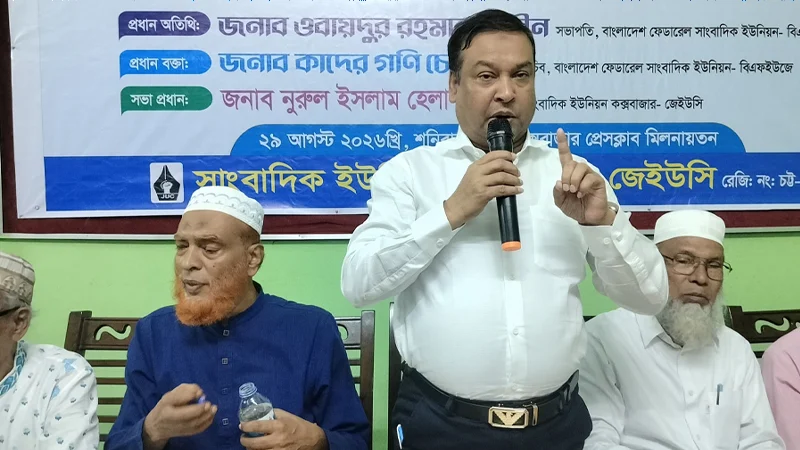
Independent and free journalism is essential for the development of the country and democracy, said Bangladesh Federal Union of Journalists (BFUJE) Secretary-General Kader Goni Chowdhury. He said the state must ensure journalists’ safety to establish democracy. Without that safety, he said, press freedom will be curtailed. He also said journalists need to build unity among themselves to protect their own existence.
He made the remarks as chief speaker at the annual general meeting of the Journalists Union, Cox’s Bazar, held Saturday morning at the Cox’s Bazar Press Club.
Speaking at the meeting, chaired by Journalists Union, Cox’s Bazar president Nurul Islam Helali, Kader Goni Chowdhury said journalists are now able to work more freely than at almost any time in the past. But he said the challenges have not ended. Political influence, institutional pressure and professional insecurity, among other factors, continue to challenge the environment for journalism. He said unwarranted interference in journalists’ work undermines press freedom, just as unprofessional journalism and a lack of professional skill remain major problems.
He said ensuring responsible journalism requires more than just security — it also requires fair pay, a proper working environment and professional dignity for journalists. He said most media outlets do not pay salaries in line with the wage board. At many outlets, he said, journalists are paid less than the owner’s driver. He said this must stop, and that the government has been urged to enforce a “no wage board, no media” policy. Doing so, he said, could help eliminate much of the disorder within the media.
The BFUJE secretary-general said journalism is not merely a job. Journalists play an important role in protecting democracy, human rights, the rights of all religions, ethnicities and communities, and in eliminating discrimination. He said that when the media falls silent, various forms of crime spread through society. Without strong, independent journalism, he said, democracy and civic rights cannot be secured.
Addressing the government, he said only independent journalism tells the government the truth. Others, he said, will often obscure the truth and simply praise the government. Bureaucrats, party loyalists or intelligence officials may, for various reasons, not always tell the truth. Independent journalism, he said, is the one institution capable of telling the government the truth. He added that the government also has the opportunity to verify information published in the media.
Kader Goni Chowdhury said journalists are considered the conscience of the nation, and that the pen is the most powerful weapon of that conscience. He said that when a journalist exposes corruption, irregularities, terrorism, mismanagement or injustice against people, they are working in the broader interest of society. An attack on a journalist, he said, means narrowing the path to revealing the truth.
Also speaking at the meeting were Bangladesh Federal Union of Journalists president Obaidur Rahman Shaheen, Cox’s Bazar Press Club president Mahbubur Rahman, press club founding member S M Aminul Haque Chowdhury, general secretary Mumtaz Uddin Bahari, vice president Kamal Hossain Azad, joint secretary Ikram Chowdhury Tipu, and Journalists Union, Cox’s Bazar general secretary S M Zafar.