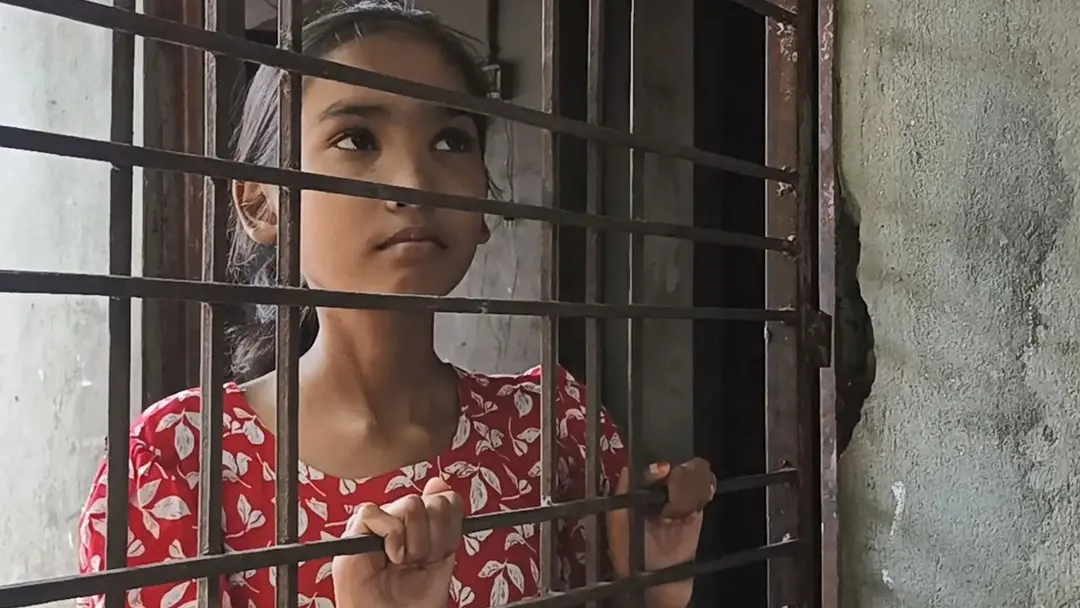
This costly, complex treatment requires a liver transplant costing between 5 million and 7 million taka. For her father, a vegetable trader who already struggles to cover current medical costs, finding such a huge sum seems impossible. As a result, whether Eshamoni survives now hangs on the question of money. If government or private institutions, or well-off individuals, come forward, this child could return to a normal life.
Vegetable trader Ibrahim Ahmed lives with his wife and two daughters beside the southern wall of Shishu Niketan School in Registripara, Kurigram town. His elder daughter, Eshamoni, 11, is a fourth-grade student at PTI School. His younger daughter, Ifti Akter, is five years old. His dream for his two daughters was to educate them and help them stand on their own feet. But since an incident four months ago, Ibrahim and his wife, Marufa, now see only darkness ahead.
Eshamoni’s mother, Marufa Yasmin, said: “Four months ago, teachers from PTI School sent a peon to our house to say Eshamoni had suddenly fainted in class. We rushed to the school and first took our unconscious daughter to Kurigram Sadar Hospital. When doctors there didn’t admit her, we arranged an ambulance and took her to Rangpur Medical College Hospital instead. By then, my daughter’s legs, face, head and stomach had swollen up with fluid. She couldn’t speak. We had to stay at the hospital for 16 straight days. After various tests there, doctors confirmed my child had developed liver cirrhosis.”
She said: “We knew nothing about this disease. As we slowly learned about it, my heart was breaking. She’s my first child. The first time I heard myself called ‘Mother.’ And now this bright, beautiful girl has a fatal illness. Both my husband and I were in agony, thinking about how we would afford her treatment. Her father had to give up a shop he’d taken for his vegetable business to raise money, and we used that money for her treatment. That alone cost around 200,000 taka. A single injection for her costs around 10,000 taka. Where will we find that much money?”
Eshamoni’s father, Ibrahim, said: “Whenever she falls ill, she needs an expensive albumin protein injection. That injection is apparently what’s keeping her alive. Now we’re struggling just to cover her food and medical costs. Doctors have told us there’s no good treatment for this in our country outside India or Singapore. If we go for treatment in Hyderabad, India, they would remove her liver and transplant part of her mother’s or my own liver, which could improve her condition somewhat. There’s no other treatment. I’m a poor vegetable shopkeeper. I have no land. We live in a rented house. Now I don’t know how we’ll even feed ourselves, let alone treat our daughter.”
Eshamoni’s grandmother, Beba Begum, said: “My granddaughter has been sick since she was little. Four months ago we learned she had a serious illness. Every so often, fluid builds up in her stomach, legs, face and head. She has constant headaches. She has trouble breathing. She has loose stools. She can’t sleep through the night. It breaks my heart to look at my beautiful granddaughter.”
Neighbour Anjum Ara said: “The girl has been sick since childhood. She’s very good at her studies. Because of her illness, she’s had to stop going to school. Her parents can’t afford treatment because of poverty. If she got help with her treatment, she could recover and go back to school.”
Eshamoni’s grandfather, Mosaber, said: “My son can’t afford his granddaughter’s treatment costs. If we get government or private support, the girl could return to a normal life.”
Eshamoni herself said: “I can’t eat properly, and eating makes me feel bad. My hands and feet hurt, and I feel like vomiting. My body feels heavy, and I can’t get up once I sit down. I get tired very easily. I get out of breath.”
On the matter, Kurigram’s former civil surgeon, Dr S M Aminul Islam, said this is an extremely costly and complex disease. She needs to be taken urgently to a specialised hospital in Hyderabad, India, for the fastest possible advanced treatment. Only a liver transplant, he said, may be able to treat her and bring her back to health. Altogether, around 7 million taka is needed for this.