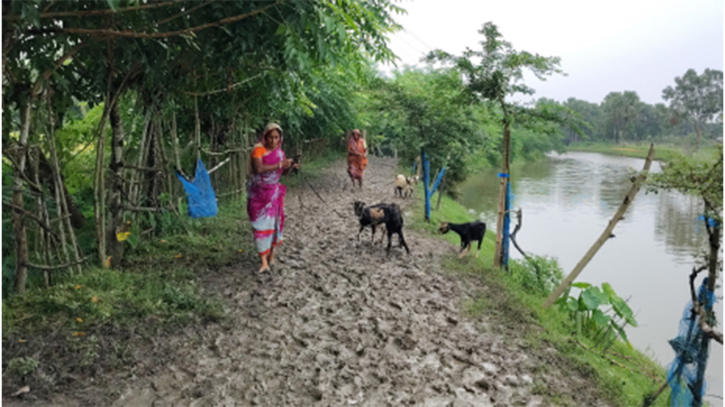
Khutikata village in Shyamnagar upazila, coastal Satkhira. Once a place where growing vegetables in winter or summer felt like an impossible challenge because of soil salinity, the scene here has now completely changed. With green fields stretching to the horizon and farmers busy at work, Khutikata has become a self-reliant community.
Nearly 400 farmers in this coastal area now regularly grow various vegetables, turning around their fortunes. Local farmers Nilkanta and Subrata said many had been on the verge of giving up farming altogether because of repeated losses caused by excessive soil salinity. But with technical support, training and access to improved high-yield seeds through the Syngenta company’s “Go-Gro” project, they began to see a new ray of hope.
To address the shortage of freshwater for irrigation — the main obstacle to vegetable farming — the project dug 15 ponds at various points across the village. By capturing and using monsoon rainwater, farmers can now grow a variety of vegetables year-round. Beyond agricultural development, several hundred saplings of salt-tolerant trees have also been planted along two kilometers of village road on both sides, to protect the environment and create a green buffer.
However, poor road infrastructure remains the sole obstacle standing in the way of farmers’ new gains.
Farmers say that with about three kilometers of unpaved road in the village, travel becomes extremely difficult during the monsoon season.
As a result, harvested crops cannot be taken to the main market on time, and perishable vegetables spoil, leading to major losses. They are demanding that the road be paved quickly.
Agricultural officials say this turnaround by Khutikata’s farmers, achieved by overcoming a hostile environment, is a positive model for agricultural potential in coastal areas. With improved infrastructure and adequate government support, this village could become an inspiration for the entire country.