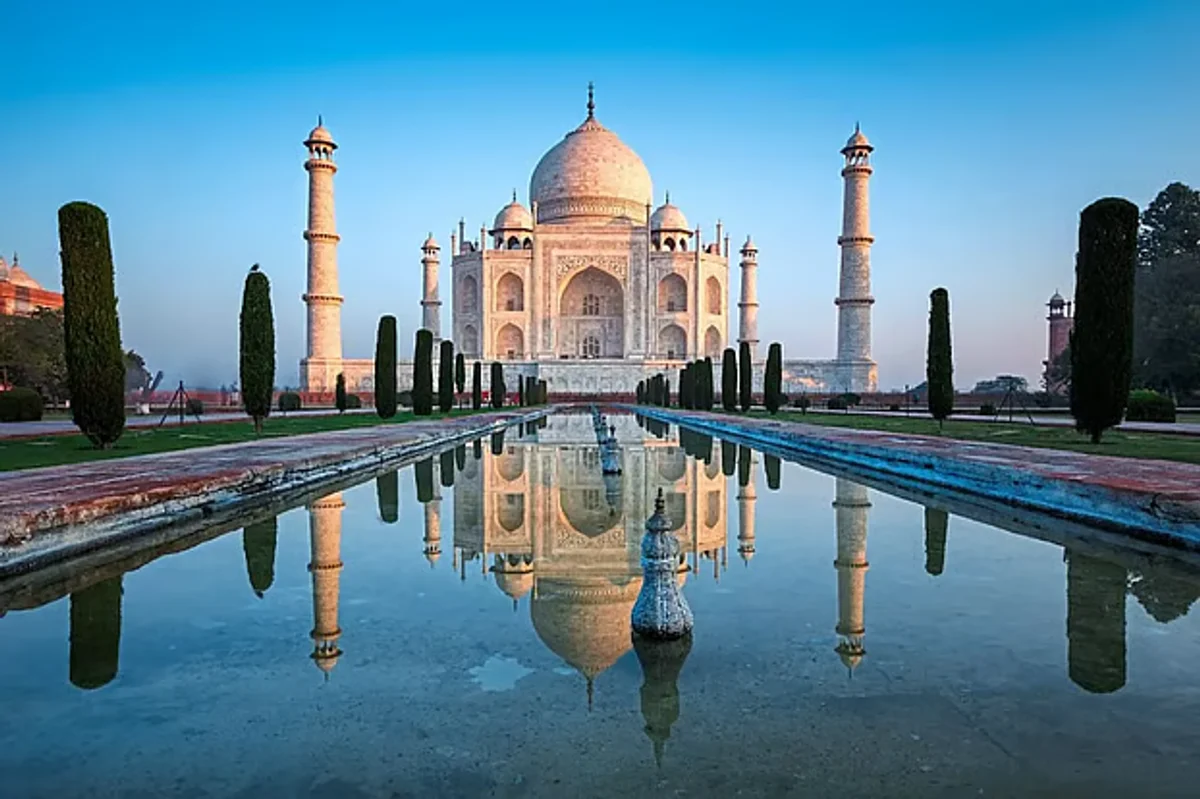
The Taj Mahal, India’s most compelling destination for observers and historians worldwide, may be entering its final chapter. The Allahabad High Court in Uttar Pradesh on Monday issued a notice to the central government and the Archaeological Survey of India (ASI), seeking their views on an order by an Agra court.
The Agra court in Uttar Pradesh had previously declined to permit the appointment of an advocate-commissioner to photograph and videograph the monument for a survey. That is, an application filed by a lawyer in 2015 seeking a survey of the Taj Mahal had earlier been dismissed by the Agra court.
Hearing that case recently, the Allahabad High Court on Monday asked why a survey could not be conducted to search for evidence of a temple beneath the Taj Mahal.
After hearing arguments from advocate Harishankar Jain, representing the petitioner, a bench of Allahabad High Court Justice Rohit Ranjan Agarwal asked why the monument could not be surveyed. Petitioner’s counsel Jain claims the world-famous monument is in fact an ancient Hindu temple named “Tejo Mahalaya,” dedicated to Lord Mahadev.
The Hindu deity Mahadev has been made a principal party to the case, as is common practice. The petition was filed with Mahadev as the principal party, represented by his “dearest friend” advocate Harishankar Jain and several other devotees.
Several years ago, following the Indian Supreme Court’s verdict on the contentious Ram Temple-Babri Masjid dispute, Hindutva advocate Harishankar Jain’s son, advocate Vishnu Shankar Jain, told Prothom Alo in an interview that they had prepared a long list of monuments believed to have Hindu holy sites beneath them.
Vishnu Shankar said these sites would be selectively identified and litigated one by one. The father-son duo is now pursuing that very effort. Vishnu Shankar Jain told this correspondent that they are affiliated with the Hindutva organization Hindu Mahasabha.
In the Allahabad High Court case, the plaintiffs (petitioners) have sought a declaratory decree and injunction, whose central claim is that the monument is a Hindu temple, and that members of the Hindu community should therefore be permitted to worship inside the Taj Mahal premises.
In light of that claim, the Allahabad High Court has asked the government and the ASI why a survey should not be conducted to resolve the matter.
The Allahabad High Court played a central role in resolving the contentious Ram Janmabhoomi-Babri Masjid land ownership dispute. On September 30, 2010, the High Court’s Lucknow bench ruled by a 2:1 majority that the disputed 2.77 acres of land in Ayodhya could be divided equally into three parts among the Hindu deity Ram Lalla, the custodian Nirmohi Akhara, and the Sunni Waqf Board.
Regarding the Taj Mahal, the petitioners claim that Hindus have a fundamental right under Article 25 of the Indian constitution to “view” and “worship” inside the monument. Following this, an application was filed in 2019 seeking appointment of an advocate commissioner to survey the Taj Mahal.
However, the additional civil judge (senior division) in Agra dismissed that application at the time. The court reasoned that the plaintiffs had failed to submit any revenue records (such as a khatian or draft) to confirm a specific plot number at the Taj Mahal, and that the described boundaries and area of the property (77 bigha) did not match the defendants’ records.
A revision petition against that order was deemed non-maintainable by the Agra additional district judge in April 2026. Challenging both orders, the plaintiffs approached the High Court.
In their petition, the plaintiffs cited specific historical and architectural claims made in the original case, stating that the so-called ancient Tejo Mahalaya temple (the Taj Mahal), where the deity Agreshwar Mahadev resides, was built by King Paramardi Dev in 1155-56 AD.
Notably, UNESCO has declared the Taj Mahal a “heritage site,” and this is stated on the Indian government’s tourism website.
That same website states that it was built by Mughal emperor Shah Jahan in memory of his wife, Mumtaz Mahal, and includes images (hand-drawn or computer-generated) of Mumtaz Mahal and Shah Jahan.
Historians say construction of the Taj Mahal began in 1631 AD and was completed around 1653. A calculation about a decade ago put the monument’s market value at more than $50 billion. It is India’s leading tourist destination.
The Hindutva-affiliated petitioning lawyers, however, reject this account. They claim that over time, the monument came under the control and ownership of Raja Man Singh, and that later, in the 17th century, Raja Jai Singh of Jaipur was enthroned at this site — that is, the Taj Mahal.
They claim Mughal ruler Shah Jahan then forcibly seized the so-called “Tejo Mahalaya” palace from Raja Jai Singh and converted it into a memorial for his deceased queen, altering parts of the disputed monument to add Islamic features in the process.
Representatives of the Hindutva organization further claim there are at least 109 archaeological features and pieces of historical evidence proving the property is a Hindu temple.
The petition alleges that the ASI “illegally” allowed Muslims to offer “namaz” prayers at Tejo Mahalaya, or the Taj Mahal, last Friday, obstructing visitor entry and keeping several floors of the building locked. The plaintiffs claim that using the property for any purpose other than Hindu “worship” and devotion to the deity is unlawful.
The petition insists there is no dispute over the identity of the disputed property, since it is a well-known ancient monument. It further argues that the monument’s physical characteristics, structural features and locked sections “cannot be effectively proven through oral testimony alone.”
The petition claims the plaintiffs do not have unrestricted access to the ASI-controlled monument, making it essential to appoint a court-designated photographer and videographer for an effective, impartial determination.
Against this backdrop, the petitioners have asked the High Court to set aside the Agra court’s order and direct the trial court (lower court) to dispose of the application for appointment of an advocate-commissioner on its merits.
In a separate application seeking an interim stay, they have also requested that the High Court direct the ASI director to allow photographs of the building’s interior and exterior to be taken in the petitioners’ presence and submitted to the ongoing judicial proceedings.
Lawyers familiar with the matter believe the dispute over the Taj Mahal, which took formal shape on July 6, marks the beginning of a new controversy — similar to the one that began three decades ago over the Babri Masjid, which courts in India recognized as the Ram Temple site in 2019. What is written in the Taj Mahal’s fate may become clear within the next few years.
বাংলায় মূল প্রতিবেদন পড়ুন · Read the original Bengali report