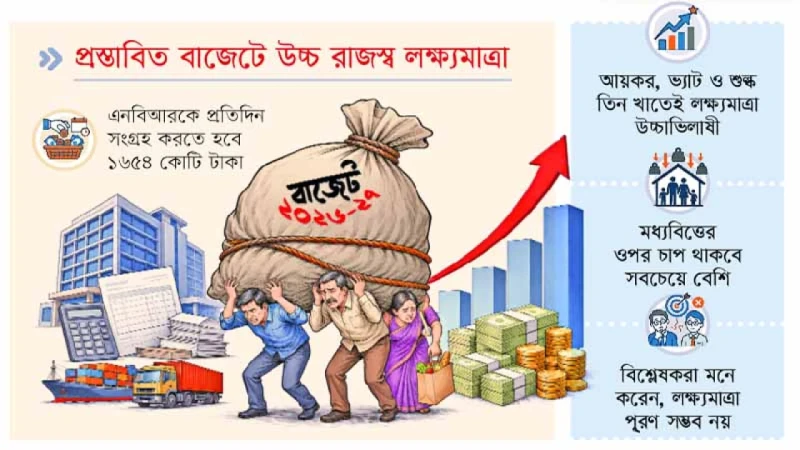
For the coming 2026-27 fiscal year, the National Board of Revenue (NBR) has been set a huge revenue-collection target. Under the target, the NBR must collect Tk 6.04 lakh crore in the next fiscal year. The target is Tk 1.05 lakh crore higher than in the current fiscal year and Tk 1.01 lakh crore higher than the revised budget. Experts said that although the budget’s policy framework is strong, the financial basis for its implementation is weak. The budget has been made larger than the resources available. The revenue-collection target that has been set is far too high. As a result, there will be a large shortfall in revenue collection at the end of the fiscal year. On the other hand, the existing high inflation has already left middle- and low-income people struggling. So providing extra taxes will have a negative impact on their livelihoods. And with no roadmap to bring inflation down, it will be difficult for the NBR to meet its target as well. All in all, both ordinary people and the revenue board will have to remain under severe pressure throughout the fiscal year.
Finance Minister Amir Khasru Mahmud Chowdhury said that revenue collection would increase through reform of the National Board of Revenue. The NBR’s policy wing and implementation wing would work separately, he said. Corruption would be reduced, and digitalization would be carried out for this purpose.
Experts say revenue strategy will be the biggest test of this budget. With a tax-to-GDP ratio below 7 percent of GDP, Bangladesh cannot finance a modern welfare state, quality education, health care, infrastructure, climate resilience and industrial transformation — and the budget has acknowledged this. It has also proposed digitalization, risk-based audits, expansion of the tax base, a review of tax exemptions, and the separation of tax policy from tax administration. These are reasonable reforms. Success will depend on monitorable reform indicators, transparent tax-expenditure accounts, time limits on incentives, and strong links between tax breaks and employment, exports, technology transfer, productivity and regional development.
The private research organization Centre for Policy Dialogue (CPD) has already questioned the revenue-collection target. According to CPD, actual revenue collection in the current fiscal year may be limited to about Tk 4.50 lakh crore. To meet a target of collecting Tk 6.95 lakh crore in the next fiscal year from that base, growth of about 54.4 percent would have to be achieved. According to CPD, such large growth is not achievable in practice without improving the efficiency of tax administration, curbing tax evasion, expanding the tax net and carrying out structural reform of the National Board of Revenue.
Experts believe that if only high targets are set without removing the long-standing weaknesses in revenue management, a revenue shortfall will again be created at the end of the year, and the government will have to rely on additional borrowing.
The reality is that pressure is rising on the economy from both domestic and international fronts, and there is no sign that the situation will change soon. In such circumstances, economists believe the huge target for the coming fiscal year is not achievable. They also advised the NBR to set a realistic revenue-collection target. They further advised that the NBR’s capacity be increased.
Economists say inflation cannot be reined in. The overall inflation rate in the country stood at 9.42 percent in May. This is reducing people’s purchasing power. People on limited incomes are struggling to run their households. In such a situation, the 2026-27 fiscal year budget has given no guidance on bringing inflation under control. There is no roadmap to control this inflation challenge. As a result, it will be difficult for the NBR to meet its target. All in all, revenue collection will be under pressure for the entire fiscal year. In the next fiscal year, the NBR must collect Tk 6.04 lakh crore in revenue. Given the global economic situation, this target is almost impossible.
Hossain Zillur Rahman, executive chairman of the Power and Participation Research Centre (PPRC), said the chance of actual revenue collection reaching anywhere near this target is very small.
Dr. Fahmida Khatun, executive director of the private research institution Centre for Policy Dialogue (CPD), said that if a target is not realistic, then it cannot be implemented either. And whenever this target cannot be implemented, the discipline of the budget is disrupted. Then many problems arise over where the budget’s income will come from and where it will be spent. Our revenue-collection system has historically had failings and weaknesses, she said. Every year a high revenue-collection target is set according to needs, but we cannot achieve it.
Dr. A.H.M. Hamidur Rahman Azad, assistant secretary general of Bangladesh Jamaat-e-Islami, said the revenue-collection target is not realistic. As in the past, an over-ambitious revenue-collection target has been set this time too; but a practical roadmap to achieve that target is absent. As a result, this over-ambitious target will not be achieved by any means, and it will become a major obstacle to implementing the budget.
It has been learned that in the 2026-27 fiscal year the NBR must collect Tk 6.04 lakh crore in revenue. As a result, the NBR must collect Tk 1,654 crore every day. Of this, the income-tax collection target has been set at Tk 2.19 lakh crore (Tk 2,19,835 crore), which is Tk 37,834 crore higher than in the 2025-26 fiscal year. The value-added tax collection target has been set at Tk 2.28 lakh crore (Tk 2,28,915 crore), which is Tk 40,397 crore higher than in the 2025-26 fiscal year. Analysts believe this will increase the tax burden on all people.
In addition, the supplementary duty collection target has been set at Tk 82,283 crore, which is Tk 14,039 crore higher than in the current 2025-26 fiscal year. The import-duty target has been set at Tk 61,939 crore, which is Tk 10,501 crore higher than in the 2025-26 fiscal year. The export-duty target has been set at Tk 99 crore, which is Tk 21 crore higher than in the 2025-26 fiscal year. The excise-duty target has been set at Tk 7,285 crore, which is Tk 1,119 crore higher than in the 2025-26 fiscal year. The target for collecting other taxes has been set at Tk 3,644 crore, which is Tk 1,014 crore higher than in the 2025-26 fiscal year.
Over-ambitious targets have been set in all three areas of revenue collection. The pressure on the middle class will be greater. But this pressure is no less for the NBR. According to experts, as in previous years, the NBR will be under pressure to collect a vast amount of revenue without reform. The kinds of structural change, policy reform and other capacities required to collect such a large amount of revenue are, they believe, far too inconsistent.
The American Chamber of Commerce in Bangladesh (AmCham), an organization of U.S. business people operating in Bangladesh, believes that on the question of revenue collection, extensive reform of tax administration is needed to achieve the over-ambitious target of Tk 6.95 lakh crore. Such initiatives will play an important role in expanding the tax base and reducing dependence on borrowing, AmCham said. It also called for reconsideration of separating tax-policy formulation from tax-administration operations.
বাংলায় মূল প্রতিবেদন পড়ুন · Read the original Bengali report