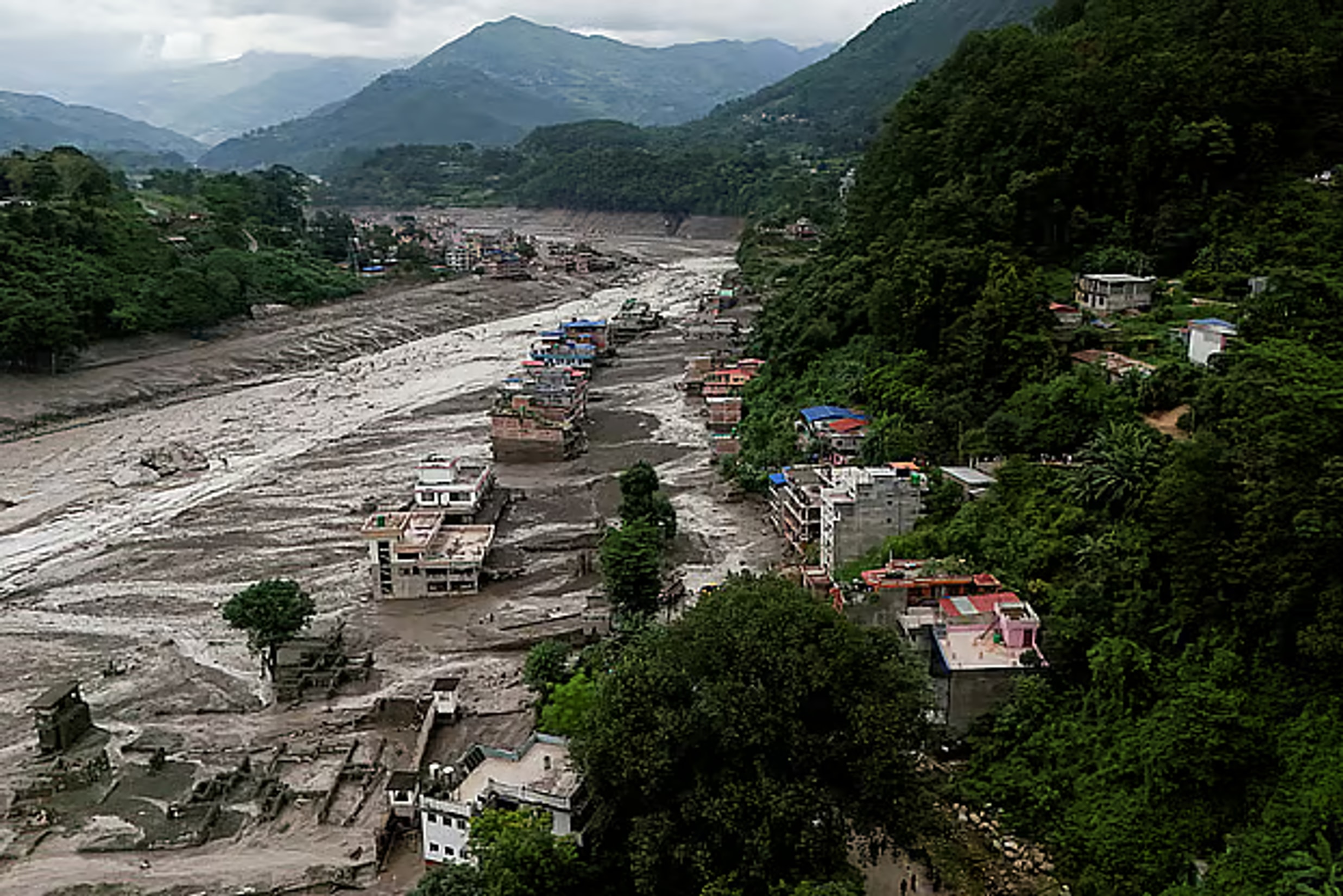
A glacier likely weakened by the climate crisis collapsed last month, triggering catastrophic flooding in Nepal and Tibet that killed hundreds of people, according to the first scientific study of the disaster. Researchers identified abnormally warm weather in the region before the glacier collapse. After it gave way, roughly 110 million cubic metres of snow and ice cascaded into the valley below, causing a near-unprecedented flash flood that struck downstream communities without warning.
Friederike Otto, a professor of climate science at Imperial College London, said: “Emissions from fossil fuels, produced thousands of miles away, created this crisis, and people in Nepal are paying for it with their lives.” The study was carried out by Imperial College London. Otto added: “When warming destabilises the roof of the world, no amount of local adaptation can fully protect vulnerable downstream people from destruction on this scale. Unless faster action is taken to bring fossil-fuel emissions down to zero, we will inevitably see more disasters like this in the years ahead.”
On August 26, a massive section of hanging glacier and rock, covering roughly 200,000 square metres, collapsed from Langtang Lirung mountain. The disaster killed more than 1,300 people, and more than 5,000 remain missing. The mass of glacier and rock fell roughly 1,400 metres, striking the valley floor with such force that the tremor was registered as an earthquake. This melted the ice and produced an icy flash flood that raced down the river at speeds exceeding 177 kilometres per hour.
In Tibet’s Gyirong region, a devastating surge of water, ice, rock and sediment swept away families, homes, settlements, roads, bridges and other infrastructure. Many survivors were left trapped and cut off from other areas. The study said: “Rockslides of this scale are rare. By rough estimate, an event of this magnitude might occur once every one thousand to ten thousand years. This event shows that the limits of adaptation are already being reached.”
This study differs from previous research Otto and her team have carried out under World Weather Attribution (WWA), a joint initiative between Imperial College and climate experts around the world. Earlier WWA studies typically established a link between climate disruption and a specific weather event, but that could not be done in this case. Instead, researchers found that several factors worked together to cause the disaster, with their effects amplified by decades of atmospheric warming from greenhouse-gas pollution.
Ben Clark, who researches extreme weather and climate change at Imperial College, said the long-term changes that occurred around the glacier before the catastrophic collapse show a clear “fingerprint of climate change.”
The study found several key facts. In the region where the collapse occurred, temperatures have risen by roughly 2 degrees Celsius due to the climate crisis compared with pre-industrial times. In July and August alone, temperatures rose by about 1.5 degrees Celsius, and locally, July and August 2026 were the warmest two months on record. In the days before the glacier collapse, temperatures were 5 degrees Celsius above the 30-year average. Since the 1980s, the freezing-line altitude in the Himalayas has risen by roughly 100 metres per decade, meaning ice-melting temperatures now reach higher elevations and persist for longer, weakening mountain slopes built on permanently frozen ground, or permafrost. Due to rising temperatures, the glacier had already retreated significantly; ice that had helped keep the area around the collapse site stable had shifted, while meltwater had also accumulated there.
A 2015 earthquake of magnitude 7.8 in Rasuwa, Nepal, played a role in weakening the mountain slope, though researchers could not confirm its precise role in the August disaster. Otto, Clark and the WWA research team did not directly say the climate crisis was the primary cause of the disaster. Rather, they say it is more accurate to view climate change as one factor that destabilised an already-existing geological structure. “We have seen climate change altering high-mountain environments,” Clark said. “Its influence is felt across many of the possible causes behind this collapse.”
Nepal has formally applied to the United Nations’ Loss and Damage Fund for financial assistance to address the destruction caused by the floods; securing help from the fund requires demonstrating a link between the disaster and the climate crisis. Nepal’s foreign minister, Shishir Khanal, has called on high-emission countries such as China and India to “wake up” and acknowledge their shared responsibility for the disaster.
Madhav Upreti, a senior technical adviser at the Red Cross Red Crescent Climate Centre, part of WWA, said a path to addressing the losses faced by vulnerable and frontline communities can only be built through sharply reducing emissions worldwide. He added: “Alongside an almost unimaginable humanitarian disaster, recovering from this will also require enormous sums of money. That a country which played virtually no role in creating this problem now finds itself in this situation makes one thing clearer than ever: fairness must be ensured in helping climate-vulnerable countries cope with a crisis they did not create.”