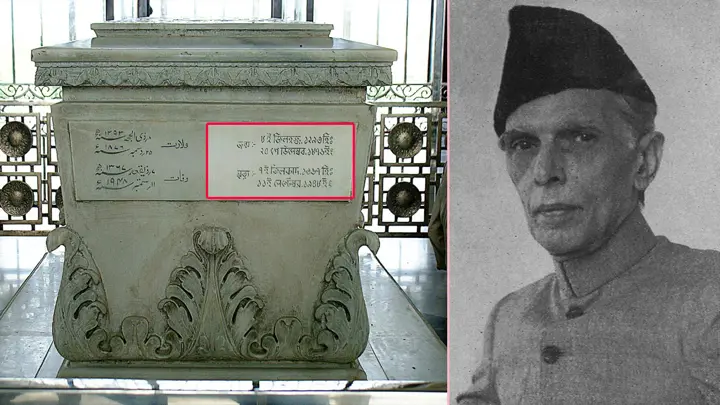
A nationwide debate is currently under way over the display of a photograph of Pakistan’s founder, Muhammad Ali Jinnah, at the archive of the Dhaka University Central Students’ Union (DUCSU), and its subsequent damage by a former DU student. DUCSU authorities have said the photograph was displayed to illustrate Jinnah’s historical stance against the Bengali language. Remarkably, however, the mausoleum of that same Muhammad Ali Jinnah — who wanted Urdu made the state language — along with the tombs of several other top Pakistani leaders, bear birth and death dates carved in Bengali.
The mausoleum of Muhammad Ali Jinnah, the father of Pakistan and its first governor-general, known as the Mazar-e-Quaid, is located in Karachi and is one of the country’s leading tourist attractions. Built of Italian white marble, the mausoleum has his birth and death dates carved not only in Urdu but also in Bengali script — a fact that would surprise and make proud any history-conscious Bengali speaker.
It is not only Muhammad Ali Jinnah; the graves of several other Pakistani leaders also bear inscriptions in the Bengali alphabet. These include Jinnah’s younger sister, Fatima Jinnah; Pakistan’s first prime minister, Liaquat Ali Khan; Pakistani prime minister Nurul Amin; and the country’s former communications minister, Sardar Abdur Rab Nishtar. Each of their graves has the name, birth date and death date carved in Bengali script.
The mausoleum complex, built on roughly 61 acres of land in the centre of Karachi, is one of the country’s leading national symbols. Open to everyone, thousands of people visit the site every day. Under protocol, a guard of honour is maintained at the site around the clock, with the country’s army, navy and air force taking turns on the duty every four months.