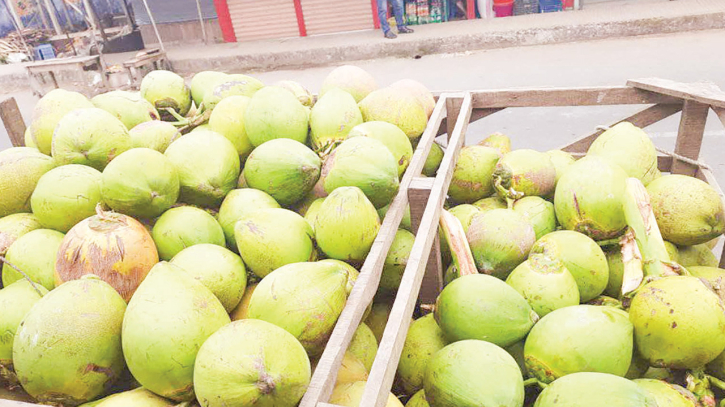
Damage from Cyclone Sidr, rising salinity from climate change, and infestations of whitefly and rats have, taken together, driven an alarming decline in Bagerhat’s coconut production over two decades. Once the mainstay of the district’s economy, more than a hundred coconut oil mills have shut down for lack of raw material. But amid this collapse of tradition, tender coconuts, or “dab,” have lit a spark of hope. Even as the market for mature coconuts has shrunk, soaring nationwide demand for tender coconuts is now giving farmers and traders in this coastal district the strength to turn things around.
At more than 150 collection points across Bagerhat, including Depara, Munigonj, Baitapur, Signboard and Doibagyahati, hundreds of maunds of tender coconuts are bought and sold every day. From these depots, tender coconuts are trucked to Dhaka, Chattogram, Rajshahi, Bogura, Rangpur and other major cities across the country.
Liton, a trader at “Borkot Dab Ghar” in Depara Bazar, said that while they typically ship around 1,500 tender coconuts three to four days a week, they send as many as 3,000 a day to various northern districts during the summer season. Small traders in Signboard and Depara buy tender coconuts from orchards and pond embankments at 40 to 85 taka each and sell them on to depots for 75 to 120 taka, which eventually retail in city markets for 80 to 200 taka.
While no specific government database exists, traders and locals estimate around 150 depot owners, more than a hundred retailers, and over 2,000 middlemen are directly involved in the tender coconut trade in the district. According to the Department of Agricultural Extension, coconuts were cultivated on 3,691 hectares in Bagerhat in the 2025-26 fiscal year, with production of around 33,712 metric tonnes. The district agriculture department estimates the coconut and tender-coconut sector generates around 3 billion taka in annual income.
Sharif Sardar, an official at the BSCIC industrial estate, and local traders lament that where annual production once exceeded a hundred thousand metric tonnes, many oil mills have now shut down due to raw material shortages, forcing operators to turn to other businesses.
Monir Sheikh, a farmer in Kachua upazila, said: “Trees don’t bear coconuts like they used to. Production has fallen because of disease, but the good price for tender coconuts in the market is making up for some of the shortfall.”
Agricultural marketing officer Abdus Salam Tarafdar said: “When dengue outbreaks and heat rise, demand for tender coconuts skyrockets across the country, which has kept Bagerhat’s rural economy running.”
Agricultural experts believe, however, that relying on tender coconut sales alone cannot sustain this sector in the long run. Motahar Hossain, deputy director of Bagerhat’s Department of Agricultural Extension, said farmers need modern technological support to control whitefly, mites and rats. Alongside this, he said, establishing a “coconut and betel nut research centre” in this historically significant region could help restore this coastal resource to its former state.