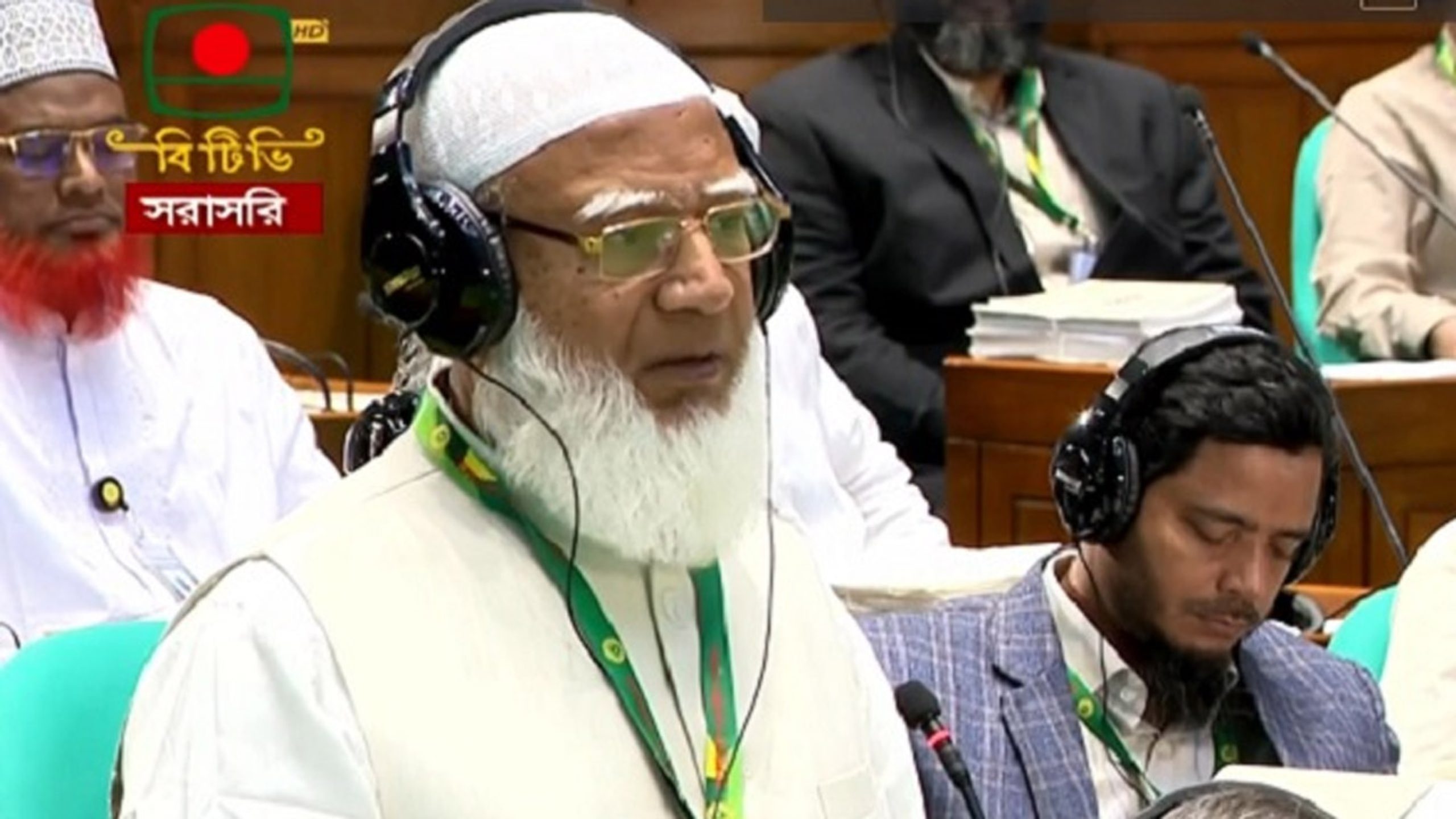
Accusing the government of moving to form a new force nearly identical to the disbanded Rapid Action Battalion (RAB) — keeping its personnel, installations, logistics, powers and infrastructure unchanged — Opposition Leader Dr. Shafiqur Rahman has demanded withdrawal of the “Special Response Battalion (SRB) Bill-2026.” He said, “The nation wanted RAB disbanded, not the same force brought back under a new name alone. Without reviewing the need for and structure of such a force based on the opinions of the public and all relevant stakeholders, a law like this should not be passed.”
The opposition leader made these remarks Thursday (Sept. 10) afternoon while speaking on the “Special Response Battalion (SRB) Bill-2026” during the final day’s sitting of the third session of the 13th National Parliament. Deputy Speaker Barrister Kaiser Kamal presided over the session.
Earlier, Home Minister Salahuddin Ahmed had introduced the bill to form the SRB as a specialized unit under the police. The proposed law includes provisions to transfer RAB’s personnel, assets, documents and other matters to the new unit.
Dr. Shafiqur Rahman said, “This bill is not like the other ordinary bills of national life; this is an entirely different and extremely important matter. The nation’s overall experience with this force since RAB’s formation has not been a happy one. While there were some positive aspects, its negative activities were so extensive that they became a cause of concern not just domestically but internationally as well.”
He said many of those victimized by RAB are present in Parliament today. He himself had been tortured by the force, he said, but he survived; many others lost their lives, and many more were subjected to enforced disappearance and remain missing to this day. The opposition leader also mentioned MP Mir Ahmed Bin Kasem, who was forcibly disappeared by RAB and later returned.
Citing the case of the husband of reserved women’s-seat MP Marzia Begum, who was tortured and thrown from a rooftop, he said the nation’s memory holds countless such incidents. These were the reasons behind the demand for RAB’s disbandment. Human rights organizations at home and abroad also spoke out on the matter, but no one demanded that RAB be replaced with another force of the same kind. The opposition leader said, “Now a proposal has been brought in which nearly the same force, in the same place, is being run under a new name. RAB’s members will remain, its installations will remain, its logistics will remain, its power structure will remain — so where is the change? The nation will not accept simply putting one name in place of another.”
He said, “Just a few days ago, an incident occurred that raises the question of whether the desired change has actually come to the attitude and mindset of the force’s members. In old Dhaka, an attempt was made to pick up a former student of Jagannath University from her home without a search warrant, he claimed. Had university administration officials not arrived there quickly, the woman could have been taken away.”
Dr. Shafiqur Rahman said, “Whether the woman had committed any offense is a separate matter. But such an incident raises a bigger question — will simply transferring those against whom so many allegations have arisen in the past from one force to another bring about the desired reform?”
He said, “I have read the bill thoroughly. I have also reviewed the note of dissent submitted by the opposition in the parliamentary standing committee on the Home Ministry.”
Recounting the political context at the time of RAB’s formation, he said, “Later, not just one political group but various sections of the entire nation were victimized at the hands of this force.”
The opposition leader said, “After the move to form the SRB came to light, objections and concerns have also arisen from civil society. So there is no need to rush the bill through the current session. Rather, the matter should be reviewed more deeply through discussion with all relevant stakeholders.” In his words, the rationale for why such a specialized force is needed must be made clearer to the nation. The public must be convinced that such a new specialized force is genuinely needed for the country’s law and order and public safety. If a controversial force is established under a new name without building trust and consensus within the nation, the public will not naturally accept it.
He said, “Although some minor changes and a few new obligations have been added to the bill, no significant change has been made to the fundamental areas. The biggest question concerns the system of accountability and complaint investigation.”
He also remarked that an arrangement along the lines of “I commit the offense, and I investigate myself” cannot be acceptable.
The opposition leader said, “We agree on the disbandment of RAB. But before establishing the same kind of force under a new name, more thought, discussion and national consensus are needed. The concerns and objections of the international community and human rights organizations that strengthened the demand for RAB’s disbandment will not be resolved merely by changing the name.”
He said, “In the greater national interest, this bill should not be passed right now. Out of respect for the people’s sentiment and genuine concerns, the government should withdraw the bill. Later, if a truly accountable, transparent specialized force that has the public’s trust is genuinely needed, a new law can be brought based on the necessary reforms, broad discussion and everyone’s opinions.” The opposition leader said, “This is an opportunity for the government to set an example. Withdrawing the bill out of respect for the people’s sentiment and genuine expression would be a democratic and responsible decision.”