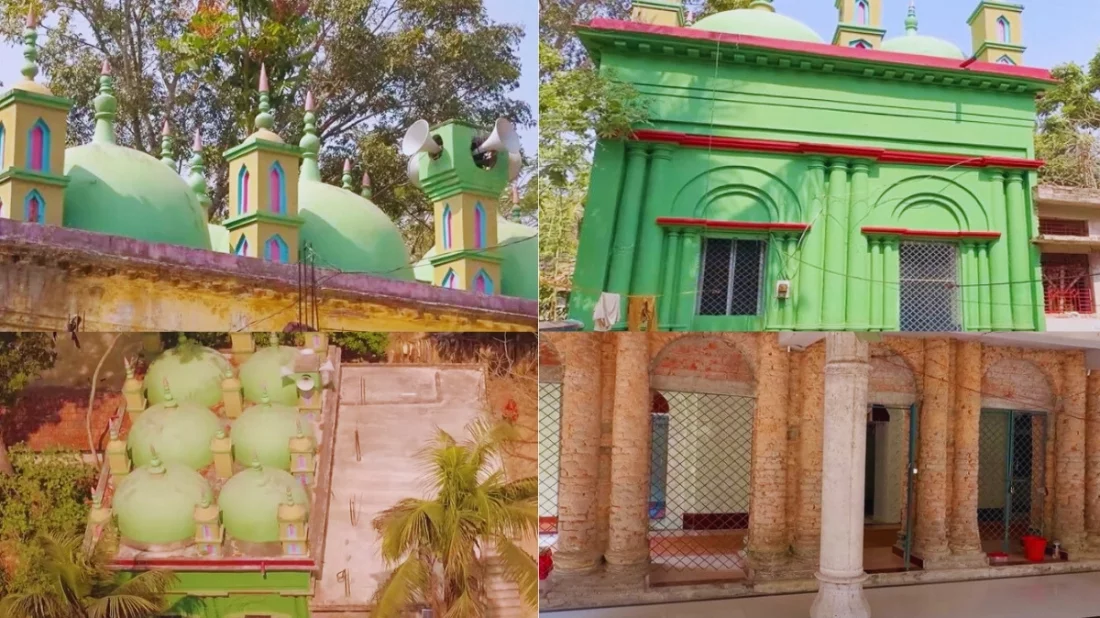
One of the oldest and most historically significant landmarks in the region, the Cheraghat six-domed mosque in Kolaroa upazila, Satkhira, stands as a silent witness to the passage of time.
Located approximately four kilometers from the upazila headquarters, the mosque sits beside a canal in the Damdam area, surrounded by dense shade. Built approximately 164 years ago, it is locally known as “Kayem Biswas’s mosque.”
According to the mosque’s nameplate, it was established in the Bengali year 1269, corresponding to 1862. Built with thin bricks and lime-surki mortar on 12 shotok of land, the mosque features seven doors, a roof supported by 10 pillars, six domes, and 10 minarets. Standing approximately 15 feet tall, it can accommodate more than 100 worshippers at a time.
Local accounts say the mosque was built by Kayem Biswas, a powerful local landlord. According to oral history, Biswas had a dispute with Durgapad Chowdhury, a zamindar from Murshidabad in present-day India, who threatened his life. When Biswas sought forgiveness, the zamindar set a condition: he must build a mosque. Biswas brought construction workers and materials from Kolkata to build the mosque in his home village of Cheraghat. The story is also recorded in “History of Kolaroa Upazila” by Prof. Md. Abu Nasr.
The mosque has recently been extended, with new stairs connecting the original structure to the expanded section. Worshippers said the mosque is not just a place of worship but a part of the community’s heritage and identity, and called for government support to preserve it as a durable historical site and potential attraction for visitors.
বাংলায় মূল প্রতিবেদন পড়ুন · Read the original Bengali report