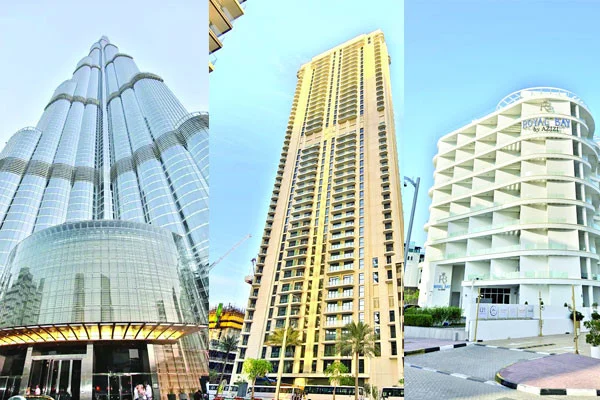
A mountain of wealth belonging to fugitive leaders of the banned Awami League has been traced in the desert city of Dubai. Information has been found of at least 53 flats, houses, villas, hotel apartments and office spaces in their names. Sources said they had built an empire of luxury assets in Burj Khalifa, Marsa Dubai, Wadi Al Safa and the artificial island of Palm Jumeirah — and had done so through money laundering.
On 3 April 2023, the Anti-Corruption Commission (ACC) formed a committee to investigate allegations of money laundering to Dubai under the golden-visa facility. The committee’s first team leader was the ACC’s deputy director Ramprasad Mondal, who was later transferred to Gopalganj. He said letters were being exchanged through the foreign ministry to collect information on those who laundered money to Dubai, and that efforts continued to obtain information by writing to the US-based Center for Advanced Defense Studies (C4ADS) and the Organized Crime and Corruption Reporting Project (OCCRP).
The OCCRP had leaked information about 459 Bangladeshis buying various properties in Dubai, UAE. The High Court then ordered the ACC, the Bangladesh Financial Intelligence Unit (BFIU), the police Criminal Investigation Department (CID) and the National Board of Revenue (NBR) to investigate. Sources said a flat had been found in Dubai in the name of Bilkis Iqbal — the mother-in-law of Nafisa Kamal, daughter of former finance minister AHM Mustafa Kamal (Lotus Kamal). The flat, number 2202-0 in the Marsa Dubai area, was bought using passport number B1201060. Bilkis, however, died in 2017.
Two flats (numbers 2410-0 and 2001-0) in Dubai’s Burj Khalifa have been traced in the name of former Awami League MP and Premier Bank chairman Hifzul Bari Mohammad Iqbal, alias HBM Iqbal. He also has a commercial space (number 910-0) and an office space (number 1201-0) there, and a house in Palm Jumeirah (number PJFRC047). He used three different passports to buy these assets — numbers 0339842, AG5123414 and E0692792. On 18 November 2024, the BFIU froze the bank accounts of HBM Iqbal, his wife — the one-time film actress Anjuman Ara Shilpi — and their three children.
In the name of Awami League leader and former Brahmanbaria-1 MP Syed AK Ekramuzzaman, a flat (number 2309-0) in Marsa Dubai and another (number 703-0) in Al Shahla, Palm Jumeirah, have been found; his son Kamruzzaman also reportedly has ownership. Sources said Ekramuzzaman (Sukhan) was once an adviser to BNP chairperson Begum Khaleda Zia. On 28 November 2023 he was expelled from all BNP posts, after which he joined the Awami League and was elected an MP as an independent candidate in the 12th parliamentary election.
The largest number of assets in Dubai has been found in the name of the fallen Awami League government’s former land minister Saifuzzaman Chowdhury Javed. He is recorded as having two flats in Burj Khalifa and 27 in Nad Al Sheba. He also has houses in Polo Residence (numbers A2, 2B/R 293, 1B/R 293), two flats in Marina Vista Tower (numbers 106 and 302), four flats in Sunrise Bay Tower-1, and a hotel apartment in Royal Bay, Palm Jumeirah (number 805). The two Bangladeshi passports he used to buy them are numbered DC6004076 and BT0015807, giving his Bangladeshi address as 7 Sarson Road, PO Box-4000, Chattogram.
A flat (number 4407-0) in Palm Jumeirah has also been traced in the name of his brother Anisuzzaman Chowdhury. A flat (number 1303-0) in Burj Khalifa has been found in the name of Ifzal Ahmed Chowdhury, organising secretary of the Jalalabad Association and a US Jubo League leader. Asked about this, CID Financial Crime Unit additional DIG Bashir Uddin told this correspondent that they had begun investigating on the High Court’s order after receiving information from an international organisation about Bangladeshis holding vast assets in Dubai. A money-laundering case has been filed against former land minister Saifuzzaman Chowdhury Javed, he said, while the names and addresses of the others were being confirmed.
Inquiries also found a hotel apartment (number 12A04) in Burj Khalifa in the name of Zaker Party chairman Mostafa Amir Mohammad Faisal, along with a Dubai address — 117 Al Hashemi Building Apartment, 201 Firoz Al Murar. The Bangladeshi passport used to buy it is numbered BF0894851. Monowar Hossain, a Dubai expatriate involved in preparing Emirates IDs, said in a social-media conversation that the identities of Bangladeshis who bought assets were kept strictly confidential when their IDs were prepared. Supreme Court lawyer Wahiduzzaman Bulbul said: “If someone earns legally in Dubai and buys assets there with that income, there is no legal problem.” But recovering laundered money, he said, would only be possible if Bangladesh had an agreement with the Dubai government.
The investigation also found flats or houses in Dubai in the names of several others, including Juran Chandra Bhowmik, awarded in the specialist-professional category in 2019; former Chittagong University vice-chancellor Professor Iftekhar Uddin Chowdhury and his daughter Shehtaz Munasi Khan; Rumana Rishat Jaman, wife of Sabber Ahmed Chowdhury, former manager of Titas Gas’s Gazipur sales zone; and Manjula Morshed, daughter of former Bangla Academy director-general, linguist and Dhaka University professor Abul Kalam Manzoor Morshed.
Transparency International Bangladesh (TIB) executive director Dr Iftekharuzzaman said: “Dubai is one of the countries from which it is hard to recover laundered money. The bulk of the money laundered from Bangladesh is done through the forgery of import-export invoices. Besides that, there is huge laundering through multi-layered fraudulent loans and investment fraud via paper companies in real and fictitious names, as well as traditional hundi. Among the destinations that have recently developed as the most attractive for such ongoing international organised crime, Dubai has become one of the main hubs. It must be remembered that, like all such destinations, Bangladesh’s laundered money has now become investment and assets in those countries’ economies — and global experience shows only about one percent of it is recovered, and even that through a complex process averaging seven to 15-20 years, though there are some rare exceptions.”
বাংলায় মূল প্রতিবেদন পড়ুন · Read the original Bengali report