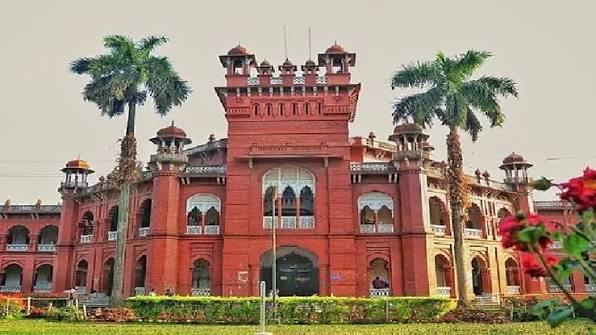
Most public universities have realised, however belatedly, that building a university into a true academic institution is impossible without appointing capable teachers, but Dhaka University still refuses to accept this today. Other public universities have come to understand, belatedly, that faculty recruitment based solely on an oral interview cannot be conducted professionally. Chattogram University’s 20th vice-chancellor was the first to take the bold step of amending the teacher recruitment policy and passing a syndicate law introducing written examinations, presentations and demonstration classes alongside the oral interview. Rangamati Science and Technology University, Rajshahi University and Jahangirnagar University later adopted the same process for recruiting teachers. But Dhaka University has yet to take this issue into account.
Where a written examination is standard practice for teacher recruitment even at MPO-listed colleges, government colleges, secondary schools and even government primary schools, how justified is it that the highest seats of learning, which award PhD, MPhil, master’s and honours degrees, appoint teachers based on a single oral interview alone? In Western universities, faculty recruitment is conducted with great care and takes considerable time. At renowned American universities, holding an advanced degree or good results alone is not enough to become a professor. Applicants must prove their merit through a lengthy process before securing a teaching post. Candidates must first give a “job talk,” where faculty from the relevant discipline, along with senior and research students, question them to gauge the depth of their knowledge of the subject. At the same time, their presentation style, analytical skills and depth of knowledge on the topic presented are also assessed.
The candidate must then meet one-on-one with each faculty member in the department, who question them about their research plans and review their list of published research. Based on these discussions, faculty members submit a report on the candidate to the department chair. The chair then meets with the candidate to understand their academic qualifications and performance, and assesses what kind of academic contribution they could make to the department if hired. If everything is positive, the candidate is initially appointed. Even after joining and beginning to teach, however, the position is not made permanent. Student evaluation reports at the end of each semester, along with the number and quality of published research, are taken into consideration. If these are not satisfactory, the person cannot survive as a teacher. As a result, after securing a teaching job, a faculty member remains under intense academic pressure, and there are cases of people unable to cope with that pressure leaving teaching for other professions.
Without following this lengthy process for teacher recruitment, Dhaka University still follows the traditional practice of hiring teachers based on a single oral interview alone. As a result, selecting qualified academics through this process largely proves impossible. Under this recruitment process, political interests, party influence, covert political recommendations and various loopholes allow many less-qualified applicants to join the university as teachers. When these relatively less-qualified people join as teachers, many of them become more active in party-affiliated politics than in academics. When they need publications for promotion, they turn to others, publishing papers jointly with five or seven people. Some publish plagiarised papers and are later caught. On the other hand, their classroom performance also tends to be poor, with many unable to teach classes effectively. As a result, Bangladeshi universities have been steadily falling behind on quality indices.
Is Dhaka University actually being run according to the 1973 Public Universities Ordinance/Act it is supposed to follow? Is the vice-chancellor being appointed as the law prescribes? This law is being violated at every turn. If the university cannot comply with this law, shouldn’t it be updated to reflect the times? Has that been done? Where? The university act has given university teachers unfettered freedom, but has failed to ensure their accountability. As a result, some teachers skip classes whenever they please. Many fail to complete the syllabus on time, creating session jams. Without a student evaluation system in place, teachers are not focused on classroom teaching, and students suffer academically as a result.
The distribution of university positions and privileges is being measured by party affiliation. It appears that no work is carried out sincerely without a political interest attached. Since the administration has not introduced a teacher evaluation system, DUCSU has recently introduced one online itself. This is certainly not DUCSU’s job to do.
Nor can this work be considered neutral if carried out by DUCSU, because, without naming it, everyone knows that elected representatives of a single party currently dominate DUCSU. If teacher evaluation is carried out under that party’s management, there is reason to doubt whether teachers affiliated with rival parties would be evaluated the same way that party’s leaders, workers and supporters evaluate teachers aligned with their patron party. Dhaka University’s administration should introduce a teacher evaluation system in a way that allows students to carry out the work constructively and impartially. But evaluation alone is not enough. It must also be made clear what disciplinary measures will apply to teachers whose evaluation reports remain poor across several consecutive semesters.
Dhaka University needs to make decisions on several other matters as well. Not all teachers treat students equally. Although few in number, some teachers do not view all students equally. They sometimes pre-target one or two students and try various tactics to bring them into the department as teachers, ensuring they get good results by whatever means necessary. Conversely, some students are targeted to ensure they never get a good GPA, and are treated differently as a result — perhaps evaluated differently in tutorials, oral exams and exam scripts. There can be no greater sin than this. Though rare, such teachers cannot be said not to exist. This is an old malady. Law’s brilliant student Professor Dr Salimullah Khan was reportedly given just 8 out of 25 in his oral exam, and Dr Anwar Jowarder of statistics, who has taught at 15 universities around the world, was victimised the same way in his master’s exam.
To address this old academic malady, Chattogram University’s 20th vice-chancellor passed a law under which any examinee dissatisfied with the marks received in a course can, if aggrieved, fill out a form, pay a set fee, and have their exam script challenged and re-evaluated. Dhaka University has no such system. As a result, a student can be victimised, for political or any other reason, by a teacher in tutorial, assignment or exam script evaluation, or in oral exam marking. Dhaka University authorities, along with other public universities and the UGC, should give this matter serious thought.
The current elected democratic government should not forget that, after the authoritarian government’s departure, the interim government formed a dozen reform commissions but did not form one for reforming the education system — recognised as the nation’s backbone. As a result, some reforms have taken place, and the reform process continues, in areas including the constitution, the judiciary and the administration. But the education system, which had reached the brink of collapse, has seen no significant reform. After the BNP government was formed, some positive changes to the curriculum have been initiated at the lower levels of education, particularly primary and secondary. Regrettably, however, no reform initiative has been taken in higher education. If the government wants to reform universities, it must put an end to the practice of subservient party politics at the university level and take steps to burnish the academic image of higher education institutions. To that end, the 1973 Public Universities Ordinance/Act must be modernised where necessary. The government can do this if it wishes, since it holds a two-thirds majority in this parliament.
Dhaka University is an autonomous institution. If it wishes, the university can independently decide what more needs to be done regarding teacher recruitment, teacher and student politics, and enhancing the university’s academic image. The university authorities should acknowledge that recruiting teachers through a single oral interview alone, out of step with the rest of the world, is not a well-considered practice. Without being able to hire good teachers, the university will fall behind in both classroom teaching and contributory research. Dhaka University is the country’s largest public university. We hope that Dhaka University will follow the path taken by Chattogram, Rajshahi, Jahangirnagar and other universities in reforming teacher recruitment. We hope Dhaka University’s administration will finally wake up to the importance of hiring qualified teachers to move the university forward.