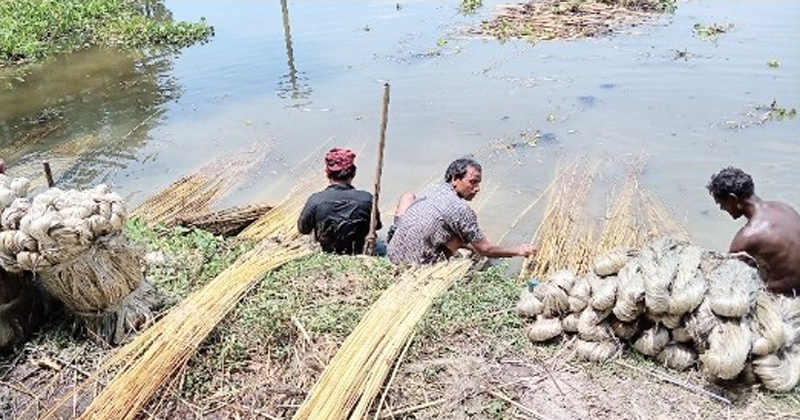
Growing jute in Rajarhat upazila’s seven unions takes more labor and carries more risk than growing rice, corn or other crops — especially when there isn’t enough water to rett the jute after it’s cut. That shortage lowers jute quality and drives up production costs.
Rope, sacks, small bags and other everyday household items were once commonly made from jute across rural areas. But that picture has changed with time. Plastic now dominates in both towns and villages, and jute production keeps declining, even though jute products are environmentally friendly and interest in them keeps falling as harmful plastic use rises.
According to the agriculture office, the upazila’s total cultivable land is 13,653 hectares. Jute was grown on 565 hectares in FY2024-25, 293 hectares in FY2025-26, and just 223 hectares in FY2026-27 — a drop of 342 hectares over three years.
Various studies have found that indiscriminate plastic use doesn’t just harm the environment — it seriously harms the human body. Tests are now detecting microplastics in human blood, which raises the risk of cancer.
Agriculture officer Sathi Begum said: “One of the main reasons farmers are losing interest in jute cultivation year after year is that profits are low relative to production costs, along with the rise of plastic products, which is severely damaging the environment.”
Jute farmer Sri Subhash Chandra Roy said: “There are costs right from the start of jute cultivation — land preparation, seed, fertilizer, weeding and tending. Then there’s more expense for labor to cut the jute, bundle it, transport it and rett it. But if the market price doesn’t meet expectations, the whole calculation falls apart.”
Farmer Nirmalendu Babu said: “Selling jute is a hassle. You can’t sell directly to buyers. Middlemen come to the fields and buy jute cheap, then the price of that same jute keeps rising at each later stage.”
Jute goods seller Sabor Uddin said: “My father used to make rope, cattle halters, sacks and market bags from jute and sell them — I still do the same. But now people buy plastic instead.”
Farmers say growing jute on one bigha costs 10,000-12,000 taka. With the market not matching those costs, their interest is fading somewhat.
Additional Agriculture Officer Hoimonti Rani said: “One of the main reasons for lower jute production this year is frequent rainfall. Because the rain came early, in April, there wasn’t enough water for retting after the jute was cut, which may also be a factor behind the lower output.”