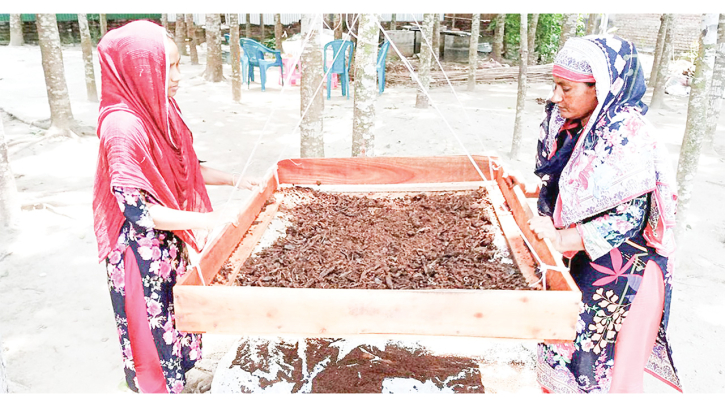
More than a hundred women in Kushtia’s Bittipara village are earning income by producing vermicompost, or earthworm-based fertilizer, in their home yards. Alongside using the fertilizer on vegetables grown on their own land and in their yards, they are also selling the surplus. Started by one woman with training and support from the agriculture department, the initiative has now spread to more than a hundred women in the village.
Bittipara Bazar lies roughly 10 kilometers south of Kushtia district town along the Kushtia-Jhenaidah highway. Bittipara village is about half a kilometer east from there. In the yards of various homes across the village, vermicompost is being produced in rows of cement rings. Made using cow dung, vegetable scraps and banana-tree bark, the women use this fertilizer for their own crops and also sell it.
Housewife Jahanara Khatun was the one who started producing earthworm fertilizer in Bittipara village. In 2021, she set up two cement rings in her yard and began making organic fertilizer using cow dung and earthworms. She also received training and technical support from the Kushtia Sadar upazila agriculture office.
She now has 40 rings in the tin shed behind her house, and another 10 in front. Alongside dung from her own cattle, she collects dung from various houses in the village. She mixes this with vegetable scraps and banana-tree bark to make the fertilizer.
Jahanara Khatun said: “Earthworm fertilizer has changed our lives. Just a few years ago, we had a thatched hut at home. Now I’ve built a brick structure there. I raise cattle and goats. I have a small plot of land. Whatever rice it produces is enough for us. On top of that, I grow vegetables in the yard. I’ve come this far with various kinds of government support. Watching me, many women in the village are now making organic fertilizer too. They’re becoming self-reliant as well.”
Jahanara Khatun said each cement ring costs between 100 and 150 taka. Cow dung, vegetable scraps and banana-tree bark are placed inside, and then earthworms are added. After the ring is covered for 20 to 25 days, the organic fertilizer is ready. During this time, it needs to be sprinkled with water occasionally.
Each ring yields roughly 30 kilograms of fertilizer. Jahanara currently produces about 40 maunds a month. Selling it at 15 taka per kilogram brings in roughly 24,000 taka a month in fertilizer. Of that, two to three maunds are used on their own land. The rest is sold.
Farmers from various areas contact her by mobile phone and come to her house to buy the fertilizer.
Women in Bittipara village aren’t just selling fertilizer — they’re also using their own fertilizer to grow vegetables in their yards and on their farmland.
Rina Parvin and Nilufa Yasmin said: “Vegetables and other crops are grown in Bittipara village. The women are trying to produce safe crops using organic fertilizer. First, the fertilizer is used on their own farmland. Selling the surplus fertilizer brings in some income, which helps with household expenses.”
Monira Khatun said residents of the village are now using less chemical fertilizer than before. Alongside growing chili, eggplant and various vegetables in their yards with organic fertilizer, it is also being used in paddy, corn and cucumber fields.
The women entrepreneurs say the money from selling organic fertilizer covers various family needs, including their children’s education and school uniforms. Because the fertilizer is made using locally available materials, production costs are also relatively low.
Bittipara block sub-assistant agriculture officer Ashraf Siddiqui said: “Men are often away from home. But women stay home and do various kinds of work. That’s why women were chosen for organic fertilizer production. Seeing the financial benefit, women are now becoming interested in producing organic fertilizer themselves. They’re now aware of the benefits of this fertilizer.”
Sadar upazila agriculture officer Rupali Khatun said: “I’m a woman myself. That has made it easier to connect with the women. Almost every week, my team and I try to find out what the women need and help meet those needs. Alongside that, we’re providing training to build their skills. In this village, starting with just one woman, more than a hundred are now producing organic fertilizer. That is a major success for us.”
She added: “The agriculture department is providing incentives and support. Women are being trained in nearly every household to grow vegetables in sacks. Sacks and seeds are also being supplied. Fruit tree saplings are being distributed. We will continue this support so women can use organic fertilizer to produce safe vegetables and earn extra income by selling this fertilizer.”
The initiative started by Jahanara Khatun has now created a path to extra income for more than a hundred women in Bittipara village. Alongside using organic fertilizer for their own crops, they are adding to their household income by selling the surplus. If the agriculture department’s training and support continue, there is scope for this initiative to spread even further.