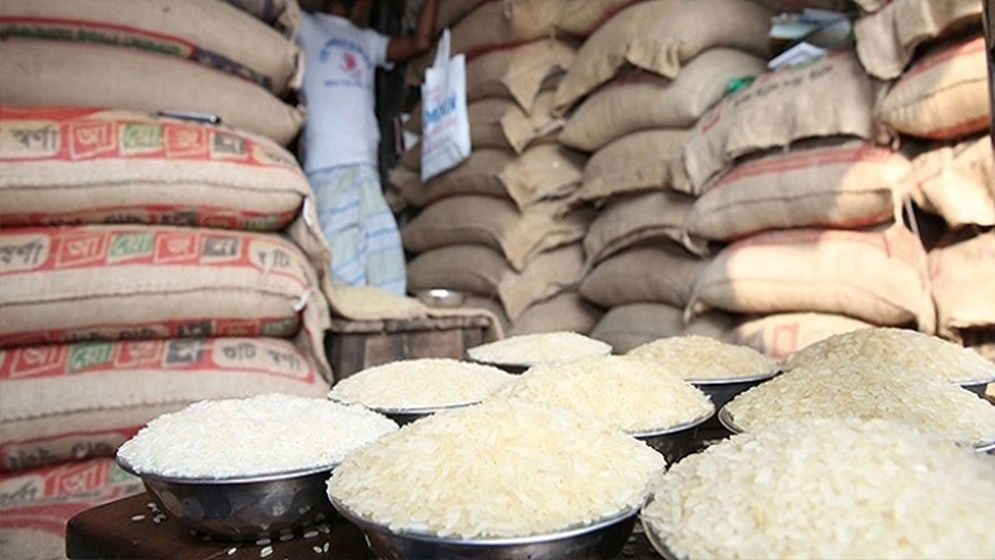
The country has seen a bumper paddy harvest, and government warehouses have built up ample stocks. To keep prices tolerable, the budget waived duties and taxes on rice. Yet the market price of rice is not falling. For years a visible millers’ syndicate has kept the trade in an uneasy grip: despite back-breaking toil, farmers are not getting a fair price for their paddy, while a dishonest ring makes hefty profits selling rice milled from that very paddy. From the mill gate through wholesale to the retail shelf, the price gap on rice is being doubled, forcing people across the country to buy at inflated rates — and none of that money reaches the farmer. Such is the picture that has emerged in a Jugantor investigation.
Market analysts say that, on top of the rice they mill, millers are earning huge sums by selling bran, husk, grit and broken rice — yet this has no effect on the retail price of rice. Farmers lose out in the field and consumers in the market, while the profiteering ring in the middle swells. Complaints abound, but effective action appears to be missing.
According to the latest Food Ministry data (July 5), safe national stocks of paddy, rice and wheat have been built up since the BNP government took office. Government warehouses hold a total of 2,252,815 tonnes of food grain. Of this, total rice stocks — including 4,772 tonnes of floating rice — stand at 1,795,969 tonnes, alongside 331,183 tonnes of paddy and 193,327 tonnes of wheat. Even so, millers control the country’s market.
Abdul Alim, a farmer from the Tarash area of Sirajganj, told Jugantor that cultivating paddy on one bigha of land costs more than 25,000 taka, including sharecropping. The sharecropping charge alone runs to 15,000 taka a year, while pesticides cost 3,000 to 4,000 taka.
Day labourers must be paid 5,000 taka and irrigation costs another 3,000 taka, he said, putting the total cost of cultivating one bigha at 25,000 to 27,000 taka. “But in the current market we are having to sell a maund of paddy for 1,100 taka, a loss of 200 to 300 taka. Millers are creating chaos in the paddy market through a syndicate. We farmers toil and sweat to grow paddy but make no profit, while the millers turn that paddy into rice and reap excessive profits,” he said.
According to the Consumers Association of Bangladesh (CAB), farmers are selling a maund of paddy for 1,000 to 1,100 taka. One maund yields 25 kilograms of rice, putting the value of 50 kilograms of paddy at 2,200 taka. At the mill level, meanwhile, so-called “minicket” rice — sold illegally under that name — goes for 3,300 taka a 50-kilogram sack. That means the millers, after covering incidental costs and profit, sell the 50-kilogram sack for 1,100 taka more. A sack of minicket priced at 3,300 taka at the mill then sells for 3,400 taka wholesale and 4,000 taka retail — so the rice roughly doubles in price on its way from the farmer’s paddy to the buyer.
S M Nazer Hossain, a vice-president of the CAB central committee, told Jugantor that rice changes hands four times — from farmer to mill, wholesale and retail — before reaching the buyer. If rice worth 2,200 taka were sold at a maximum of 3,000 taka once production and transport costs were added, buyers would not suffer, he said. “But rice is being sold at a wide margin right from the mill, and the price climbs further at the wholesale and retail stages, with the burden of that extra cost falling on the consumer. This needs to be monitored,” he said.
He said that although the current fiscal year’s budget cut taxes on 63 essential goods, including rice, no positive effect had been seen in the market. Without effective oversight by market-monitoring agencies, the prices of rice and other essentials cannot be kept tolerable, he added, calling for stern action against dishonest traders.
Inquiries at mills in Naogaon, Dinajpur and other areas found that a 25-kilogram sack of Nazirshail rice, up 200 taka over the month, now sells for 2,000 taka at the mill, 2,100 taka wholesale and 2,300 taka retail. A 50-kilogram sack of BR-28 rice, up 100 taka at the mill, sells for 2,600 taka, rising to 2,700 taka wholesale and 3,200 taka retail.
Siddiqur Rahman, owner of the Allahr Dan Rice Agency in Karwan Bazar, told Jugantor that rice of every kind is dearer at the mill level, with mill owners keeping prices high through a syndicate. Even though they buy paddy cheaply from farmers, the millers make extra profit, and by the time the rice moves from mill to wholesale and retail the price nearly doubles — a cost ordinary people must bear.
He said mill owners had abruptly driven up the price of pulao rice over the past month. A 50-kilogram sack of pulao rice now sells at the mill for 8,300 taka, up from 6,600 taka a month earlier, pushing the retail price to 190 taka a kilogram from 150 taka — a rise of 40 taka a kilogram.
Asked about the situation, a dozen assistant-director-level officials of the monitoring body, the Directorate of National Consumer Rights Protection, told Jugantor that monitoring was continuing to keep rice prices tolerable. “We also run drives in coordination with Food Ministry officials. Coordinated drives will be carried out from the mill through the wholesale and retail levels, and stern action will be taken immediately if irregularities are found,” they said.
বাংলায় মূল প্রতিবেদন পড়ুন · Read the original Bengali report