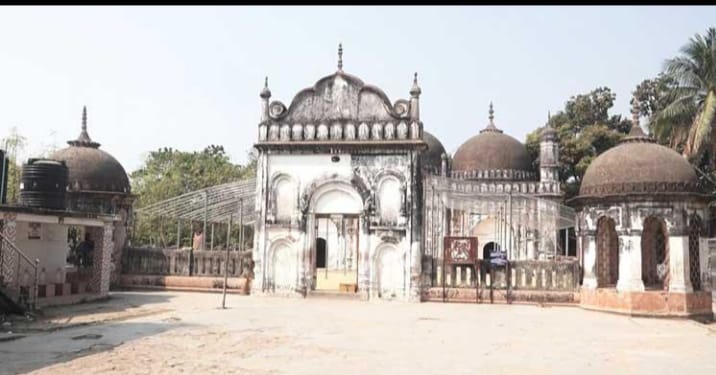
The Shahi Mosque of Kushtia is a traditional and picturesque mosque. Hundreds of visitors arrive every day to see it in Jhaudia, a remote village in the district. Standing tall for a hundred years in the traditional village of Jhaudia, in Jhaudia union of Kushtia Sadar upazila, is the historic Jhaudia Shahi Mosque. A unique example of Mughal architecture, the mosque is not just a place of worship but an important marker of Kushtia’s history, heritage and architectural craft.
The site comes alive with hundreds of visitors and travel enthusiasts. But there are few facilities for visitors here — no proper resting areas, and no lodging or dining options. As a result, despite being a worthy attraction, the site’s reputation is suffering for lack of visitor amenities. The mosque’s long lack of development has also begun to erode its former grandeur. The mosque’s main structure has three domes, with striking minaret-like towers at its four corners. The beauty of ancient architecture is reflected in the design of its walls, arches and domes. Its brick-and-lime-mortar construction and ornate craftsmanship give the mosque a distinct character.
It is known that many saints came to this land to spread Islam, giving up everything they had, their lives and possessions, in the process. They made the mosque the center of religious propagation and all their spiritual work, building mosques, madrasas and khanqahs in various places accordingly.
Jhaudia is a remote village in Jhaudia union under Kushtia’s Islamic University (Ibi) police station area. The traditional Shahi Mosque was established here during the reign of Emperor Shah Jahan. Some 300 years ago, Emperor Shah Jahan bore the cost of building this mosque. Construction was carried out at the time by Shah Sufi Adari Mia Chowdhury. Shah Sufi Adari Mia Chowdhury, a religious preacher who came from the subcontinent, died here at the age of 85. Historical sources say he never married in the course of his religious mission.
After his death, in 1969, a respected figure named Hasan Chowdhury handed the mosque over to the Department of Archaeology under a registered agreement with the government of the time. Under the agreement, the mutawalli, or custodian, of the mosque was to be Hasan Ali Chowdhury or his descendants. His descendants reportedly continue to run the mosque committee today. Even after all this time, its architectural style still draws visitors.
Local worshippers, along with history enthusiasts and visitors from various parts of the country, come to see the Jhaudia Shahi Mosque every day. Its ancient architecture, surroundings and history captivate visitors.
Local residents say the Jhaudia Shahi Mosque is not just an old mosque; it is a symbol of pride and heritage for their area. With proper preservation and expanded tourism facilities, this historic structure could become even better known as one of Kushtia’s major attractions.
Many believe the mosque was built through supernatural means. Because of this, hundreds of people from various parts of the country crowd in to visit the striking mosque. On Fridays in particular, there is no room left to accommodate the crowds. Many bring votive cattle, goats, ducks and chickens with them. Some cottage-industry workers around the mosque have also come to depend on it for their livelihood.
Standing as a silent witness to history, the Jhaudia Shahi Mosque is thus a valuable archaeological heritage site for the people of Kushtia, alongside its religious significance. Preserving its historical importance and architectural beauty for generation after generation is now a demand of the times.