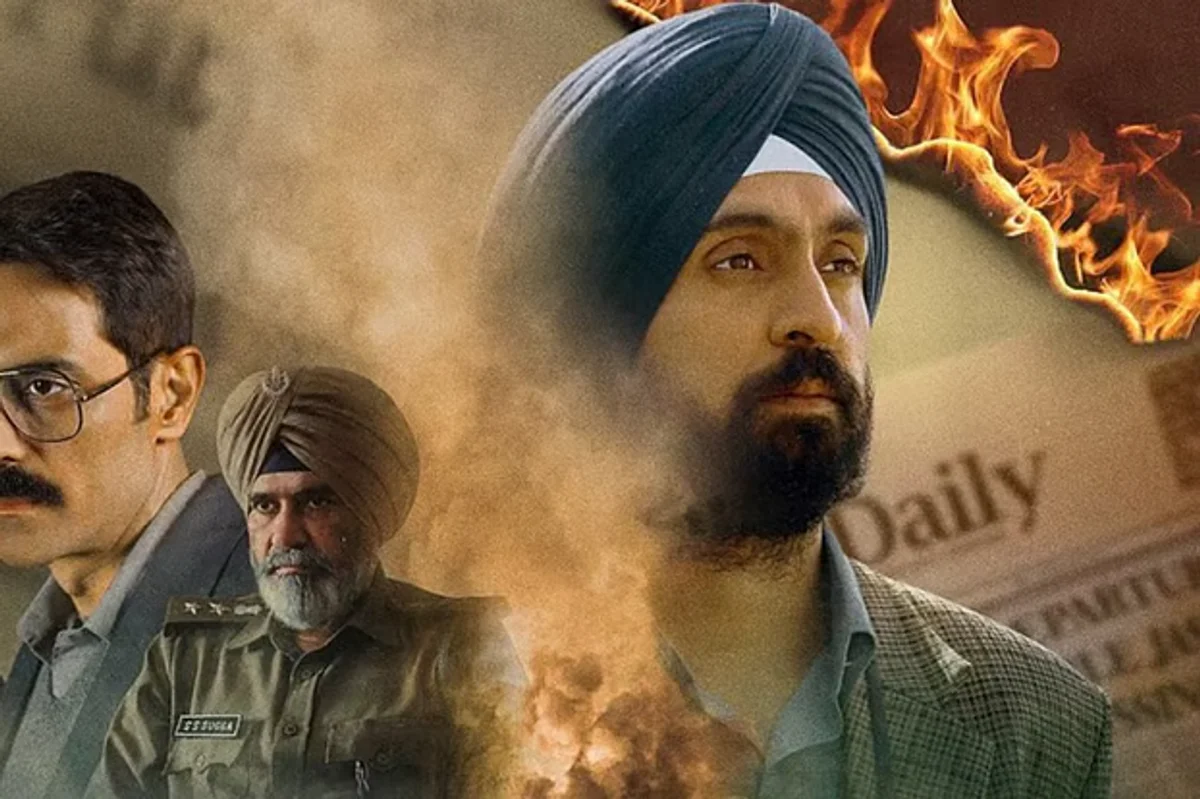
September 6, 1995. The human rights activist Jaswant Singh Khalra was abducted from in front of his own home in Amritsar, Punjab. After that he was never seen again, alive or dead. There were eyewitnesses, and public feeling was growing steadily stronger. Yet almost a year passed with no progress in the case. What had actually happened to Khalra? Had he suddenly vanished from the earth? Or had he, as the police claimed, gone to work as a laborer in Europe or America? Or was he one of the thousands of young men shown as “missing” and made victims of extrajudicial killing — the very people for whose justice Khalra sacrificed his own life?
The film at a glance: “Sutlej.” Genre: drama. Director: Honey Trehan. Cast: Diljit Dosanjh, Suvinder Vicky, Geetika Vidya Ohlyan, Kanwaljit Singh, Jagjeet Sandhu, SM Zaheer. Language: Hindi and Punjabi. Streaming: Zee5. Length: 2 hours 44 minutes.
The uncertainty through which Khalra’s spirit seemed to drift was mirrored in the journey of Honey Trehan’s film. It was first titled “Punjab 95.” In 2023 it was withdrawn from the Toronto International Film Festival. It was then stuck at India’s Central Board of Film Certification (CBFC) for three straight years, because the board ordered about 120 cuts to the film, which was made about human rights violations and the price of civic protest. The casting director Honey Trehan held private screenings during this time, gave interviews and spoke of his long battle with the censor board. Like Sandhya Suri’s “Santosh” — which laid bare the harsh reality of the police-state system in north India — the renamed “Sutlej” also got no chance for a theatrical release in India, and was quietly put out on an OTT platform instead. Perhaps that was not the saddest outcome. Zee5’s “Berlin,” “Kennedy” and “Sutlej” make up an extraordinary trilogy for concerned citizens to watch together. But there was no final reprieve even after release: 48 hours after its July 4 release, the platform was forced to take the film down under government pressure.
So what is in this much-discussed, much-praised and banned film? “Sutlej” is a powerful political film that makes no compromises. It fearlessly brings to the fore the terrible situation that arises when the state and its police force, instead of protecting people’s rights, trample on those very rights. The result is a deeply shaking film. It is not an easy watch, but for all its length “Sutlej” never gives the viewer a chance to look away; it demands the audience’s full attention. Honey Trehan takes us to the Punjab of the 1980s and 1990s, where a bloody chapter of the separatist movement engulfed society. The merciless picture he draws of political repression and the unchecked power of the police remains equally relevant and chilling today.
Although the story revolves around a particular region and a particular time in India, “Sutlej” is in fact a universal document of terror, state repression and the abuse of power that can serve as a warning for any society. It shows what the consequences are when lawlessness serves the interests of those in power. A mandatory declaration at the start of the film states that it is not a documentary but a film based on the events of the life of the human rights activist Jaswant Singh Khalra. Produced by RSVP and Macguffin Pictures, the film was written by Honey Trehan, Niren Bhatt and Utsav Maitra. Its departures from real events are mainly the changing of a few characters’ names: the real-life inspirations behind characters such as DGP IPS Bitta (Kanwaljit Singh), or the chief minister Anant Singh — a week after whose killing in a suicide bombing Jaswant Singh was abducted from in front of his Amritsar home — are easy to guess.
The bank officer Jaswant Singh Khalra (Diljit Dosanjh) first grows suspicious when his close friend and the friend’s mother go missing. When he goes to the police station to lodge a complaint, an officer (Vansh Bhardwaj) preoccupied with his own promotion refuses even to accept it, absorbed in his dream of being promoted to inspector and getting married. Khalra then goes to the morgue, where the doctor on duty (Geeta Agarwal Sharma) gives him information that stuns him. But a bigger shock awaited him at the crematorium, where he finds a register listing hundreds of unidentified bodies. From there the story grows steadily more horrifying. Ignoring threats and warnings, Khalra keeps searching for the truth. His wife Paramjit (Geetika Vidya Ohlyan) knows this path is putting the whole family, including their two school-going children, in danger, yet she stands by her husband. Jaswant’s childhood friend, the constable Satnam Singh (Saurabh Sachdeva), works at the local police station and, at his own risk, keeps passing Jaswant important information gleaned from his work as a driver for senior officers — a courage for which he too pays a price.
“Sutlej” is essentially a story of the conflict between police and militants, but it shows how, in the end, it is the police who turn into the most terrifyingly violent force, breaking the law with complete impunity. It is a warning about the decay of democracy and the horrifying consequences of normalizing the naked abuse of power. After Khalra’s disappearance, the additional director of the Central Bureau of Investigation, Samudra Singh (Arjun Rampal), comes from Delhi to Punjab; the character also serves as the film’s narrator. Meanwhile a lawyer (Varun Badola) files cases in court on behalf of the families of the men and women unlawfully killed. Some parts of the film may feel a little long, but because of the importance of the subject and the sharpness of the storytelling, “Sutlej” holds the viewer from start to finish. It shakes and unsettles at the same time.
The film is also outstanding in its performances. Diljit Dosanjh must be mentioned first: without exaggeration he wonderfully conveys anger, resolve and the sense of unseen danger. He blends himself completely into the character and the time, without foregrounding any star presence. Suvinder Vicky plays SSP Sugga, a corrupt, hateful and cruel police officer who loves to prolong interrogations and inflict mental torture — a character reminiscent of Hans Landa in “Inglourious Basterds.” “Sutlej” shows how the world’s large democratic states humiliate those who expose the truth in the name of national security and try to cover up institutional crime. It is not merely a record of the memory of forgotten people; it is an urgent mirror held up to the modern democratic state machinery, and demands attention not just as cinema but as an important document of its time. Some of the film’s lines stay with you after they are spoken. Khalra says, “We are not anti-police, nor anti-government.” The film ends with another of Khalra’s famous sayings, “I challenge the darkness.” But the simplest line Khalra speaks is the one that stays with you most: “Someone or other has to come forward.”
বাংলায় মূল প্রতিবেদন পড়ুন · Read the original Bengali report