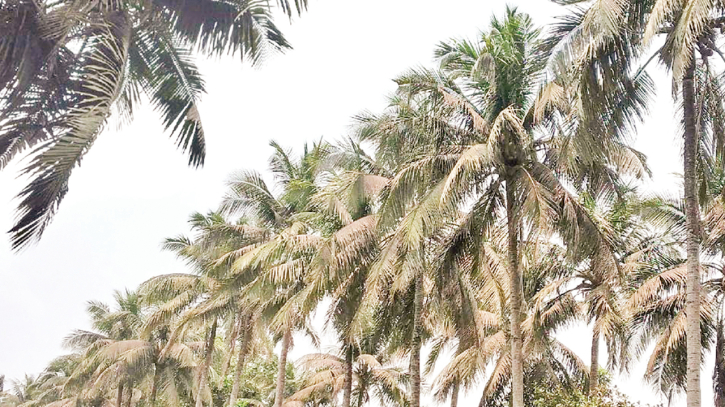
Rows of coconut trees once lined the yards, gardens, roadsides and fish-enclosure embankments of this coastal community. Fakirhat in Bagerhat was once one of the leading coconut-producing areas. But disease, pests, fungus, salinity and cyclone damage are steadily reducing tree yields. At the same time, since most coconuts are sold as green, unripe coconut water, the shortage of mature, ripe coconuts is also growing more severe.
According to the Department of Agricultural Extension, coconut production in Fakirhat stood at 4,600 tons in the 2015-16 fiscal year. It fell to 4,050 tons in 2020-21 and to 4,000 tons in 2024-25 — a decline of roughly 13% over a decade. Local farmers and traders, however, say yields have fallen by 50-60% on many trees over the past two decades.
A recent visit to various parts of Fakirhat found countless coconut trees still standing in home gardens, fish enclosures and along roadsides. But many trees show black spots and a white coating on their leaves, and the number of leaves has also declined. As a result, even though the trees remain, they aren’t yielding as they once did.
Research funded by the Krishi Gobeshona Foundation found widespread infestation of the rugose spiraling whitefly in Bagerhat. A 2021-22 study found that about 97% of the district’s coconut trees were infested by the pest. The insect creates a white coating on leaves, which later helps a black fungal layer form. This disrupts the tree’s photosynthesis and weakens it.
Fakirhat agricultural extension officer Md. Touhidul Hossain said a healthy coconut tree typically has about 36 leaves, but many trees now have only 15-20.
Farmer Jinnat Sheikh said coconut production began declining after Cyclone Sidr in 2007. Subsequent cyclones like Aila, Amphan and Yaas, along with salinity and disease and pest attacks, have made the situation worse since.
Jinnat Sheikh owns roughly 200 coconut trees. He says these trees earned him about 100,000 taka a year seven or eight years ago; that income has now fallen to around 30,000 taka.
The decline in yield has also affected Fakirhat’s traditional coconut market. Local wholesalers say hundreds of thousands of coconuts once changed hands at the market every Sunday and Wednesday. Trading has now shrunk to just two lanes.
Wholesalers Nityananda Das, Ali Sheikh and Sheikh Hafizul Islam said a trader would buy 8,000-10,000 coconuts a day just a few years ago. Now they’re buying only 1,000 to 1,500.
Prices have also risen several times over. A coconut that sold for 25-30 taka five or six years ago now costs 130-160 taka, depending on size.
The decline in coconut production has also affected local industry. Swapan Kumar Bosu, owner of Grand Auto Coconut Oil Mill, said Bagerhat had about 109 coconut oil mills around 2003. More than 100 of them have since shut down amid a raw-material shortage.
He claims about 90% of coconuts produced are now sold as unripe green coconuts. He said demand for green coconut water rose during the COVID-19 pandemic and dengue outbreaks, further increasing the tendency to sell coconuts before they mature.
The coconut shortage isn’t confined to agriculture and the market; it’s also affecting the coastal region’s traditional food culture.
Homemaker Bishakha Das said coconut milk was once used to cook egg korma and fish curries, and grated coconut was used to make shrimp fritters, patuli, naru, puli and steamed pitha. Now, with coconut prices so high, making these dishes has become difficult outside of festivals.
Fakirhat upazila agriculture officer Sheikh Sakhawat Hossain said integrated pest management is needed to control disease and pests on coconut trees, though the agriculture office’s logistical support remains limited. He said 30 tree climbers received training last year, and 800 farmers were given coconut saplings this year.
Bagerhat Department of Agricultural Extension deputy director Md. Motahar Hossain said tree age, inadequate use of balanced fertilizer, climate change and whitefly infestation are among the main reasons for the decline in coconut production.
Dr. Mainul Islam, a senior scientific officer at the Bangladesh Agricultural Research Institute, said insect and fungal diseases are having a serious impact on coconut production in coastal areas, and that addressing the problem requires long-term research.