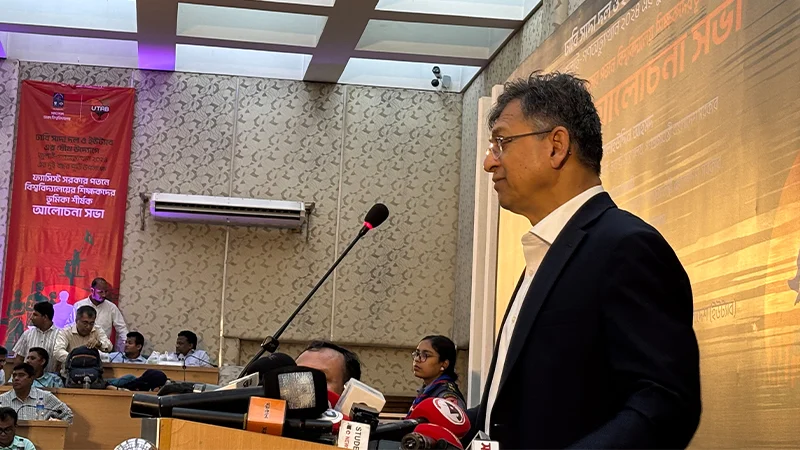
On India recently allowing ousted prime minister Sheikh Hasina to hold a news conference, Home Minister Salahuddin Ahmed has said that playing the “Hasina card” on one hand while wanting friendship with Bangladesh on the other are two contradictory things.
He made the remarks on Saturday at a discussion meeting organised by the Sada Dal and the University Teachers Association of Bangladesh at Dhaka University’s Nabab Nawab Ali Chowdhury Senate Building.
Salahuddin Ahmed said: “I saw in the press that India’s spokesperson says India does not support what Sheikh Hasina has said against Bangladesh’s new government. So does India support letting her hold meetings again and again? Diplomatic relations do not work this way.”
The home minister said: “They are our neighbouring country and we will maintain mutual relations. There is interdependence in this mutual relationship, which we consider a strength. We want to maintain friendly relations with you. But we can never become the Awami League.”
He said: “We will keep relations with you on the basis of mutual respect, dignity and equal sovereignty, upholding Bangladesh’s interests. That does not mean you will play the ‘Hasina card’ and also want friendly relations with Bangladesh. The two are contradictory. I hope the Indian authorities and the Indian government will understand this.”
He said: “It is now being said — if Tareque Rahman can do politics sitting in London and Salahuddin sitting in India, what is Hasina’s fault? Yes, Hasina has a fault. None of us was a fascist. We were forcibly exiled while struggling for democracy. That is the difference between us and Hasina.”
The home minister said: “We have further differences with Hasina. Mr Jaishankar said in India’s parliament that Bangladesh’s former prime minister had taken shelter in India, that she had made contact, that she had fled, and that one of your own cabinet members received her at the airport. These are exceptions in our case. We were bound in sacks, hands, feet and eyes tied, and then dumped there in sacks. These exceptions exist.”
The home minister said Sheikh Hasina committed crimes against humanity in this country. “According to the UN report, more than 1,400 people were killed, of whom women and children were 13-14 percent, and people of this country were killed by firing from helicopters in the sky. Even after this, can we allow her to be used as some leader of democratic culture? I leave this question.”
Salahuddin Ahmed said that after Hitler’s genocide, his party was put on trial. “We have spoken of trying the Awami League as an organisation. That law has been made under Article 47; it is in the ICT Act. Their activities have been banned. But whether it will be banned as a political party, whether it will be suspended for a fixed or a permanent period — these provisions are laid down there. Whether all their property will be confiscated is also stated in that law. The investigation is under way, and we hope it will be completed. As individuals, the trial of Sheikh Hasina and her accomplices is ongoing. Some trials have concluded; many more will proceed through the formal framing of charges.”
He also noted that there is a death sentence in Hasina’s name in the country and further cases are ongoing. “But this fascist has no remorse. She has not expressed regret before the people of Bangladesh. Those who carried out the democratic movement and took part in the uprising, she claims, removed her from power through militant activity. If there were a box office for misinformation and lying, that would be Hasina’s box.”
বাংলায় মূল প্রতিবেদন পড়ুন · Read the original Bengali report