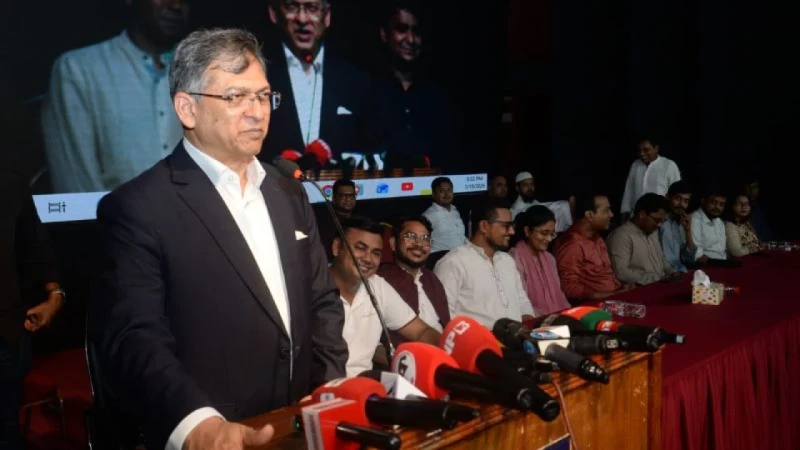
There is no scope for the ousted former prime minister Sheikh Hasina to surrender, Home Minister Salahuddin Ahmed has said. He made the remark as chief guest on Wednesday afternoon at a discussion titled “The Day the Mass Uprising Turned,” organised by the Bangladesh Jatiyatabadi Chhatra Dal at the TSC auditorium of Dhaka University.
Salahuddin said it was the duty of people of all walks of life to protect the freedom and the long-hoped-for democracy won through the student-people mass uprising of July-August 2024. He called for keeping the national unity forged in the anti-autocracy movement firm and unbroken, to resist any return of fascism or conspiracy.
Recalling the early days of the July uprising, he said that on 15 July, when the course of history was being changed at Dhaka University with its now-famous protest slogans, he had been in exile but his full attention and cooperation had been with the movement.
On the country’s current political and constitutional reforms, he said: “Freedom is easy to win but hard to protect. We want to carry out democratic reform of the structures of the state, so that autocratic forces can never again trample this country’s democracy. The election manifesto was built around the 31-point programme we drew up. All the country’s political parties united against fascism to sign a National July Charter, and under it we are committed to carrying out necessary reforms of the constitution and other laws.”
Reaffirming the government’s firm position on trying the former autocratic prime minister, the minister said: “I said clearly in parliament yesterday too — there is no scope for Sheikh Hasina to surrender. A formal letter has been sent by the interim government to bring her back under the extradition treaty. She will be arrested once returned to the country, and the court’s verdict will be carried out.”
He said Interpol arrest warrants had been issued to bring back ministers, MPs and officials of the fascist government who had fled abroad, and that former IGP Benazir Ahmed had been arrested as a result.
On banning or trying the Awami League as a party, the minister said: “We are not in favour of banning any political party by administrative or executive order. We want the political fate of this organisation, a collaborator of fascism, decided through a fully lawful and judicial process.”
He said necessary amendments had been made to the International Crimes Tribunal (ICT) Act and the anti-terrorism law, so that the Awami League could be placed in the dock as an organisation alongside Sheikh Hasina as an individual, and that Article 47 of the constitution clearly allowed organisations to be tried for genocide and crimes against humanity.
Salahuddin said that just as the Nuremberg tribunal had banned Hitler’s Nazi forces and the Gestapo and stripped them of political rights after the Second World War, the Awami League could not escape responsibility for what he called an unprecedented genocide in Bangladesh, in which, he alleged, state forces had been used to shoot children and housewives from the air.
Expressing regret, the minister said that even after such a massacre the Awami League and its leader showed no remorse or plea for forgiveness, and were instead dreaming of returning to politics by branding the heroic fighters of July as “militants.”
In a warning, he said: “The history of the Awami League means the killing of 30,000 freedom fighters by the Rakkhi Bahini, a ‘century’ of rapes, the establishment of one-party BAKSAL rule and the tarnishing of student politics.”
Calling on all not to use or trade on the spirit of the July movement for any single party’s or group’s political ends, the home minister said the credit for the July revolution belonged to no one alone — the ordinary people of the country had fought fascism with their chests bared, and the credit was theirs alone. Ganabhaban was being turned into a “July Memory Museum,” he said, so that future governments could learn what becomes of autocracy.
The minister called on all, including the young generation, to work in unity to build the safe, democratic, autocracy-free and prosperous Bangladesh dreamed of by the martyrs of 1971 and 2024.
The event was presided over by Chhatra Dal central president Rakibul Islam Rakib, with BNP joint secretary general Habib Un Nabi Khan Sohel as special guest. Chhatra Dal Dhaka University unit general secretary Nahiduzzaman Shipon gave the welcome address, and central general secretary Nasir Uddin Nasir conducted the event, which included a special prayer for the departed souls of the martyrs of the July uprising.
বাংলায় মূল প্রতিবেদন পড়ুন · Read the original Bengali report