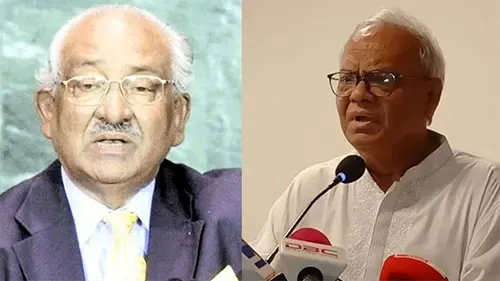
BNP acting secretary general Ruhul Kabir Rizvi has said the mystery surrounding the death of former finance minister M. Saifur Rahman should be investigated.
He made the remarks Monday at a discussion organized by the M. Saifur Rahman Memorial Council at the National Press Club, held to mark the 17th death anniversary of the former finance minister.
Ruhul Kabir Rizvi said, “One thing keeps nagging at me — Saifur Rahman sahib died in an accident. Was it truly just an accident, or was there some national or international conspiracy behind it? We need to find that out today too. Because a man like him, who built the foundation of the economy for a small, poverty-stricken country like ours — who gave it a real foundation — that wasn’t something many countries liked.”
He said many countries, or many forces within, dislike nationalist forces. “Bangladesh building itself up on its own economy, becoming self-sufficient in food based on its own agricultural economy — I don’t think some people liked that. So there is suspicion around the accident that led to his death. We’ve heard ever since that accident happened — was it truly just an accident? We need to find out whether there was any conspiracy behind it.”
Highlighting the career of Saifur Rahman, who served continuously as finance minister under martyred President Ziaur Rahman and former Prime Minister Begum Khaleda Zia, the BNP acting secretary general said the late Saifur Rahman is an asset to this nation and a source of pride for BNP. “Because of his many contributions, he is a national asset. His achievements are so extensive that they are recognized today both at home and abroad. We take pride in the fact that he was a member of the Bangladesh Nationalist Party.”
He said the event’s moderator had recounted a story in which Pakistan’s prime minister pointed Saifur Rahman out to her husband and called him a successful finance minister. “And it wasn’t only Pakistan’s prime minister who said this. India’s Prime Minister Dr. Manmohan Singh, himself an economist, followed Saifur Rahman’s policies — the liberalization of Bangladesh’s economy that he crafted — and introduced it in India. We often forget that Saifur Rahman. We must not forget him; we must remember him.”
Rizvi said, “M. Saifur Rahman was such an economic manager that he stopped the flight of capital abroad. The syndicated looting of banks, the plundering we’ve seen over the past 17 years — when Saifur Rahman was this nation’s finance minister, when he was managing this nation’s economy, we never heard of this kind of looting, this kind of capital flight, banks being emptied out, or the government covering its budget deficit by taking money out of the banks.”
He added, “Because he built the budget out of the country’s own economy, out of its own tax collection. Bank money stayed in the banks. The banking sector was viable in his time. The past 17 years have been an economy of plunder, an economy of hollowing everything out. Looting and capital flight had practically become a culture of our economy.”
Rizvi also detailed the steps M. Saifur Rahman had taken to build the foundation of the national economy.
At the event, Sylhet City Corporation administrator Abdul Kaiyum Chowdhury said M. Saifur Rahman was the architect who built the foundation of Bangladesh’s economy. He said Saifur Rahman had drawn up a grand plan for advancing the country through a free-market economy, and successfully launched various reform initiatives in the economic sector as a result. He said Bangladesh has reached its current position today because of the economic direction Saifur Rahman set.
The meeting, chaired by M. Saifur Rahman’s son, lawmaker M. Nasser Rahman, was attended by parliament’s chief whip G.K. Gauche, Jatiotabadi Samajik Sanskritik Sangstha (JASAS) president Helal Khan, and leaders from Sylhet and Moulvibazar.