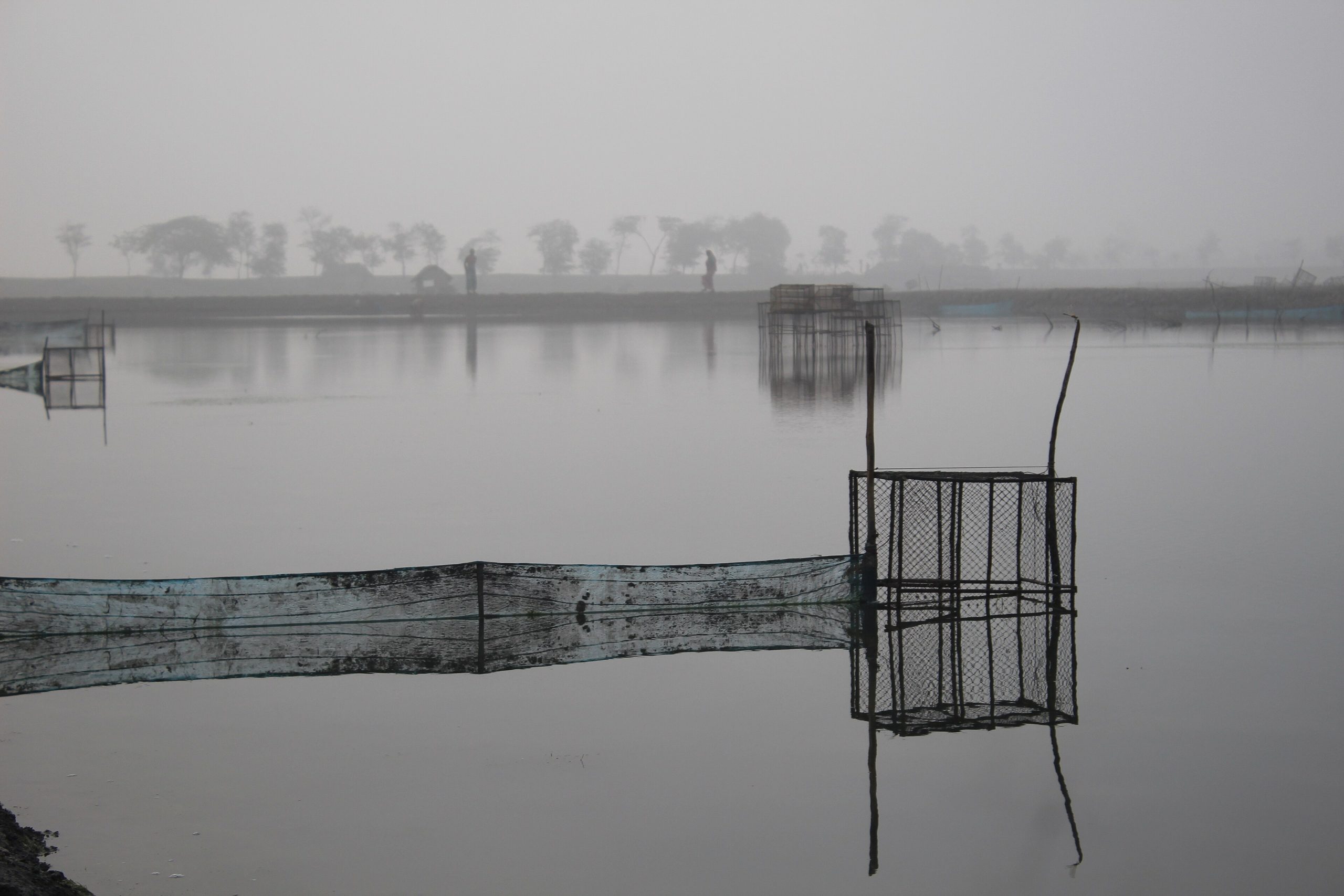
Farmers in Satkhira’s Kaliganj upazila are finding success farming bagda (giant tiger) prawn using an improved traditional method. With no disease in the stock, very fast growth and double the invested money returned in just three months, they are collectively turning to this method. The farming, under a Department of Fisheries project, is encouraging others.
According to the district fisheries office, bagda is farmed by the traditional method in about 55,000 enclosures across 262,000 hectares in the district. Farming prawn this way, Satkhira’s farmers used to suffer losses every year — with bagda wiped out in their enclosures by virus and heatwaves, they were on the verge of ruin. A later semi-intensive method brought little success, so farmers were losing interest day by day. But the fisheries department stepped in to save them. Under a project called “Sustainable Coastal and Marine Fisheries,” farmers were trained to farm bagda using the improved traditional method, whose main features are maintaining the right water depth and biosecurity. All the district’s farmers were advised to adopt it.
Currently, 23 farmers are farming bagda the improved traditional way in 23 enclosures across 13 acres in Shibpur, Kaliganj. Shibpur farmer Moktadir Hossain said: “The 23 of us are farming in this project. Salt water comes into this canal from the Kalindi river. First we fill the enclosure with water. Then, after applying lime and bleaching in stages, we release virus-free fry, and feed them as instructed. We have been hugely successful — I harvested 185 kg of fish from 72 decimals of land, whereas before I could harvest only 60 to 70 kg.”
Farmer Monirul Islam said: “Because fry are released according to the water’s salinity (PPT), there is virtually no disease. Earlier, with no testing of water salinity and virus, the fish would die within 40 days; now they hardly die. Using the prescribed method, we have produced three to four kg of fish per decimal.” Kaliganj senior fisheries officer Nazmul Hasan said: “We started work with 23 farmers in Shibpur under the Sustainable Coastal and Marine Fisheries project, and the success there is huge. Biosecurity and virus-free fry are used in the enclosures. We are very pleased — in just three months, 20 prawns make one kg. Farmers should farm bagda this way.”
বাংলায় মূল প্রতিবেদন পড়ুন · Read the original Bengali report