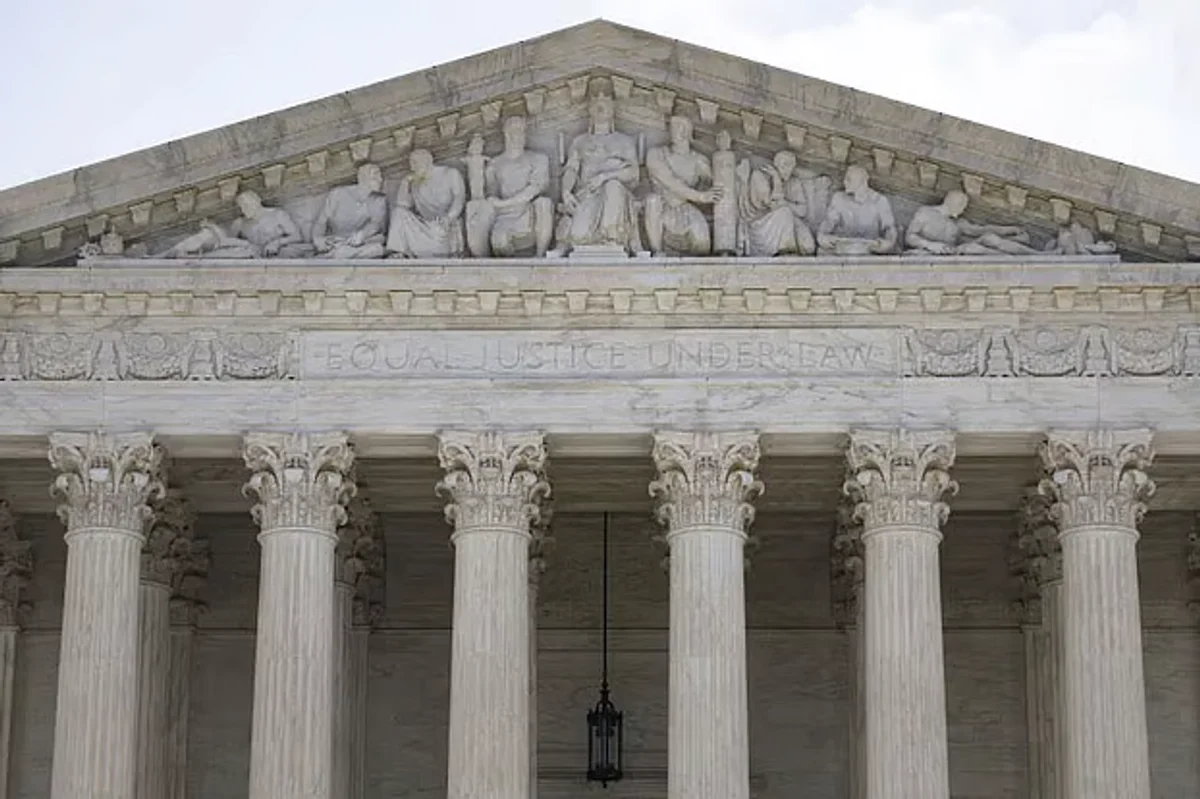
The US Supreme Court issued multiple significant rulings involving President Donald Trump on Monday. Three went against him and only one in his favor. The court delivered another ruling against Trump on Tuesday.
The rulings covered presidential authority over independent regulatory agencies, voting rights, a sexual assault case, and birthright citizenship. Trump gained power only on the question of dismissing independent agency officials.
Expanded power to fire independent agency officials
The Supreme Court expanded Trump’s executive authority by ruling that the president no longer needs to show cause to dismiss members of independent government agencies.
The court ruled that Trump’s dismissal of Federal Trade Commission Democratic member Rebecca Slaughter was lawful, and simultaneously overturned a 1935 precedent that had allowed Congress to protect certain regulatory agency heads from removal at the president’s will.
Trump had fired Slaughter last year without stating a reason, reportedly over policy disagreements. Lower courts had sided with Slaughter, finding that Trump’s action violated congressionally established protections.
On Monday, six of the court’s nine justices ruled that the president no longer needs to show cause to dismiss independent agency officials.
Attorney Bruce Fein told Al Jazeera that the ruling “significantly increased Trump’s control over the executive branch and his power to fire government officials at will.”
Analysts said the decision could have far-reaching implications. Since beginning his second term in January last year, Trump has been seeking to expand presidential executive authority while restructuring the federal bureaucracy and installing political allies in key positions.
Trump welcomed the ruling on social media, saying it came at a time when expanding presidential power was “most needed.”
Liberal Justice Sonia Sotomayor dissented, writing: “Today the majority overturns a 90-year-old tested and effective system to establish an immature theory of executive power that is at once all-consuming and yet dependent on some vague exceptions.”
Democratic Senator Elizabeth Warren also criticized the ruling, saying: “Donald Trump has fired Democratic appointees and seized control of independently run agencies. He wants them to serve him and his wealthy allies instead of the American people.”
Blocked from firing Federal Reserve governor
The Supreme Court on Monday blocked Trump’s attempt to fire Federal Reserve Governor Lisa Cook, thereby upholding the independence of the Federal Reserve System.
The Federal Reserve is a nonpartisan institution that sets monetary policy for the world’s largest economy. Its governors are nominated by the president and confirmed by the Senate.
Trump had cited unsubstantiated mortgage fraud allegations against Cook as grounds for her removal. Cook denied the allegations, maintaining that the real reason was a policy disagreement over Trump’s pressure to lower interest rates.
No US president had ever attempted to remove a Federal Reserve governor since the institution’s founding in 1913.
The majority opinion specifically emphasized the importance of the Federal Reserve’s independence, stating: “Not only independence itself, but the visible appearance of independence is a critical part of the Federal Reserve’s structure.”
Attorney Bruce Fein said the ruling “permanently obstructed Trump’s attempt to seize control of the Federal Reserve Board and influence monetary policy for political advantage.”
Cook welcomed the court’s decision.
Trump immediately objected, writing on social media: “We will take immediate appropriate action to ensure that important decisions regarding the welfare of the United States are not made by anyone engaged in irregularities.” He did not clarify what he meant or what steps the administration might take.
Mail-in ballot counting rules upheld
The Supreme Court upheld a state law that allows mail-in ballots postmarked by election day but received afterward to be counted — another setback for Trump.
The Republican National Committee had challenged a Mississippi law that allows ballots postmarked by election day and received within five business days to be counted. The court rejected the challenge, overturning a lower court ruling that had found the state law incompatible with federal law setting the timing of presidential, Senate, and House elections.
Trump has long criticized mail-in voting, claiming without evidence that the system is susceptible to fraud and blaming it in part for his 2020 loss to Joe Biden.
In March this year, Trump signed an executive order to tighten mail-in voting rules, but a lower court stayed its implementation.
On his social media platform Truth Social, Trump called the ruling a “big loss” for voter rights and called on Congress to pass the “Save America Act.”
Chief Justice John Roberts and conservative Justice Amy Coney Barrett voted to uphold Mississippi’s law, joining the court’s three liberal justices.
Writing for the majority, Barrett said: “Federal law determines when votes must be cast, and state law determines when those ballots must be received.”
Democratic voters generally use mail-in voting more than Republicans. The practice surged during the Covid-19 pandemic. Trump himself has used mail-in voting.
Polls suggest Trump’s Republican Party risks losing its narrow congressional majorities in the November midterm elections, particularly in the House of Representatives. If Democrats win the House, they could block Trump’s policy agenda and potentially initiate impeachment proceedings again. Trump was impeached twice during his first term.
Sexual assault case ruling upheld
In May 2023, a Manhattan federal civil court found that Trump had sexually assaulted columnist E. Jean Carroll in a New York department store in 1996 and ordered him to pay $5 million in damages. Trump had asked the Supreme Court to reconsider the ruling, but the court declined.
Trump reacted angrily, writing on social media: “Surprisingly, the Supreme Court has refused to reconsider a verdict in a fake case brought by a woman I never met. (A photo of her standing next to me with her husband at some event decades ago does not prove we knew each other.)”
He added: “I will continue to fight against this case in which the law has been weaponized against me for political purposes, including the laughable defamation claims.”
Carroll wrote in her 2019 book that Trump had sexually assaulted her in the changing room of a New York department store 23 years earlier. Trump called Carroll a “crazy woman,” which she said damaged her reputation and constituted defamation.
Carroll’s attorney Roberta Kaplan said in a statement: “Today’s Supreme Court decision conclusively confirms that, as the jury unanimously found, President Donald Trump sexually assaulted Carroll and made defamatory statements against her.”
Carroll added: “Trump’s multiple attempts to appeal this ruling have failed. Today’s decision brings an end to his efforts to evade accountability for his actions.”
Birthright citizenship affirmed
On Tuesday, the Supreme Court upheld the right to birthright citizenship in the United States, ruling that virtually everyone born on US soil is entitled to citizenship. The decision dealt a significant blow to one of Trump’s primary anti-immigration agenda items.
On the first day of his second term, Trump had signed an executive order aimed at stripping automatic citizenship from children born in the United States to undocumented immigrants and foreign nationals residing temporarily in the country.
Writing for the majority, Chief Justice John Roberts said the executive order was inconsistent with the 14th Amendment to the US Constitution.
Roberts wrote: “Then and now, citizenship is the right to have rights — the means of free participation in our political community. The framers of the Fourteenth Amendment made that promise to every person born in this territory. Today we uphold that promise.”
The Guardian reported that the justices drew on historical examples to explain what citizenship means, tracing the concept from early English law through the abolition of slavery and attempts to strip citizenship from Chinese-Americans.
Roberts described the 1857 Dred Scott decision as “deeply odious” because it stripped citizenship from Black Americans and declared that citizenship should be determined by bloodline rather than place of birth. The 14th Amendment was enacted to reverse that ruling, ensure the rights of Black Americans, and guarantee citizenship for “all persons born in the territory of the United States.”
The majority opinion stated explicitly: “If a parent is in the United States unlawfully or temporarily — such as on a tourist or student visa — and their child is born in this country, that child is a full citizen of the United States by birth.”
বাংলায় মূল প্রতিবেদন পড়ুন · Read the original Bengali report