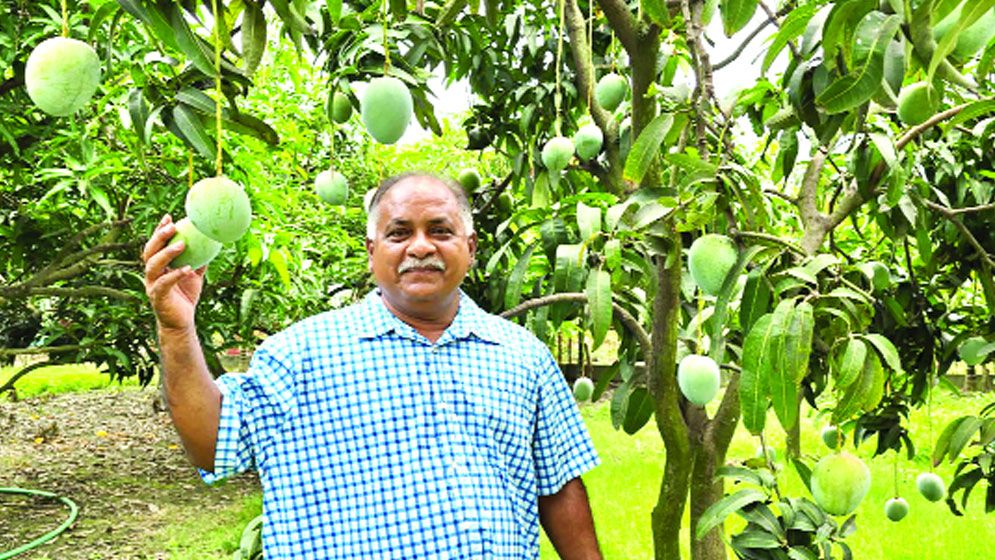
In the Dharmatala area of Bypass Road in Arabpur union of Jashore Sadar stands a single-storey house called Bagh-e-Adam. A railway line runs directly behind it. On a little more than two acres wedged between the highway and the railway sits the “orchard house.”
Step through the main gate and the first thing to catch the eye is a small tree heavy with mangoes. Plump and large, the variety is called Chiang Mai; when this foreign variety ripens, each fruit weighs about a kilogram.
Chiang Mai is only the beginning. Adams Agro Farm grows 75 mango varieties in all, local and foreign — against just 53 at the Jashore Horticulture Centre. The orchard alone has about 850 mango trees, said the farm’s founder, Abdullah Md. Hossain Masud. Orchards line both sides of the farm, with two ponds in between. The plot to the right of the entrance was where the first mango saplings went in, said Masud, 64, who completed his honours and master’s in botany at the University of Dhaka in 1988.
From 2013 to 2018 he worked at the LG Butterfly Group, he said. During that time he saw various fruit saplings at a BRAC nursery beside his workplace and resolved to build a farm on his family land to fulfil his father’s dream; his elder brother, a horticulturist, encouraged him. He bought 25 to 30 saplings from that nursery — Indian Totapuri, Tosha, American Kent, Australian R2E2, Sim One, Mexican Palmer, hybrid Gopalbhog, Alphonso, banana mango and an unknown Malaysian variety he later named “Adam Sundari” himself — and had them sent over before planting them at home. Many trees have since been propagated from those mother trees, all grafted by Masud.
Masud’s father was Abul Hossain and his mother Begum Jahan Ara. His father was the Jashore district fisheries officer. On 3 April 1971 he left the family in their village and returned to the city, where he was shot and disappeared by the Pakistani army; his body was never found. The couple had six sons, of whom Masud is the youngest.
The ancestral land at Bagh-e-Adam was about 25 katha; the brothers later bought more, and the farm now covers a little more than two acres. Its mango varieties include Amrapali, Langra, BARI-4, BARI-11, Khirsa, Ranipachhand, Gourmati, Indian Totapuri, Chosha, Arunima, Alphonso, Surya, Jardalu, Kesar, CITU, Doshori, Pakistani Chosha, Namphoklai, Yellow, Green, Doc Mai, Thai White, Chili Mango, Haribhanga, American Kent, Thai Katimon, Chiang Mai, Red Ivory, Nilambari, Simon, Mallika, Miyazaki, Sweet Tart, Venus Glen, Nag Fazli and Red Chiang Mai. Among local fruits there are also jambul, jackfruit, lychee, lemon, sapodilla, jujube, wood apple, elephant apple, olive, date, palm, guava, karamcha, falsa and gab — even apple trees. Various fish are farmed in the ponds, and the farm keeps 100 ducks, 19 geese and more than 300 local chickens.
“I built this agro farm to keep my parents’ memory intact,” Masud said. Its aims, he said, are to collect and conserve local and foreign fruit varieties, to run educational exhibitions and training, to develop nurseries of selected varieties and market saplings, to sell produce at home and export it abroad, and above all to preserve his parents’ property, realise their dream and uphold their ideals. Dipankar Das, deputy director of the Jashore Horticulture Centre, said no other orchard in Jashore holds such a diverse collection of mango varieties.
বাংলায় মূল প্রতিবেদন পড়ুন · Read the original Bengali report