The proposed budget for the coming fiscal year offers no specific guidance on how revenue will be raised, and its target of Tk 6 lakh crore in collections is not realistic, speakers said. Meeting that target could push authorities into aggressive tax and duty collection, they said.
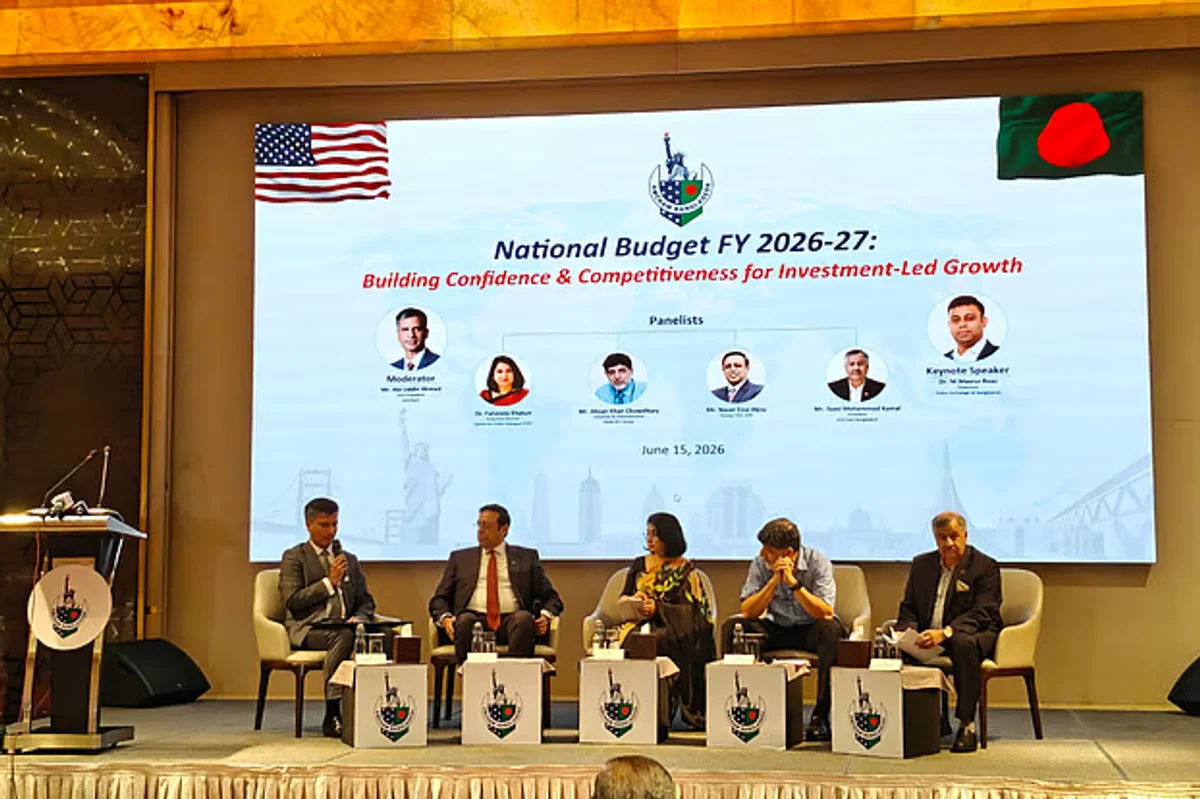
The speakers made the remarks Monday at a budget discussion hosted by the American Chamber of Commerce in Bangladesh (AmCham).
The meeting, held at Hotel Sheraton in Banani, was chaired by the chamber’s new president, Syed Mohammad Kamal. Economists attended alongside AmCham members.
The keynote paper was presented by M Masrur Reaz, chairman of Policy Exchange Bangladesh. He said an unrealistic revenue target had been set, and that efforts to meet it could lead to aggressive measures.
On spending, Masrur Reaz said 41 percent of the budget would go to salaries and allowances, pensions, subsidies and interest payments. A large share of the development allocation had also been kept as block allocation, he said, adding that block allocations often lack transparency in how they are spent.
In the panel discussion, Fahmida Khatun, executive director of the private research institute Centre for Policy Dialogue (CPD), said the size of the budget was under discussion. The new government had made many commitments to the public, making this an expansionary budget, she said, but financing it was a major challenge.
Another panelist, Ahsan Khan Chowdhury, chairman of the PRAN-RFL Group, said, “The budget was meant to make doing business easier, but that was not fully achieved. More attention is needed on building skilled human resources. Allocation for agriculture has not risen the way it should have. Still, the current government has listened to us more than any previous government.”
Naser Ezaz Bijoy, former chief executive officer of Standard Chartered Bangladesh (SCB), told the panel that the budget framework did not spell out how revenue would be collected. A large part of the banking sector was in a weak state and facing a liquidity crisis, he said, so greater reliance on bank borrowing could create a credit crunch for the private sector.
The panel was moderated by Ala Uddin Ahmad, chief executive officer of MetLife Bangladesh and a vice president of the chamber.
Closing remarks were delivered by Reza Ur Rahman Mahmood, managing director of Philip Morris International Bangladesh and AmCham treasurer. He said 8 of AmCham’s 18 proposals had been accepted in this year’s budget.
বাংলায় মূল প্রতিবেদন পড়ুন · Read the original Bengali report