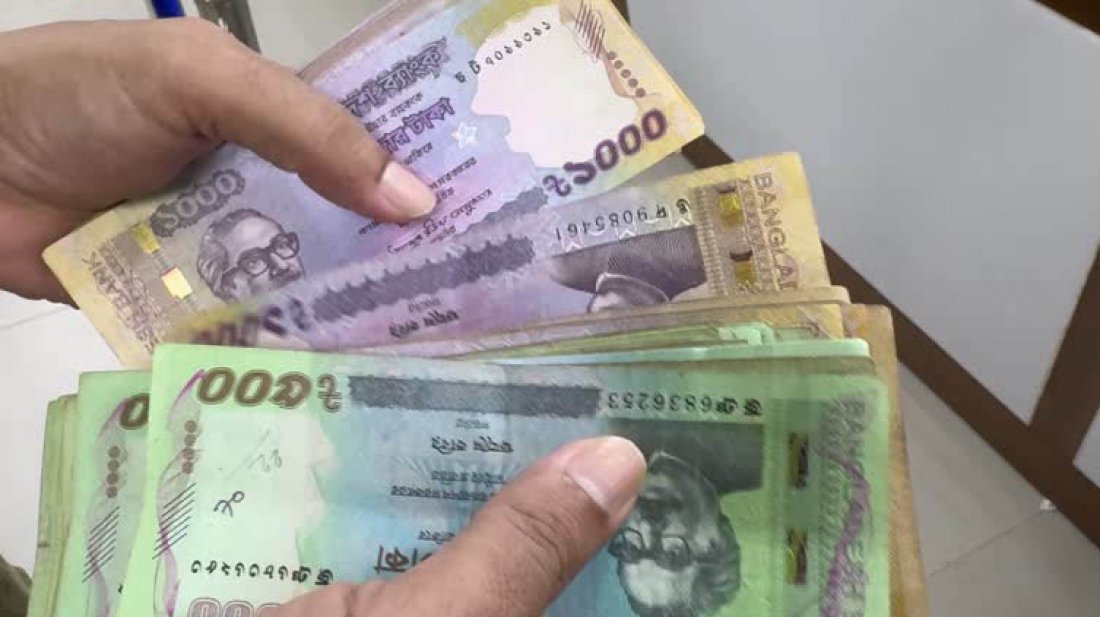
There was a time when many families could run a whole month’s household on a month’s salary. That reality is changing fast. For many, bank accounts are almost empty within days of being paid, and countless families depend on loans, credit cards or help from relatives to get through the last week of the month. The question is why, on the same salary, the money runs out at the start of the month.
Economists say the main reason is not inflation alone, but the combined effect of years of high inflation, weak market management, inefficiency in the supply system, the dominance of middlemen, high interest rates, stagnant investment and falling real incomes.
The government has not been able to bring inflation down to a comfortable level in four consecutive fiscal years. Official statistics show the inflation rate has fallen somewhat in recent months, but ordinary people do not feel that relief when they go to market.
Rice, pulses, oil, fish, meat, eggs, milk and vegetables — the prices of almost all essentials remain far above ordinary people’s purchasing power.
According to economists, falling inflation does not mean prices have fallen; it means the pace of price increases has slowed somewhat. So the prices people actually pay have brought no real relief.
A 100-taka basket now costs more than 140
Inflation’s biggest impact has been on the family’s monthly budget. Analysis shows that a basket of goods that could be bought for 100 taka four fiscal years ago now costs more than 140 taka.
Wages and salaries have not risen at the same rate over the same period, so people’s real incomes have fallen. Salaries may have risen on paper, but that money no longer buys what it once did. In economists’ terms, purchasing power has fallen significantly.
One major cause of the abnormal price increases is weakness in the supply system. Vegetables bought cheaply from Mahasthangarh in Bogura and other farming areas change hands several times before reaching the capital. At each stage, commission, transport costs, warehouse charges, profit and sometimes informal extortion are added. So a product a farmer sells at 20 taka sells for 50 to 60 taka in Dhaka. It is not only vegetables: for rice, eggs, fish, chicken, milk and many other goods the gap between producer and retail prices is two to three times. Economists call this a major failure of market management.
Why prices are not falling
The government has cut duties on several essentials, given import facilities and increased market monitoring. So why are prices not falling?
Analysts point to several reasons: a long supply chain, too many middlemen, weak market monitoring, limited competition, rising transport costs, higher business costs from high interest rates, and stocks of goods imported earlier at higher prices. As a result, many of the benefits the government provides do not ultimately reach the consumer.
The pressure of high interest
Bangladesh Bank has raised the policy rate to control inflation, increasing the cost of bank loans. Businesses say higher loan interest has raised production costs, so even where there is scope to reduce prices they cannot. Falling new investment is also slowing job creation.
Salary gone, credit cards the fallback
The latest Bangladesh Bank figures show credit-card use rising fast within the country. Credit-card transactions in May 2026 totalled 4,287 crore taka, up more than 33 percent in a year. The highest spending was at department stores — clear evidence that people are now using credit cards not just for luxury purchases but for everyday shopping.
Bankers say that as the gap between monthly income and expenditure widens, many families are being forced towards debt-dependent living.
Dr. Mustafa K Mujeri, former chief economist of Bangladesh Bank, said that while credit cards give temporary relief, they can become a major financial risk in future if repayment is not possible on the borrower’s income.
Still high inflation in South Asia
In June, Bangladesh had the second-highest inflation among South Asian countries after Pakistan. Low- and middle-income families are hurt most, particularly those on fixed incomes whose expenses rise daily.
Monetary policy alone is not the answer
Economists say inflation cannot be controlled by raising interest rates alone. Effective solutions require modernising the supply system from farmer to consumer, reducing unnecessary middlemen, effective monitoring of wholesale and retail markets, expanding digital agricultural marketing, developing cold-chain infrastructure, increasing market competition, firmly suppressing extortion and artificial shortages, and ensuring an environment friendly to production and investment.
Experts say relief will not return to ordinary lives without structural reform of the market system alongside inflation control. A transparent, competitive market must be built in which farmers get fair prices, consumers can buy at reasonable prices and the abnormal profits of middlemen are reduced.
Because even if inflation falls on paper, when people still have to buy rice, eggs, fish or vegetables at the same prices, no economic statistic feels like good news. The reality is that for many families the biggest question is no longer how much the salary is, but how many days of the month it can run a household.
বাংলায় মূল প্রতিবেদন পড়ুন · Read the original Bengali report