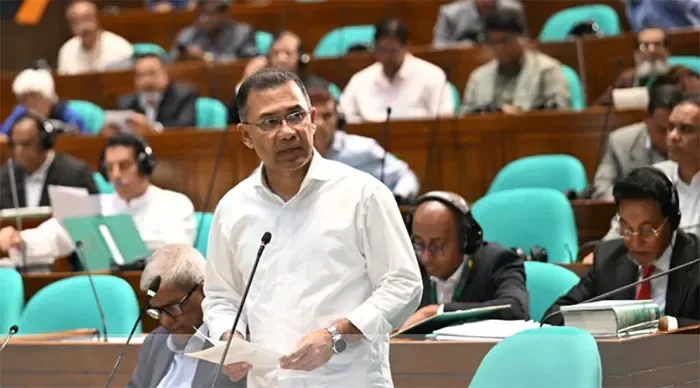
Prime Minister Tarique Rahman has proposed several people-friendly amendments to the proposed budget, including easing the tax burden on ordinary people, withdrawing the controversial provision allowing black money to be whitened, and expanding domestic industry and private higher education. He also expressed a firm commitment to ending the fascist system of governance, restoring discipline to the economy and swiftly bringing back money laundered abroad.
The prime minister made the appeal on Monday while taking part in the budget-session discussion in the National Parliament. Describing the present government’s budget as a budget for rebuilding the nation, he called on both the government and opposition to remain united in reviving the economy and establishing good governance.
The prime minister recalled the devastated economic condition inherited from the former autocratic government. Deep anxiety had been created among the public, particularly in the stock market and banking sector, because of past misrule, he said. During the autocratic period, helpless people had taken their own lives in the stock market, unable to bear the suffering — something that had not happened anywhere else in the world. The present government planned to develop the stock market into an effective platform for long-term investment, and under a capable finance minister positive results would soon be seen, he said, adding that the government was taking every step to restore discipline to the banking sector at any cost.
Assuring parliament about bringing back the laundered money of the country’s people, the prime minister said 23 mutual legal assistance requests had already been sent to 13 countries. In addition, more than 15 affected banks had signed over 60 non-disclosure agreements with international asset-recovery firms. The laundered assets would be brought back as quickly as possible through international and domestic law, he said.
On revenue collection, the prime minister spoke of adopting a policy of restoring public trust in governance by not increasing the tax burden, reducing harassment and broadening the tax base. He expressed a resolve to build a revenue ecosystem in which taxpayers would take pride in paying tax as partners in development. As part of making the tax system transparent and modern, he proposed further raising the tax-free income threshold for individual taxpayers. While the proposed budget set the threshold at Tk 3,75,000 for the 2026-27 and 2027-28 tax years, the prime minister requested it be raised to Tk 4,00,000. He similarly proposed Tk 4,50,000 for the 2028-29 and 2029-30 tax years and Tk 5,00,000 for the 2030-31 tax year. He also drew the finance minister’s attention to fully withdrawing a special provision introduced in the budget to resolve complications between the actual value and mouza value in land registration, after it created public confusion about an opportunity to whiten black money.
The prime minister also made several important proposals on developing education and employment. He proposed cutting the 10 percent tax currently applicable to private universities to 5 percent, while at the same time calling on these universities to strengthen research and development, set up language labs to make students proficient in multiple languages, and offer free tuition to poor and meritorious students.
Citing public confusion, he requested the withdrawal of the proposed requirement to submit a Taxpayer Identification Number (TIN) for opening bank accounts, registering deeds of distribution and mutating property. To promote the economic development of small ethnic communities, the prime minister proposed making tax-free not only the income from economic activities run by them in the three hill districts but also the salaried income of members of small ethnic communities in both hill and plains areas.
বাংলায় মূল প্রতিবেদন পড়ুন · Read the original Bengali report