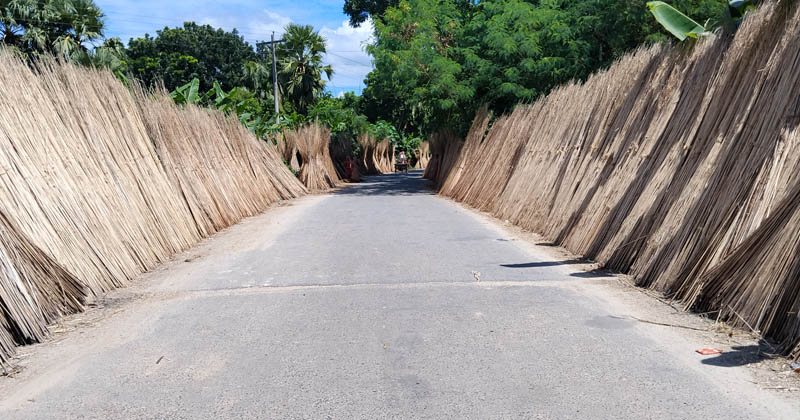
Under the slogan “full of golden fibre, we love Faridpur”, Faridpur’s farmers are keeping up the jute tradition. Jute of excellent quality is grown every year in the district’s various upazilas. Alongside jute fibre, farmers are now earning extra income by selling jute sticks as well.
Once neglected and used mainly as fuel, jute sticks have now become commercially important. Jute is grown extensively in various upazilas of Faridpur including Boalmari, Alfadanga, Madhukhali, Saltha and Nagarkanda. After cutting the jute, farmers are preserving the sticks alongside collecting the fibre. Local traders are buying the sticks directly from farmers’ homes and fields. Those concerned said jute sticks currently sell at 400 to 500 taka a maund depending on quality and dryness.
Farmers said jute sticks used to be given little importance. They were left beside fields, by ponds or in the yard of the house. Many used them as cooking fuel. Jute sticks were also used for house platforms, vegetable trellises, fencing and various other purposes. With demand rising, farmers are now able to earn additional income by selling jute sticks alongside jute.
Jute sticks going to neighbouring districts
The jute sticks collected from various parts of Faridpur are not confined to the local market. Traders are taking them to neighbouring districts including Magura, Rajbari, Jhenaidah and Gopalganj. After collection, the sticks are dried and processed for various uses.
Local traders say demand for jute sticks has risen compared with before. They buy directly from farmers and supply various areas. Because dry, good-quality jute sticks are in greater demand, farmers are becoming keener to preserve them.
One jute stick trader said: “Jute sticks used to be rather neglected. Demand has risen now. We buy jute sticks from farmers at 400 to 500 taka a maund and supply them to various districts. With the demand there, farmers are getting a good price for selling them too.”
Farmers on the extra income
Talking to jute growers established that because there is income from jute sticks after the fibre is sold, part of the production cost is recovered. Their interest in growing jute is increasing as a result.
Halim, a farmer of Felan Nagar village in Boalmari upazila, said: “After selling the fibre from the jute, we used not to get much of a price for the sticks. Now traders come to the house and buy them. Getting 400 to 500 taka a maund means extra income from the sticks too.”
Habib Molla, a farmer in Alfadanga upazila, said: “We used to use jute sticks as cooking fuel, for house platforms or for fencing. Now you can get money by selling them too. So after cutting the jute I dry the sticks carefully and store them.”
Kalipada Chakrabarti, a retired head teacher of Moyna Government Primary School in Boalmari upazila, said jute sticks are no longer confined to fuel or household use. Ash produced by burning jute sticks and other materials are being used in various industries. Carbon-based materials made from jute sticks are used in making various products, and in some cases in making ink and other industrial goods. Jute sticks are also used in betel-leaf plantations, vegetable trellises, house fencing and various agricultural work.
He said: “As a result, jute sticks have become a valuable by-product for the farmer alongside jute fibre.”
Boalmari upazila agriculture officer Alvir Rahman said the increased use of jute sticks and the creation of a market for them is positive for farmers. Farmers are able to earn additional income by selling jute sticks alongside jute. Farmers need to become more aware about preserving and marketing the sticks, however.
He added: “Jute is an important cash crop of our country. Economic value has now been created for jute sticks alongside jute fibre. Farmers are able to earn extra income by selling jute sticks. If the multiple uses of jute sticks and their market can be expanded, jute growers’ income could increase further.”
Faridpur’s traditional jute cultivation will become still more profitable as a result, he believes.