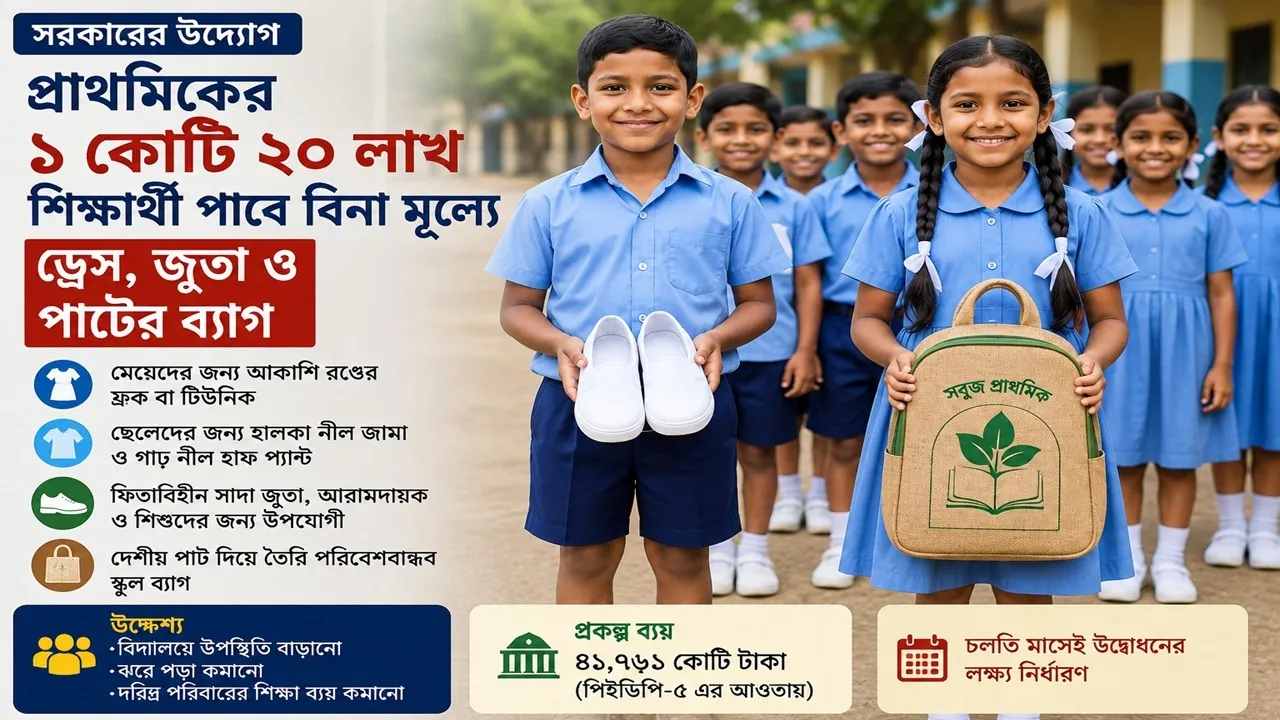
The government has taken an initiative to give free school uniforms, shoes and eco-friendly jute bags each year to about 12 million students at government primary schools, on top of the free textbooks they already receive. Among the program’s goals are increasing school attendance, reducing dropout rates and easing the education costs of poor families.
Under the government’s plan, Prime Minister Tareque Rahman may launch the school-uniform distribution program this month. In its initial phase, one government primary school in every upazila nationwide will be brought under a pilot project to distribute uniforms and bags to students. The plan is to expand the benefit in phases to all government primary schools afterward. More than 600,000 school uniforms have already been made, with production nearly complete.
The uniform design was determined with students’ comfort and practicality in mind.
The plan calls for sky-blue frocks or tunics for girls and light-blue shirts with dark-blue half-pants for boys. Laceless white shoes are being arranged for the children’s convenience, alongside an initiative to provide eco-friendly school bags made from domestic jute.
Various ready-made garment and textile mills in the country are also cooperating in producing the school uniforms under the government initiative. As part of its corporate social responsibility, the Bangladesh Textile Mills Association (BTMA) handed over school uniforms for 100,000 students to the education and primary and mass education minister on August 11. Dr. A N M Ehsanul Haque Milon, minister for education and primary and mass education, said the government plans to give students free uniforms, bags and shoes, and that the program will be formally launched soon, in keeping with the prime minister’s commitment.
State Minister for Primary and Mass Education Bobby Hajjaj also described the initiative as a special priority of the prime minister. According to the ministry’s plan, the program was originally meant to launch in July, but that was later pushed back to August 16. The launch target has since shifted again, to sometime within the current month.
Many view the initiative to give primary students free uniforms, shoes and bags positively. Those involved believe it could particularly ease the financial burden on poor families and help reduce the tendency of students to drop out of school. With students wearing similar clothing, differences in family financial circumstances would also become somewhat less visible. However, some educators believe that, alongside uniforms and bags, greater priority should be given to improving education quality, classroom environments, teacher training and accountability at educational institutions. There are also concerns about cloth quality, correct sizing, timely delivery and irregularities in large-scale government garment distribution.
The proposed Fifth Primary Education Development Program (PEDP-5) under the Directorate of Primary and Mass Education includes a program to supply school uniforms, bags, shoes and socks. The project’s total estimated cost is 417.61 billion taka, of which 338.74 billion taka would come from government financing and 78.87 billion taka is planned to come from development partners.
However, the project proposal does not specify how much will be spent separately on uniforms, bags, shoes and socks. Monowara Israt, additional secretary (administration) at the Ministry of Primary and Mass Education, who is overseeing the project, told journalists: “We haven’t fixed a price yet. Once the project begins, we’ll be able to determine the cost per uniform.”
Alongside the primary level, there are also plans to give free uniforms, shoes and bags to students at the secondary level. The Directorate of Secondary and Higher Education (DSHE) has proposed a project called the “Combined Students Facilities Program in Secondary Education.”
Under the proposed program, disadvantaged students at 1,000 educational institutions in hilly and remote areas would receive uniforms, shoes, socks and bags each year, along with meal arrangements. The plan also includes allocations for common rooms, health supplies, and participation in sports and cultural activities for students at these institutions.
Separately, the Directorate of Primary Education (DPE) has requested a list of selected schools and student numbers for the free distribution of school bags to primary students. The request was made in an urgent office order sent to divisional deputy directors on Wednesday.
বাংলায় মূল প্রতিবেদন পড়ুন · Read the original Bengali report