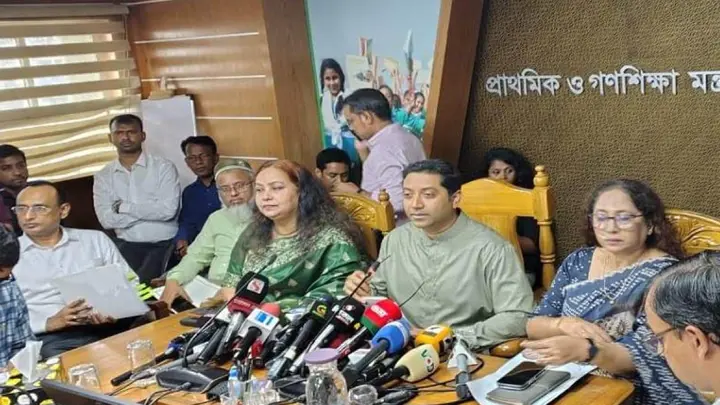
Transfers of teachers at the country’s government primary schools have been suspended indefinitely until the placement of 14,500 newly recruited teachers is completed. State Minister for Primary and Mass Education Bobby Hajjaj announced the decision Monday at a press conference at the Secretariat. He said the decision takes effect immediately.
The state minister also said a mid-day meal program will be launched at all government primary schools across the country next year.
He said, “Transfers will resume once the new teachers have been appointed. Whether it will follow the current policy under which transfers have been running, or a different one, can only be said at that time. Since it may change, there’s no need to discuss it further right now.”
The state minister added, “We are keeping an eye on all matters, including stipends, and will work accordingly. But based on feedback from officials, a needs-based approach — particularly a financial-needs basis — would work best. Going forward, our effort will be to base this on financial need and expand the number of recipients.”
Bobby Hajjaj said informal education programs are being strengthened to make primary education more effective, inclusive and of higher quality, while also bringing out-of-school children and adolescents into the education system. He said the government’s development philosophy places special emphasis on combining education with skills training, using technology, and including marginalized communities.
The state minister said Article 17 of Bangladesh’s constitution commits the state to a fundamental responsibility of establishing a universal, free and compulsory education system and eliminating illiteracy. Upholding that constitutional commitment, he said, the government has been working to bring people excluded from educational opportunity into the mainstream of development through primary education alongside informal education, adult education, life-skills and vocational training.
He said Bangladesh has made significant progress in literacy over the past few decades. According to the 2024 Labour Force Survey, the literacy rate among the population aged 7 and above stands at 78.98%. He called this progress encouraging, but said it remains true that a significant portion of the population still lacks access to the education and skills they need — including out-of-school and dropout children and adolescents, marginalized communities, and adults deprived of education. Reaching them with educational opportunity, he said, is a state responsibility and a key condition for the country’s development.
The minister said the core of the government’s education philosophy is building human capability and developing human resources. He said truly advancing a country requires more than infrastructure development alone — it requires citizens equipped with knowledge, skills, creativity, ethics and competence.