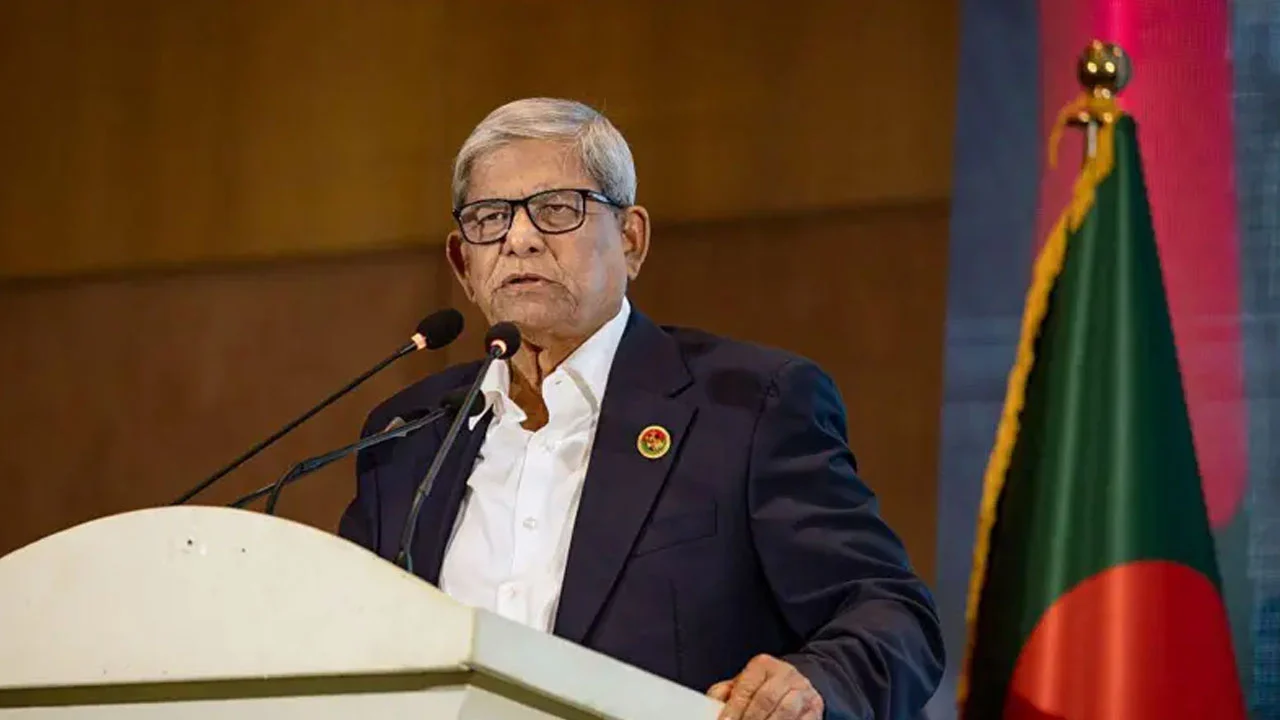
Mirza Fakhrul Islam Alamgir has been sworn in as Bangladesh’s 23rd president. He took the oath at Bangabhaban on Friday evening. Acting Speaker Barrister Kaiser Kamal administered the oath. He was elected president by a vote of national parliament members the previous day, Thursday.
President Md Sahabuddin, the 22nd president, elected on the nomination of the now-ousted Awami League while it was in power, resigned on July 24 with roughly a year and a half left in his term.
When the schedule for the presidential election was announced earlier this month, BNP nominated its secretary general, Mirza Fakhrul Islam Alamgir, for the presidency.
Following his formal swearing-in, Mirza Fakhrul Islam Alamgir becomes Bangabhaban’s resident for the next five years.
Rising from the grassroots to the country’s highest office, Mirza Fakhrul Islam Alamgir — known for leading BNP through the party’s most difficult period and for his reputation as a politician with a “clean image” — has traveled a long road to get here.
Student politics in his youth, then teaching, then leaving that profession to return to the political arena. As soon as he entered politics, he was elected chairman of Thakurgaon municipality. When BNP was in considerable turmoil amid the imprisonment of Khaleda Zia and the exile of Tareque Rahman, along with a wave of cases and repression, Secretary General Mirza Fakhrul led the party from the front inside the country.
Political analysts say his responsible role in party politics and his particular standing as a clean politician have made him fit for the presidency.
Writer and researcher Mohiuddin Ahmad said: “We saw Mirza Fakhrul’s firm stance at a time when Khaleda Zia was in prison and BNP was in considerable turmoil politically. He was arrested repeatedly, humiliated repeatedly, but he still held his ground.”
From teaching to the political field
While studying at Dhaka University in the 1960s, Mirza Fakhrul Islam Alamgir joined the East Pakistan Students’ Union. He was elected general secretary of the Dhaka University S M Hall unit. During the mass uprising against Ayub Khan in 1969, he became president of the Students’ Union’s Dhaka University unit. He had to go to prison during that period as well.
After finishing his education, he passed the BCS education cadre exam in 1972 and joined Dhaka College’s economics department as a lecturer. He went on to teach at various colleges. In 1979, he joined the administration of then-President Ziaur Rahman as personal secretary to the then-deputy prime minister, S A Bari. A few years later, in 1986, Mirza Fakhrul entered national politics by joining Maulana Abdul Hamid Khan Bhashani’s National Awami Party, or NAP.
Two years later, in 1988, he was elected chairman of Thakurgaon municipality.
He joined BNP in 1990 during the movement against the Ershad government. In 1992, he became president of Thakurgaon district BNP, and later a member of the party’s executive committee.
Professor Shamsul Alam, a teacher in Jahangirnagar University’s government and politics department and the university’s pro-vice-chancellor, said: “Mirza Fakhrul Islam Alamgir was known nationally and internationally as affable, humble and hard-working. As a selfless politician, he is respected by everyone.”
In 1991, he contested the Thakurgaon-1 seat on a BNP nomination but did not win a parliamentary seat in that first attempt. The following year, in 1992, he was elected president of Thakurgaon district BNP.
He was elected to parliament in the 2001 eighth national election on the nomination of the BNP-led four-party alliance. That same year, he was first given charge as junior minister for agriculture in the four-party alliance government’s cabinet.
Following a later cabinet reshuffle, he was given charge as junior minister for civil aviation and tourism, a post he held until October 2006.
Before rising to BNP’s leadership, Mirza Fakhrul served for a long time as first vice-president, and later president, of the Jatiyatabadi Krishak Dal, the party’s farmers’ wing.
Political analyst Mohiuddin Ahmad said: “Mayor, junior minister, minister — he has held all of these. Politicians in our country often develop various negative images while in office, but Mirza Fakhrul has stayed free of such allegations.”
Leading through difficult political times
From 2006 to 2024, BNP went through a difficult period in politics. Under the army-backed caretaker government, the party’s top leadership was detained and imprisoned, and the party at times faced the threat of a split. For nearly the entire period of Awami League rule, BNP remained largely sidelined in politics.
Mirza Fakhrul played an important role in the party during that challenging time.
BNP suffered a rout in the ninth national election in 2008, held under the army-backed caretaker government. He received the party’s nomination for a parliamentary seat in that election but could not win. He then became BNP’s senior joint secretary general at the party’s 2009 national council.
Just two years later, in 2011, BNP’s then-secretary general, Khandaker Delwar Hossain, died. After his death, Khaleda Zia gave Mirza Fakhrul charge as acting secretary general. That same year, the caretaker government system was abolished by a court ruling.
Protesting elections held under a partisan government, BNP boycotted the January 5, 2014 election and launched a movement.
BNP’s senior leadership faced arrests, cases and a crackdown. Nearly two years later, on March 30, 2016, Mirza Fakhrul became BNP’s full secretary general.
In February 2018, party chief Khaleda Zia was convicted and imprisoned. Ahead of the national election held later that year, BNP was caught up in political and legal complications.
With Khaleda Zia in prison on one side, and the party’s then-senior vice-chairman, Tareque Rahman, exiled in London on the other, Mirza Fakhrul led the party from inside the country during that difficult period.
Researcher Mohiuddin Ahmad said: “Despite all that turmoil, BNP could not be broken, because it had a secretary general like Mirza Fakhrul Islam Alamgir, who led the party from within the country.”
Leading the party from inside the country, he had to go to prison on several occasions over various cases. He also faced attacks and mistreatment at different times.
A politician with a clean image
There has always been a war of words in Bangladeshi politics. Using aggressive language against one another while speaking at rallies and gatherings is commonplace. But in this respect, Mirza Fakhrul has been something of an exception.
Professor Shamsul Alam said: “The characteristic of his politics that we noticed was that he was extremely mild-mannered, humble and affable. He never made derogatory remarks about leaders and activists of other parties. He spoke to everyone with respect and treated them with respect.”
For this reason, Mirza Fakhrul has built a reputation as a decent, different kind of figure not just within BNP but among other political parties and the general public as well.
Researcher Ahmad said: “The presidency is a position of honor. This post was rightfully his. We would want him to rise above partisan perspective and become a guardian of the state.”
Birth, upbringing and family
Mirza Fakhrul Islam Alamgir was born on January 26, 1948, in the Kalibari area of Thakurgaon town.
His father, Mirza Ruhul Amin, was a lawyer by profession. His mother, Mirza Fatema Amin, was a homemaker. Mirza Fakhrul’s father, Amin, was twice a member of the Pakistan provincial legislature and later a member of the Bangladesh national parliament. He also served as a member of the Ershad government’s cabinet. After completing his primary and secondary education in Thakurgaon, Mirza Fakhrul passed his higher secondary examination from Dhaka College. He then enrolled in Dhaka University’s economics department, where he earned his bachelor’s and master’s degrees.
Mirza Fakhrul’s wife is Rahat Ara Begum. She studied at the University of Calcutta and works at a private financial institution. The couple has two daughters, Mirza Shamarukh and Mirza Safarukh. The elder daughter, Mirza Shamarukh, completed her studies at Dhaka University and joined the university as a teacher there. She is currently working as a postdoctoral fellow in Australia.
The younger daughter, Mirza Safarukh, also completed her studies at Dhaka University and now teaches at a school. Mirza Fakhrul’s younger brother, Mirza Faisal Amin, is also involved in BNP politics. He currently serves as president of Thakurgaon district BNP. Like his elder brother, he too previously served as mayor of Thakurgaon municipality. In his student days, Mirza Fakhrul Islam Alamgir was involved in theater, acting on stage, and took part in various other cultural activities including recitation.
বাংলায় মূল প্রতিবেদন পড়ুন · Read the original Bengali report